
Szklarska Poręba: Waterfall, Museums and Hotels
Accommodation in Szklarska Poręba
When planning your accommodation in Szklarska Poręba, it is worth first looking at what the town has to offer: the Kamieńczyk Waterfall is a striking natural landmark, while the museums explore local history, art, geology and nature.
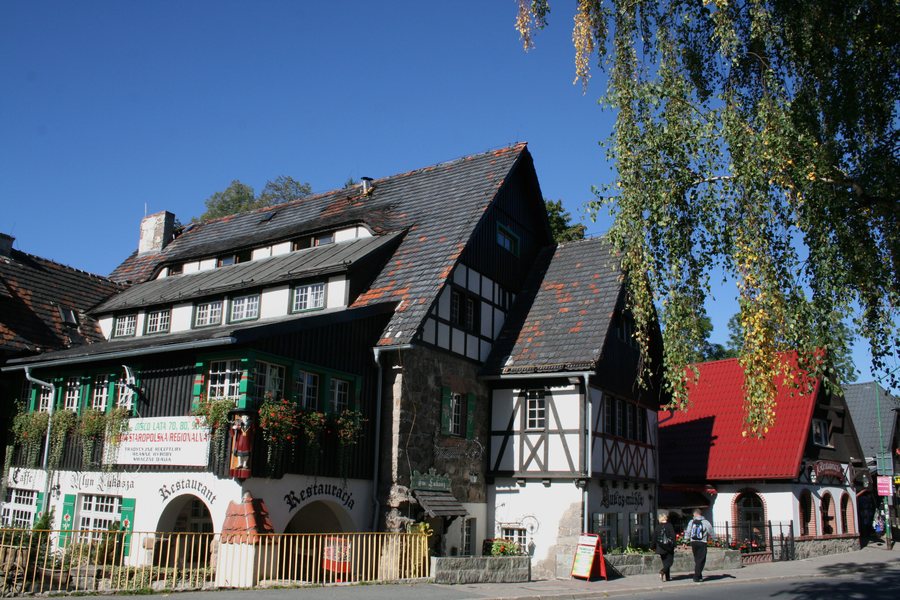 File:Szklarska Poręba, Most Św. Łukasza.JPG
Photo: Stokrotka 11 via Wikimedia Commons, CC BY-SA 3.0 pl
Quick facts about Szklarska Poręba
- The Kamieńczyk Waterfall is the highest waterfall in the Polish Giant Mountains. Its brink is at 843 m above sea level; the three-tier cascade is 27 m high.
- The Kamieńczyk Gorge is about 100 m long. Its vertical rock walls are over 25 m high; in some places, the gorge is no more than 4 m wide.
- The museums and centers explore local history, the artists’ colony, geology, the nature of Karkonosze National Park and the Jizera Mountains, as well as art.
- There is a shop at Leśna Huta selling glassware made on site; the selection may change.
What makes the Kamieńczyk Waterfall special?
The waterfall stands out for its clear distinction and striking dimensions: it is the highest waterfall in the Polish Giant Mountains. Its brink is at 843 m above sea level, while the water plunges into the Kamieńczyk Gorge in a three-tier cascade that is 27 m high. The two height figures refer to different things: the elevation of the brink and the height of the cascade.
The gorge can also be described in terms of several measurements. It is about 100 m long; its vertical rock walls rise over 25 m, and in some places it is no more than 4 m wide. The length, wall height and width in some places describe different dimensions of the Kamieńczyk Gorge. Thus, alongside the waterfall’s drop, the shape of the gorge is a distinct landscape feature.
Behind the middle cascade lies the “Złota Jama” cave. It was partly excavated by the Walloons and contains pegmatite and amethyst deposits. This adds a specific geological feature to the waterfall and gorge landscape.
What cultural and natural-history topics can you explore?
The Karkonosze Museum – Carl and Gerhart Hauptmann House presents local history and Szklarska Poręba’s artists’ colony. This focus brings together local history and an artistic perspective. The Mineralogical Museum and the JUNA Earth Museum both focus on geology, including minerals and fossils from around the world.
The KPN Educational Center and the Sudeten Center for Culture and Art offer further topics. The educational center presents the nature of Karkonosze National Park and the Jizera Mountains; the Sudeten Center for Culture and Art presents art. This gives you a choice between local history and the artists’ colony, geology, nature, and art.
Where can you find locally made glassware?
There is a shop at Leśna Huta that sells glassware made on site. This is a distinct, specific point of interest alongside the museums and waterfall: you can include it in your travel plans if you are interested in glassware. The shop’s selection may change.
Discover more destinations: Mysłakowice, Jelenia Góra, Bukowiec, Łomnica, Janowice Wielkie, Trzcińsko, Komarno, Borowice.
FAQ
How high is the Kamieńczyk Waterfall?
Its brink is at 843 m above sea level. The water falls into the Kamieńczyk Gorge in a three-tier cascade that is 27 m high.
Which museums in Szklarska Poręba present geology?
The Mineralogical Museum and the JUNA Earth Museum present geology, including minerals and fossils from around the world.
Where can you find locally made glassware?
There is a shop at Leśna Huta that sells glassware made on site. The selection may change.
To the main travel overview: Jeleniogórski.

