
Discover Konradów: Village History and Mountain Setting
Accommodation in Konradów
Konradów lies in the mountains and combines a layered village history with cultural landmarks, animal attractions and a cycling route. You can tailor your stay to different interests, from Baroque architecture and traditional rural buildings to a clearly described cycling route.
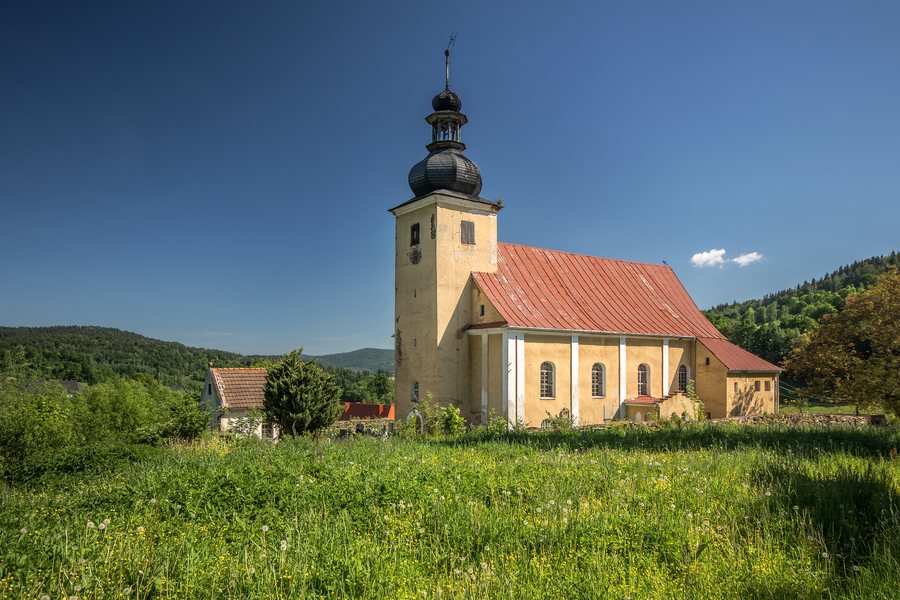 File:SM Konradów Kościół Podwyższenia Krzyża 2017 (3) ID 592794.jpg
Photo: Sławomir Milejski via Wikimedia Commons, CC BY 3.0
File:SM Konradów Kościół Podwyższenia Krzyża 2017 (3) ID 592794.jpg
Photo: Sławomir Milejski via Wikimedia Commons, CC BY 3.0
Konradów at a glance
- The Church of the Exaltation of the Holy Cross was built in phases between 1786 and 1806 and has a Baroque high altar dating from 1751.
- The Dwór sędziowski stands in the village centre; its present structure was built in the first quarter of the 18th century.
- A 30.3 km cycling route numbered 5716 passes through Konradów.
- In the second half of the 19th century, Konradów was a summer resort and lay on tourist routes.
What building history shaped the church?
The Church of the Exaltation of the Holy Cross tells a story of several construction phases. Its tower was added in 1786. The main structure was then demolished, and a new one was built between 1804 and 1806. The church is considered representative of the late Baroque period in the Kłodzko Land and its traditionalist tendency.
Its furnishings also reflect different periods: the church has a Baroque high altar dating from 1751. The architectural and decorative polychrome interior was completed in the late 19th or early 20th century. For travellers interested in culture, this offers a glimpse of the combination of Baroque furnishings and later interior design.
What historic traces can you find in the village?
The Dwór sędziowski stands in the centre of Konradów. It was created in the first quarter of the 18th century by converting an older residential and farm building. This structure is also representative of the local Baroque architecture of the Kłodzko Land and its strongly traditionalist tendency.
Other religious and architectural landmarks contribute to the historic character of the village. The old churchyard has an oval layout and is enclosed by a stone wall. A cemetery chapel dating from the second quarter of the 19th century combines a simple, practical local building style with Neoclassical forms. Crucifixes and crosses, including pieces from 1829, stand along the cemetery wall. Numerous wayside shrines, religious statues and roadside crosses have also been preserved in Konradów and its immediate surroundings.
Traditional rural buildings also shape the local architectural heritage. These include houses with cross-passage rooms, houses with wooden upper storeys that were later bricked in, and buildings with verandas. Those interested in architecture can consider these homes and everyday buildings alongside the more imposing historic structures.
What experiences suit your stay?
Alpaka Konradów’s mini zoo combines walks with alpacas and encounters with a variety of animals, including mountain goats, donkeys, peacocks, rabbits and lemurs. Another attraction, “Spacery z Alpakami i Mini Zoo” at Konradów 12, has two ponies and four dwarf goats. The range of animal species and the option of an alpaca walk can help you decide what to choose.
Another way to include the surrounding area in your travel plans is cycling route 5716. It is 30.3 km long and runs from Lądek via Radochów, Trzebieszowice, Biała Lądecka and Konradów to Kąty Bystrzyckie, then back to Lądek. Its length and route provide concrete details for planning, without suggesting a specific journey time.
What role did Konradów play as a travel destination?
In the second half of the 19th century, Konradów had the character of a summer resort. At the same time, it lay on tourist routes from Lądek to Przełęcz Puchaczówka and Śnieżnik. This historical context adds to the village’s present-day range of attractions, but should be distinguished from the cycling route 5716 described above: the tourist routes belong to the history of the 19th century, while the cycling route is defined by its own course and length.
More village pages: Potoczek, Sokolec, Polanica-Zdrój, Poręba, Międzylesie, Stojków, Radków and Raszków.
FAQ
How long is cycling route 5716?
Cycling route 5716 is 30.3 km long and runs via Radochów, Trzebieszowice, Biała Lądecka and Konradów to Kąty Bystrzyckie, then back to Lądek.
When was the Church of the Exaltation of the Holy Cross built?
The tower was added in 1786. After the main structure was demolished, a new one was built between 1804 and 1806.
Which animals are mentioned at Alpaka Konradów’s mini zoo?
The attraction includes walks with alpacas and encounters with mountain goats, donkeys, peacocks, rabbits and lemurs.
To the main travel overview: Kłodzki.

_ID_592794.jpg)