
Lauban: Via Regia, Basalt and Architecture
Accommodation in Lauban
Lauban offers several concrete starting points for planning your trip: the historic Via Regia, striking basalt formations in Na Kamiennej Górze Park, nature trails and a Neo-Gothic parish church. This can help you decide whether you are particularly interested in history, nature or architecture.
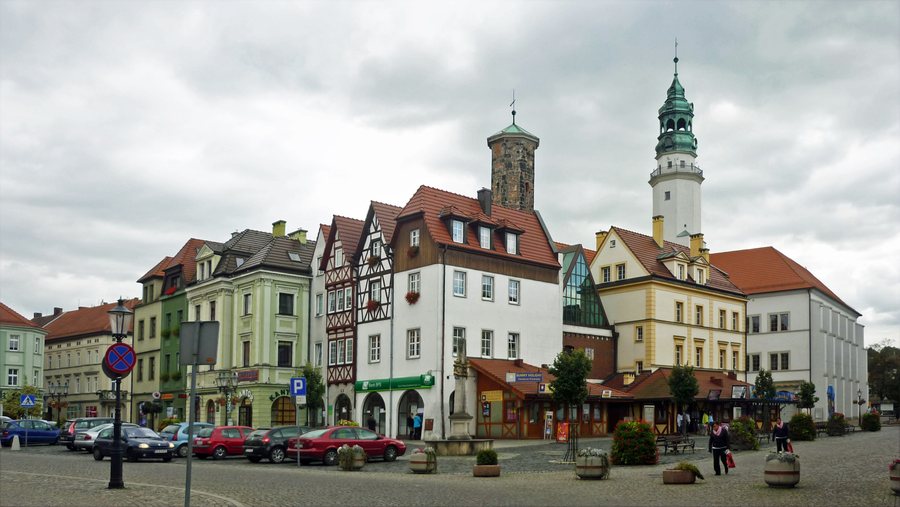
Lauban at a glance
- Lauban lies on the Via Regia, an old east–west trade route also known as the Royal Road.
- Na Kamiennej Górze Park contains two exposed walls of a basalt quarry.
- The park has two nature trails for pedestrians and cyclists.
- The Parish Church of the Holy Trinity was built in the Neo-Gothic style between 1857 and 1861.
What does the Via Regia tell us about Lauban?
The Via Regia is an old and important trade route that crosses Europe from east to west. Lauban lies on this route, which is also known as the Royal Road. If you are interested in historic transport routes, this connection offers a distinct starting point for getting to know Lauban.
The name Via Regia and the term Royal Road refer to the same route. To get your bearings, it helps to distinguish this historical connection from specific places in the city: the route describes Lauban’s relationship to a transregional road, while the park and the church are individual city attractions.
What basalt formations can you find in Na Kamiennej Górze Park?
Two walls have been exposed in the park’s basalt quarry. One is in the southeast and the other in the southwest; each is about 100 metres long. Structures formed by columnar thermal jointing are clearly visible in them. These structures reach a height of 10 to 15 metres.
The measurements of length and height describe different aspects of the quarry: around 100 metres refers to each of the two walls, while the range of 10 to 15 metres refers to the visible jointing structures. If you would like to include nature and geology in your trip planning, these exposed formations offer a specific point of interest in the park.
What nature trails and natural features can you find there?
Na Kamiennej Górze Park has two nature trails for pedestrians and cyclists: “Szlakiem Wygasłych Wulkanów” and “Szlakiem Pomników Przyrody Ożywionej.” Their names give you an initial idea of the trails’ themes. Both are intended for people who want to explore the park on foot or by bicycle.
The “Szlak przyrody ożywionej” nature trail passes 30 trees that are between 130 and 250 years old. The age range makes the trail’s theme especially tangible: rather than simply describing a general natural setting, the route identifies specific trees and their ages.
What defines the Parish Church of the Holy Trinity?
The Parish Church of the Holy Trinity was built between 1857 and 1861 at the initiative of the Convent of St Mary Magdalene. The Neo-Gothic design was created by Alexis Langer, a Silesian architect. The construction dates, style and designer give you three specific points of reference if you are interested in Lauban’s architectural history.
The church can therefore be considered a cultural highlight in its own right, alongside the historic trade route and the park’s nature themes.
Which themes suit your interests?
To begin, you can weigh the different themes against one another: the Via Regia offers a historical connection, the quarry features the geological formations described here, the nature trails focus on nature, and the parish church adds an architectural note. Consider which of these perspectives interests you most during your stay as you compare Lauban as a travel destination and look for suitable hotels.
Discover more destinations: Wolimierz, Księginice, Niemstów, Marklissa, Bad Flinsberg, Złoty Potok, Pobiedna, Jałowiec.
FAQ
What is the name of the historic route near Lauban?
Lauban lies on the Via Regia, which is also known as the Royal Road.
How long are the exposed quarry walls?
Both walls in Na Kamiennej Górze Park are about 100 metres long each. The visible structures formed by columnar thermal jointing are 10 to 15 metres high.
Who designed the Parish Church of the Holy Trinity?
Silesian architect Alexis Langer created the Neo-Gothic design. The church was built between 1857 and 1861.
To the main travel overview: Lubański.

.jpg)