
Samotwór: Palace History and Landscape
Accommodation in Samotwór
Samotwór brings together the history of a Silesian residence, a landscape park, the Bystrzyca River and visible traces of a late medieval manor. The historic sites and two marked trails give you different ways to tailor your stay to your cultural or landscape interests.
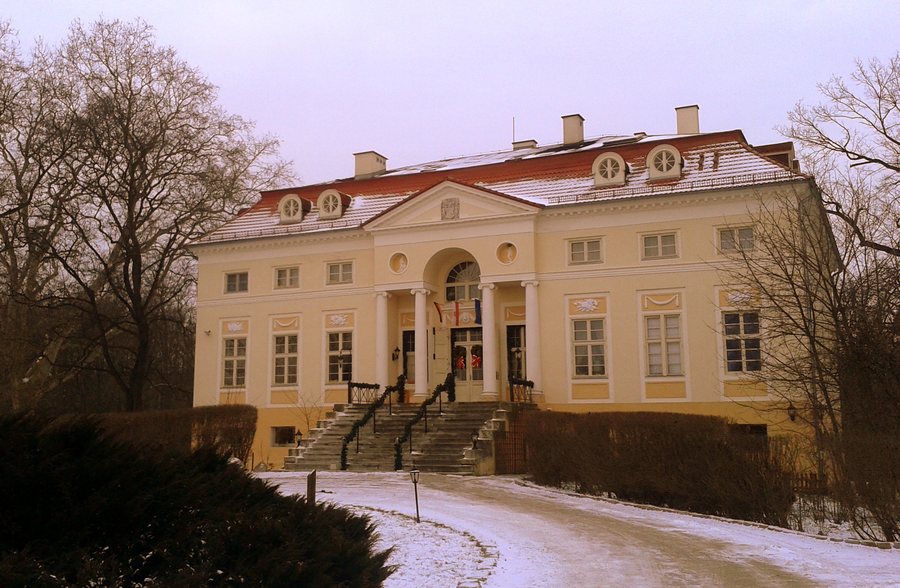
Samotwór at a glance
- The Pałac w Samotworze was built between 1776 and 1781 to a design by K. Gothard Longhans.
- It is one of the earliest rural Neoclassical residences in Silesia.
- A landscape park of about three hectares, with mature trees, surrounds the palace.
- A green-marked and a yellow-marked tourist trail pass through Samotwór.
What does the palace tell us about Samotwór?
Built between 1776 and 1781, the Pałac w Samotworze dates to the late 18th century. It was designed by K. Gothard Longhans. The building is also one of the earliest rural Neoclassical residences in Silesia—a regional connection that makes its history interesting beyond the village itself.
Its architectural influences are described as Palladian English architecture and French Neoclassicism. Together with its classification as a Neoclassical residence, this provides a concrete point of reference for travelers interested in architectural and cultural history.
How do the park and the Bystrzyca shape the landscape?
The palace stands on an artificially raised strip of land in a bend of the Bystrzyca River. Together with a small landscape park, it forms a picturesque ensemble.
The park covers about three hectares and was laid out at the end of the 18th century. Its mature trees are another feature of the grounds. This gives you a different focus to consider than the architectural history: here, the emphasis is on the designed landscape, the park’s approximate size and its historic planting.
What historic traces and trails can you find?
In the central part of the village, a visible oval hill remnant marks the site of a late medieval manor. The former estate was built of masonry; the hill measures about 40 by 45 meters at its base. Alongside the 18th-century residence, this part of the village points to a much older settlement history.
The green and yellow tourist trails both pass through Samotwór, but follow different routes through different places and municipalities. The green-marked trail passes through Samotwór and connects Kąty Wrocławskie with Leśnica (Wrocław), Mrozów, Środa Śląska, Lubiąż and Wołów. The yellow-marked trail also passes through Samotwór; it runs from Brzezinka Średzka via the western part of Wrocław and the municipalities of Kąty Wrocławskie, Żórawina and Czernica to near Jezioro Panieńskie. Within Kąty Wrocławskie municipality, it also passes through Skałka, Kębłowice, Smolec, Jaszkotle and Pietrzykowice.
For planning, you can use the places named above as reference points: the green-marked trail connects several named towns and places, while the yellow-marked trail follows a longer sequence of municipalities and villages to near Jezioro Panieńskie. Before planning a trip, check whether the trails are currently accessible.
Discover more destinations: Długołęka, Sulistrowice, Chrząstawa Mała, Brzezia Łąka, Wrocław, Bielany Wrocławskie, Dobrzykowice, Sulistrowiczki.
FAQ
When was the Pałac w Samotworze built?
The palace was built between 1776 and 1781 to a design by K. Gothard Longhans.
How large is the landscape park?
The park around the palace covers about three hectares. It was laid out at the end of the 18th century and retains mature trees.
Which marked trails pass through Samotwór?
A green-marked and a yellow-marked tourist trail pass through Samotwór. They differ in the places named along their routes and in their courses.
For the broader travel overview: Wrocław.

