
Bardo
Accommodation in Bardo
Bardo offers a range of travel-planning themes: sacred art and historic buildings, as well as the landscapes around the Nysa Kłodzka Gorge. You can prioritize cultural sites, viewpoints and activities on the water or on singletrack trails according to your interests.
Key facts about Bardo
Przełom Bardzki is a 14-kilometre stretch of the middle Nysa Kłodzka between Ławica (Młynowo) and Bardo. It is also known as the Wonder of the Sudetes. A water route follows the river from Bystrzyca Kłodzka through Kłodzko and Bardo to the village of Topola. While paddling on the Nysa Kłodzka, visitors may encounter mouflons, salamanders, grey herons or brown trout. The singletrack routes in Bardo extend across seven municipalities in the Kłodzko Valley.
If you are researching other destinations, you can also visit the pages for Złoty Stok, Frankenstein, Srebrna Góra, Kamieniec Ząbkowicki and Budzów.
Which cultural sites define Bardo?
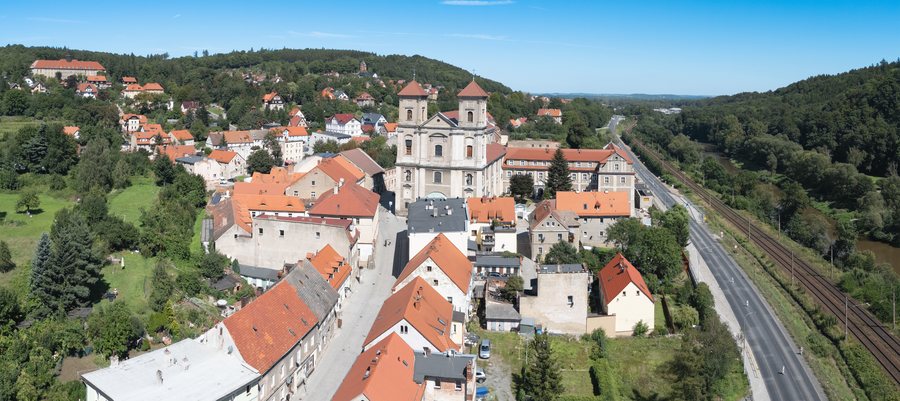
One notable religious site is Kaplica Górska. It was built from 1617 to 1619 on the summit of Góra Bardzka. The summit is 583 metres above sea level and is now called Kalwaria. On the way to the summit is the Maryi Spring, enclosed by a small brick chapel dating from 1893. The present-day Church of the Visitation of the Blessed Virgin Mary was built from 1686 to 1704.
The Museum of Sacred Art, founded in 1967, is located in the Redemptorist monastery next to the church. Its collection includes paintings, sculptures, liturgical vessels and vestments, other liturgical objects, and publications about the cult of Our Lady of Bardo. Different forms of sacred art are represented side by side: visual works, objects used in the liturgy, and publications about the local Marian cult.
The town’s history can also be encountered beyond its religious buildings. Well-preserved remains of an early medieval fortified settlement dating from the 10th to the 13th centuries lie along Noworudzka and Główna streets. They are among Bardo’s oldest monuments. The stone bridge over the Nysa Kłodzka was completed in 1589. Following its reconstruction in 1909, it acquired its present-day Gothic appearance. The mechanical panoramic nativity scene was created to commemorate 700 years of pilgrimage to Bardo (1270–1970).
What can you experience by the river and in the surrounding landscape?
For a view of Bardo and the gorge, the viewpoint at Obryw Skalny is a specific spot to visit: from there, the panorama extends over the town and the river gorge. If you would rather be on the water, you can explore the Nysa Kłodzka by paddle; possible wildlife encounters include mouflons, salamanders, grey herons and brown trout. The singletrack routes offer another distinct way to explore the area, extending across seven municipalities in the Kłodzko Valley.
How do you reach Bardo by train?
Bardo Śląskie railway station is on the Wrocław–Międzylesie and Wrocław–Kudowa railway lines. Bardo Przyłęk is listed as the nearest station. This rail information can help you factor Bardo into your travel plans; specific connections and journey times are not provided.
FAQ
How long is Przełom Bardzki?
The middle stretch of the Nysa Kłodzka between Ławica (Młynowo) and Bardo is 14 kilometres long.
What does the Museum of Sacred Art’s collection include?
It includes paintings, sculptures, liturgical vessels and vestments, other liturgical objects, and publications about the cult of Our Lady of Bardo.
Which railway lines does Bardo Śląskie station serve?
It is on the Wrocław–Międzylesie and Wrocław–Kudowa lines. The nearest station is Bardo Przyłęk.
For the broader travel overview: Frankenstein.

.jpg)