
Kamieniec Ząbkowicki
Accommodation in Kamieniec Ząbkowicki
Kamieniec Ząbkowicki combines an exceptional historicist landscape ensemble with a striking parish church. If you would like to make culture and architectural history the focus of your trip, the palace and garden complex, the mausoleum, and the church offer different points of interest.
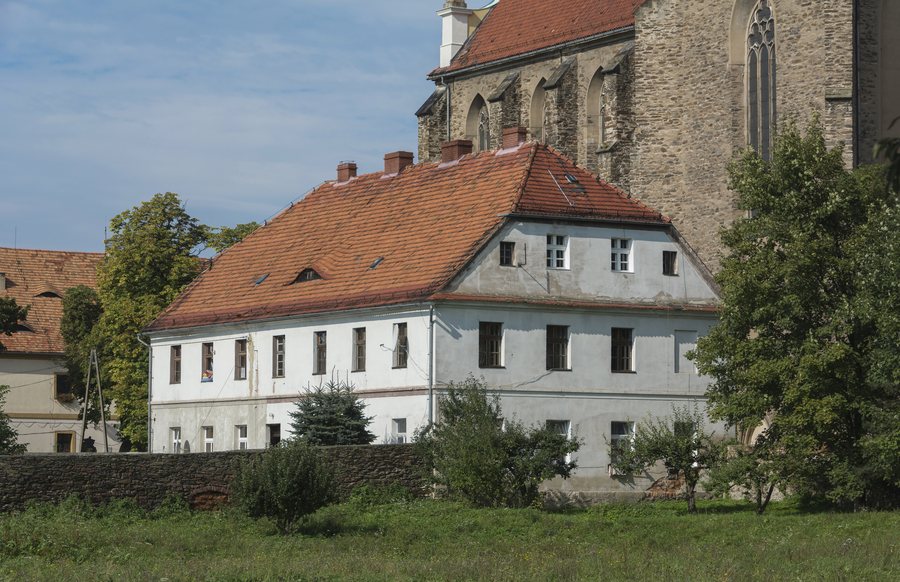 File:2014 Kamieniec Ząbkowicki, pl. Kościelny 7, 03.JPG
Photo: Jacek Halicki via Wikimedia Commons, CC BY-SA 3.0 pl
File:2014 Kamieniec Ząbkowicki, pl. Kościelny 7, 03.JPG
Photo: Jacek Halicki via Wikimedia Commons, CC BY-SA 3.0 pl
Kamieniec Ząbkowicki at a glance
The architectural and landscape ensemble of Kamieniec Ząbkowicki is a designed historicist landscape ensemble from the 19th century and is considered unique in Poland. On March 6, 2024, it was recognized as a Monument of History by a decree of the President of the Republic of Poland. The parish church of the Assumption of Mary is also part of the town’s cultural character: it is the only post-Cistercian hall church in Poland.
Kamieniec Ząbkowicki railway station has four covered platforms. The mausoleum is open to visitors Monday through Sunday from 10:00 a.m. to 6:00 p.m.
What makes the historic ensemble special?
An architectural and landscape ensemble brings buildings and designed landscapes together. In Kamieniec Ząbkowicki, this combination is associated with 19th-century historicism. Its designation as a unique ensemble in Poland and recognition as a Monument of History give the town a distinct profile for a trip in which historic architecture plays an important role.
What story does the palace complex tell?
The palace in Kamieniec Ząbkowicki is a Neo-Gothic residence of the princes of Prussia, located on Castle Hill (Góra Zamkowa). Architect Carl Friedrich Schinkel created the overall concept for the palace and garden complex between 1838 and 1841 for the owner of the Kamieniec estate, Princess Marianna Orańska (1810–1883). This links the complex, its patron, and its architect to a clearly defined planning period.
What can you discover at the church and mausoleum?
The parish church of the Assumption of Mary stands out for its distinctive classification as a post-Cistercian hall church. Its significance for a cultural trip lies in this rare and precisely defined architectural form: it is the only church of its kind in Poland. Together with the palace complex, it offers a different perspective on the town’s architectural history, although the two buildings are not comparable examples.
The mausoleum also offers a reason to visit in its own right. It is open to visitors daily from 10:00 a.m. to 6:00 p.m. The mausoleum also housed a digital exhibition about mausoleums around the world and the history of the Kamieniec mausoleum.
What does the railway station mean for choosing your destination?
With its four covered platforms, the railway station is a practical landmark for planning your journey.
When comparing different destinations, you can also refer to information about Srebrna Góra, Złoty Stok, Budzów, Frankenstein and Bardo.
FAQ
What is the architectural and landscape ensemble?
It is a unique designed historicist landscape ensemble from the 19th century in Poland and was recognized as a Monument of History in 2024.
When is the mausoleum open to visitors?
The mausoleum is open Monday through Sunday from 10:00 a.m. to 6:00 p.m.
What is known about the palace and garden concept?
Carl Friedrich Schinkel created the overall concept for the palace and garden complex between 1838 and 1841 for Princess Marianna Orańska, the owner of the Kamieniec estate.
For the broader travel overview: Frankenstein.

