
Srebrna Góra
Accommodation in Srebrna Góra
With its fortress, cultural history and varied trails, Srebrna Góra offers a range of reasons to visit. When planning your trip, the main points to consider are access to the fortress, cultural sites and opportunities for outdoor activities. This will help you decide whether historic sites, trails or cycling should shape your time in Srebrna Góra.
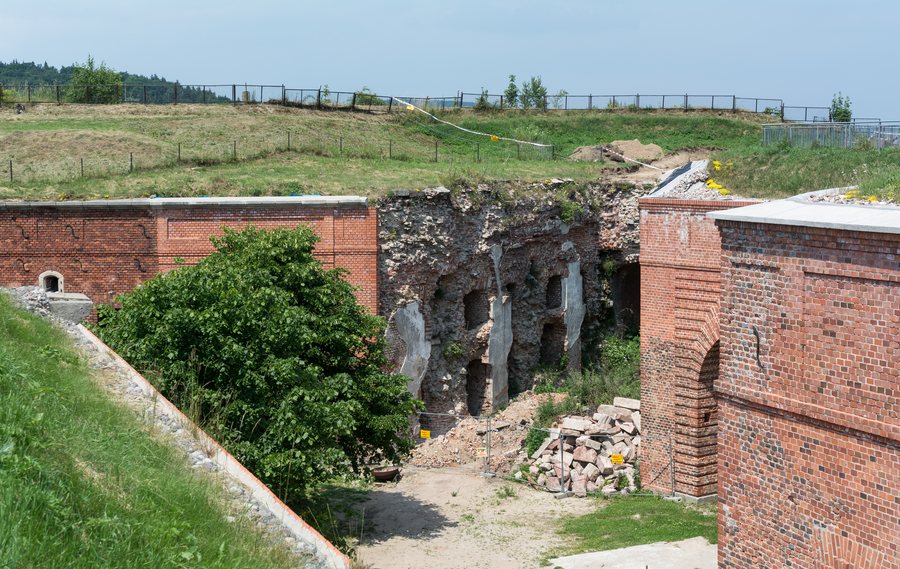 File:2016 Twierdza Srebrna Góra, fort główny (donżon) 11.jpg
Photo: Jacek Halicki via Wikimedia Commons, CC BY 3.0
File:2016 Twierdza Srebrna Góra, fort główny (donżon) 11.jpg
Photo: Jacek Halicki via Wikimedia Commons, CC BY 3.0
Key facts about Srebrna Góra
- The tourist route to the fortress starts at the pass, where there is a car park, and follows a 1 km paved road with hairpin bends through the forest; walking takes 15–25 minutes.
- The Protestant church was built between 1578 and 1592. Its former interior is now used as a venue for exhibitions and concerts.
- Fort Ostróg was built from 1766 to 1771 as an auxiliary fort to protect the main fortress on the other side of the pass.
- Activities for visitors include the “Zębata” educational trail and enduro trails that are part of Strefa MTB Sudety.
How do you get to the fortress?
The tourist route to the fortress starts at the pass, where the car park is located. From there, a paved road with hairpin bends runs for 1 km through the forest. The walk is listed as taking 15–25 minutes. These specific details about the route and walking time make it easier to plan your visit to the fortress than a vague idea of the distance would.
The fortress is a unique cultural heritage site in Europe. Those interested in its military history can consider it alongside Fort Ostróg, built from 1766 to 1771 to protect the main fortress on the other side of the pass. The relative positions of the two sites explain Fort Ostróg’s defensive role, without implying that they must be visited on a single route.
What cultural history and art can you discover?
The Protestant church in Srebrna Góra was built between 1578 and 1592. Today, the interior of the former church serves as the Srebrnogórska Przestrzeń Artystyczna, a venue for exhibitions and concerts. The building therefore brings together two distinct aspects: its historic role as a Protestant church and its current use as an arts venue. If you are interested in architectural and cultural history, this site adds another chapter to the local story alongside the fortifications.
The Forteczny Park Kulturowy is also part of the town’s cultural history. Established in 2002, it aims to protect and revitalize the fortress comprehensively while taking into account the surrounding landscape. Its purpose therefore combines preserving the fortress with consideration for its surroundings. This sets it apart thematically from individual structures such as the church or the auxiliary fort.
Which trails and technical structures shape the area?
The “Zębata” educational trail was created in 2002 through the section of the mountain considered most valuable for its natural and historical features. Visitors interested in both nature and history will find a route explicitly designed as an educational trail. Srebrna Góra’s enduro trails, meanwhile, are part of Strefa MTB Sudety. These two offerings appeal to different interests: the educational trail combines nature and history, while the enduro trails are part of the mountain biking scene.
Another story about the area’s trails is linked to the former route of the Sowiogórska Railway. Its trackbed remains intact to this day, and the blue and green hiking trails also follow one section of it. The hiking trails therefore run along part of the former railway route, not necessarily its entire length.
The area’s transport history also includes the only rack railway in present-day Poland. On the Srebrna Góra–Wolibórz section, a rack rail was used because of the steep gradient, to prevent the train from slipping while climbing. The Srebrnogórski Viaduct is another technical structure: built in 1901, it is 28 metres high. The rack railway and the viaduct illustrate different aspects of Srebrna Góra’s transport history.
Which other destinations can you compare?
If you would like to compare several destinations as you plan your trip, you can also explore Bardo, Złoty Stok, Frankenstein, Kamieniec Ząbkowicki and Budzów.
FAQ
How long is the tourist route to the fortress?
The paved route from the pass, where the car park is located, is 1 km long. Walking takes 15–25 minutes.
What is the former Protestant church used for today?
Its interior is now used as the Srebrnogórska Przestrzeń Artystyczna, a venue for exhibitions and concerts.
Which hiking trails run along the former railway route?
The blue and green hiking trails run along one section of the preserved former Sowiogórska Railway route.
For the main travel overview: Frankenstein.

_11.jpg)