
Siennica: Monastic history and educational tradition
Accommodation in Siennica
Siennica’s cultural history can be traced through two themes: the former Reformati church and monastery complex, and its educational tradition. The complex draws attention to architecture and its founding history; a municipal description of the Siennickie Muzeum Szkolne focuses on local history and education.
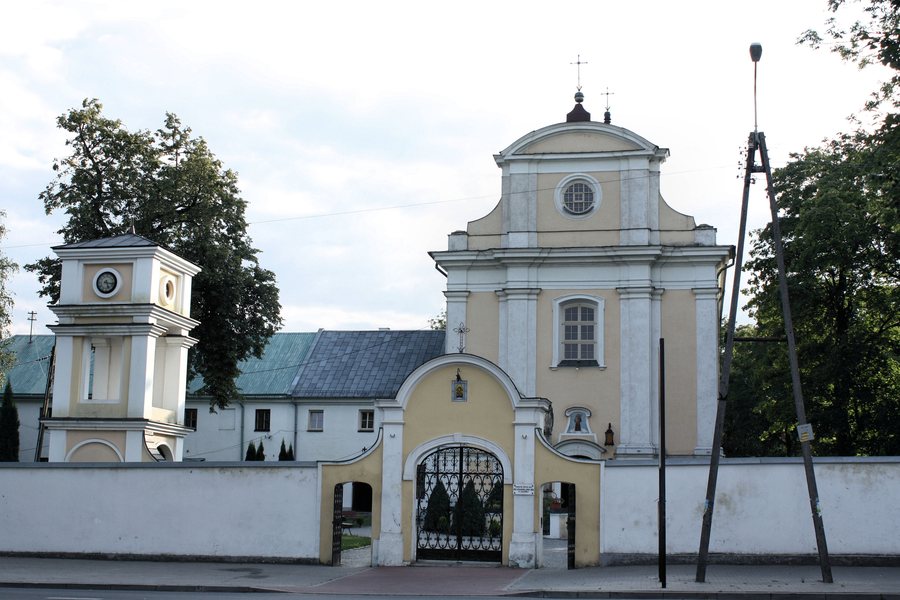 File:Zespół klasztorny reformatów, kościół par. pw. Ofiarowania NMP i dzwonnica, Siennica, KK.JPG
Photo: Katarzyna Koszewska via Source, CC BY-SA 3.0 PL
Siennica at a glance
- A municipal document describes the former Reformati church and monastery complex as the municipality’s most valuable historic site.
- The complex includes the main building, the monastery building, and their immediate surroundings.
- The church and the adjoining four-wing monastery enclose a rectangular viridarium courtyard.
- The Church of the Presentation of the Blessed Virgin Mary (pw. Ofiarowania Najświętszej Marii Panny) dates from the 18th century; the complex was founded between 1749 and 1754.
What makes up the former Reformati complex?
A municipal document describes the former Reformati church and monastery complex as the municipality’s most valuable historic site. The designation includes not only the main building and the monastery building, but also their immediate surroundings. The historic site is thus described as an ensemble, rather than as a single structure. Together, the church and the adjoining monastery form the architectural core of the complex.
This context is useful for understanding the site: the church does not stand alone, but is part of a complex that includes a monastery building and courtyard. Visitors especially interested in historic architecture can distinguish the overall complex from its individual elements.
How are the church, monastery, and courtyard laid out?
The church and adjoining four-wing monastery form an enclosed complex of brick and plastered buildings. The wings enclose a rectangular viridarium courtyard. The courtyard is therefore a central feature of the complex: it helps explain the enclosed arrangement of the church and monastery.
A statue of the Immaculate Virgin Mary, dating from the first half of the 19th century, stands in the courtyard on a Tuscan column. This detail adds a distinct artistic and religious element to the description of the overall architectural layout. Siennica thus offers two scales to consider: the overall form of the church, monastery, and courtyard, and the statue as a notable feature of the courtyard.
What is the historical context of the church and monastery?
The Church of the Presentation of the Blessed Virgin Mary (pw. Ofiarowania Najświętszej Marii Panny) dates from the 18th century. The Baroque church and Reformati monastery complex is recorded as having been founded between 1749 and 1754. Its founders are named as Kazimierz Rudziński, Antonina z Nowosielskich, and their son Michał.
The dates complement one another but refer to different aspects: the century places the church in its historical period, while 1749–1754 refers to the founding of the complex. Together with the description of the buildings, they offer a way to explore the site through its architecture, founders, and development as an ensemble.
What educational themes does the school museum cover?
The Siennickie Muzeum Szkolne focuses on different subjects from the architectural history. A municipal description mentions hundreds of exhibits relating to local history, Siennica’s educational traditions, the struggle for Polish identity and independence, and the region’s material culture.
The collections mentioned include old textbooks and encyclopedias. The description also lists the recollections and memoirs of teachers, former students, and other people associated with the school. This cultural theme thus brings together educational objects and personal memories, complementing the architectural history with local and school history.
Discover more destinations: Stanisławów, Grebiszew, Dębe Wielkie, Kałuszyn, Sulejówek, Grabina, Halinów, Okuniew.
FAQ
What are the components of the former Reformati complex?
The complex includes the main building, the monastery building, and their immediate surroundings. The church and adjoining four-wing monastery enclose the rectangular viridarium courtyard.
When does the church in Siennica date from?
The Church of the Presentation of the Blessed Virgin Mary (pw. Ofiarowania Najświętszej Marii Panny) dates from the 18th century. The Baroque church and Reformati monastery complex is dated to 1749–1754.
What themes are associated with the Siennickie Muzeum Szkolne?
A municipal description mentions local history, Siennica’s educational traditions, the struggle for Polish identity and independence, and the region’s material culture. It lists, among other things, old textbooks, encyclopedias, recollections, and memoirs.
For the broader travel overview: Miński.

