
Habdzin: Oxbow Lakes, History and the Urzecze Route
Accommodation in Habdzin
Habdzin brings together traces of the former Vistula riverbed, a dated account of the village’s history, and a described journey through the Urzecze villages. This gives you three distinct starting points for planning your trip: the river landscape, the past, and the journey onward towards Konstancin.
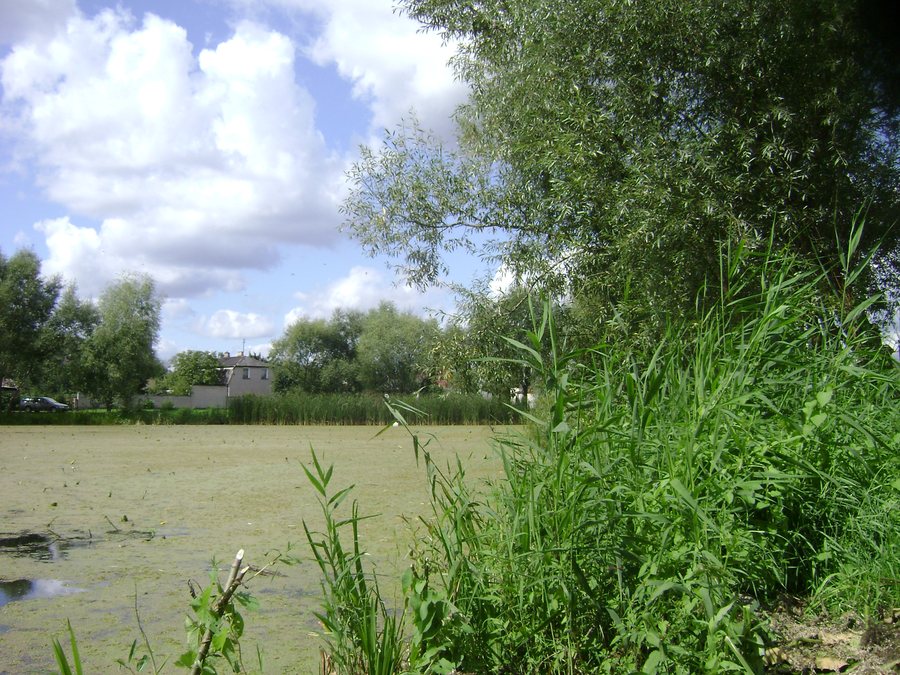 Poland. Gmina Konstancin-Jeziorna. Habdzin 001.JPG
Photo: Albertyanks Albert Jankowski via Wikimedia Commons, Public domain
Quick facts about Habdzin
- The lakes and oxbow lakes in Habdzin are among the many remnants of the former Vistula riverbed.
- The Łęgi Oborskie Nature Reserve is in the municipality of Konstancin-Jeziorna and protects an ash-elm riparian forest.
- On 25 July 1368, Duke Siemowit sold Chabdzino, the historical spelling of today’s Habdzin, to Mikołaj of Rozniszew.
- A journey from a ferry passes through Gassy, Czernidła, Łęg and Habdzin and continues to the centre of Konstancin; the distance from the ferry is given as 8 km.
What kind of landscape defines Habdzin?
The lakes and oxbow lakes in Habdzin are among the many remnants of the former Vistula riverbed. An oxbow lake is a former river channel separated from the main course. The term draws attention to an earlier course of the Vistula: this waterscape can be understood as a trace of a river whose bed has changed over time.
Another natural feature lies at the municipal level: the Łęgi Oborskie Nature Reserve is located in the municipality of Konstancin-Jeziorna. It protects an ash-elm riparian forest, a remnant of the Vistula Valley’s natural vegetation. For nature lovers, this offers two distinct perspectives: the water features found in Habdzin and the protected riparian forest within the municipality.
What does the village’s history tell us?
The historical record for Habdzin has a specific reference point. On 25 July 1368, Duke Siemowit sold Chabdzino—the historical spelling of today’s Habdzin—to Mikołaj of Rozniszew. The date, seller and buyer make this a precisely dated event in the village’s history; the former name also connects it with present-day Habdzin. If you compare destinations by their history, this medieval event offers a clearly dated point of reference.
How can you plan a journey through the Urzecze villages?
A described journey leads from a ferry through the Urzecze villages of Gassy, Czernidła, Łęg and Habdzin, and continues to the centre of Konstancin. The distance from the ferry is given as 8 km. Along the way, the chimney and buildings of the former paper mill in Mirków can be seen in the distance. The route thus connects several named villages with a striking view of the former paper mill.
The ferry crossing is described as seasonal. If you plan to take this route, check in advance whether the ferry is operating on your travel date.
Which focus suits your accommodation search?
When looking for a hotel, you can first consider what you want to focus on during your trip to Habdzin: are you especially interested in the Vistula oxbow lakes, the dated reference to local history, or the journey towards Konstancin? These topics offer different ways to decide whether the village suits your interests, without requiring you to combine them into a single itinerary.
Discover more destinations: Chojnów, Jaroszowa Wola, Przypki, Tomice, Nowa Iwiczna, Góra Kalwaria, Borowiec, Tarczyn.
FAQ
What traces of the Vistula’s natural history can be found in Habdzin?
The lakes and oxbow lakes in Habdzin are among the many remnants of the former Vistula riverbed. An oxbow lake is a former river channel separated from the main course.
What happened on 25 July 1368?
Duke Siemowit sold Chabdzino, the historical spelling of today’s Habdzin, to Mikołaj of Rozniszew.
What should you keep in mind when taking the ferry?
The ferry crossing is described as seasonal. Before setting out, check whether the ferry is operating on your travel date. The distance from the ferry is given as 8 km.
For the broader travel overview: Piaseczyński.

