
Wyszomierz and the Boundary Boulder
Accommodation in Wyszomierz
At the boundary of Wyszomierz lies a grey granite boulder, which a local tradition associates with a Marian apparition. Its location is described at two points in time: originally on the boundary with Kutyski, and today on the boundary of Wyszomierz.
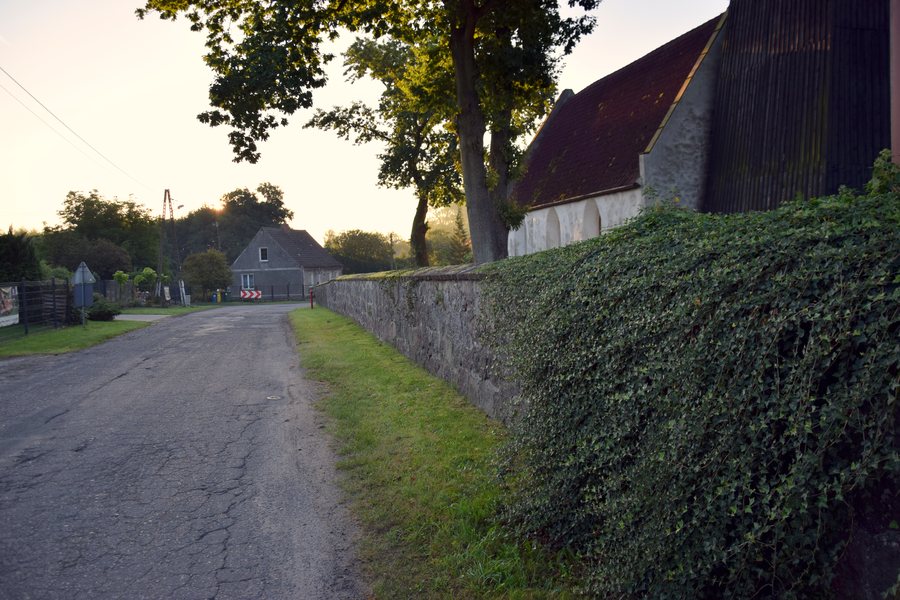
Wyszomierz at a glance
- The boulder is made of grey granite.
- The part visible above ground is stated to measure about 40 × 40 cm; these measurements refer to this visible section.
- A local tradition links the marks on the boulder to a Marian apparition.
What is said about the marks?
According to local informants, the boulder had various signs and indentations, including an impression they described as a human footprint. In 1902, Władysław Jarecki described an imprint of a left foot with clearly visible toes, as well as a cross with a base. The year refers to Jarecki’s description. The tradition links the marks to a religious interpretation; Jarecki’s account names specific shapes. These are different perspectives on the same boulder.
How is the boulder’s location described?
Originally, the boulder lay on the boundary between Wyszomierz and Kutyski. Today it is buried near the road on a hill at the boundary of Wyszomierz. The two accounts distinguish its former boundary location from its described present-day location.
Discover more places to visit: Debe, Krzemień-Wieś, Sokołów Podlaski, Sterdyń.
Why only a small part of the stone is described
The source account adds that the boulder was buried in connection with a road-widening project. It is said to have previously stood on the opposite side of the road and to have been roughly the size of a person. This earlier size is a reported description, not a measurement confirmed here.
The approximately forty by forty centimetres therefore refer to the part said by the source to be visible. They describe neither the boulder’s full volume nor a freestanding sculpture today. Anyone visiting the site to view the stone’s historical markings should not expect to find all the shapes described in 1902 on the visible section.
Distinguishing a place of remembrance from a possible visit
The account of the Marian tradition documents a local religious interpretation. It does not prove an apparition as a historical event, nor does it mention an organised pilgrimage programme. Similarly, the roadside location does not confirm a publicly accessible viewing area, a car park or a signposted route.
Before planning a special visit, the actual location and permitted access options must be checked. The former position on the opposite side of the road should not be used as current directions. The historical account also does not imply accommodation directly beside the boulder or an included guided tour. For an actual stay, use the exact street address rather than relying solely on its connection to this place of remembrance.
FAQ
What material is the boulder made of?
It is made of grey granite.
What does the local tradition say?
It links the marks on the boulder to a Marian apparition.
What did Władysław Jarecki describe in 1902?
He described an imprint of a left foot with clearly visible toes, as well as a cross with a base.
For the broader travel overview: Sokołowski.

