
Ujest: Castle, Churches and Cycling Route
Accommodation in Ujest
Ujest can be understood through its setting by the water, a cycling route that runs through the town and several buildings. The medieval castle, the parish church of St Andrew the Apostle and a granary each offer a different historical perspective. When planning your trip, you can choose between exploring the geography, cycling and architectural history.
Ujest at a glance
Ujest lies on the Kłodnica River and the Gliwice Canal. The yellow-marked cycle route No. 16 passes through the town; historical sights in the town centre lie along its route. The buildings include the castle of the Bishops of Wrocław, the parish church of St Andrew the Apostle, built in 1613, and an 18th-century granary.
What is distinctive about Ujest’s location?
Two waterways are important for understanding the town’s location: Ujest lies on the Kłodnica River and the Gliwice Canal. If you are looking for the town on a map, you can use both as reference points. Its setting by the water offers another perspective on Ujest, alongside the cycle route and historic buildings. You can first get your bearings and then decide whether to explore the cycling route or the town’s architectural history in more detail.
How can the cycle route help you find your way?
The yellow-marked cycle route No. 16 passes through Ujest. Historical sights in the town centre lie along its route. This also lets you combine the route with cultural sightseeing when planning: the town’s description covers both cycling and architectural history. Check the latest route conditions before setting out.
What do the church and granary reveal about the town’s architectural history?
The parish church of St Andrew the Apostle was built in 1613 and is Baroque. Its Neo-Gothic towers were added in the 19th century. The church can therefore be understood in terms of several building phases: its 17th-century construction was followed by the later addition of the towers.
The granary near the market square served a different purpose. This three-storey, masonry and plastered commercial building dates from the 18th century and is currently used for storage. Its construction date, design and present-day use distinguish it from the church. Together, these details illustrate different aspects of the town’s architectural history without equating the two buildings.
What should you know about the castle?
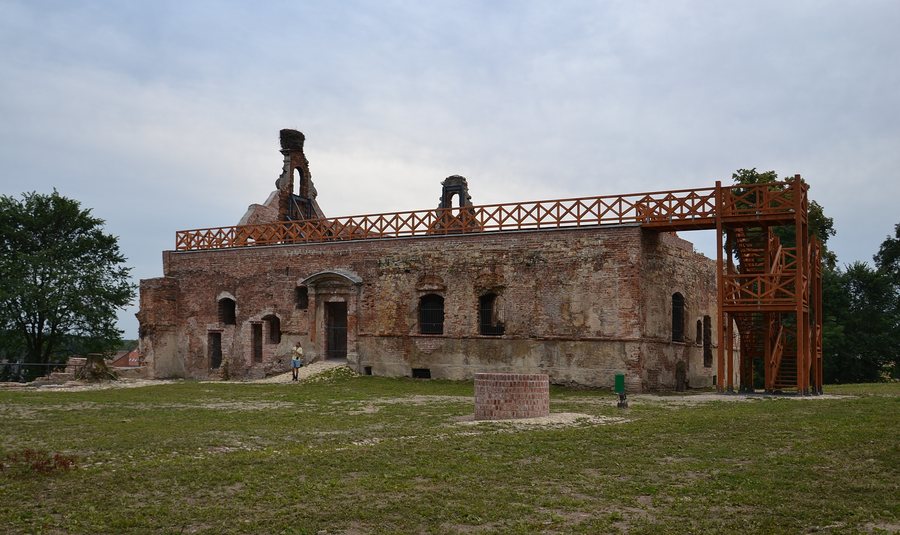
The medieval castle of the Bishops of Wrocław was built at the beginning of the 13th century. Its ruins offer panoramic views of the surrounding area. The ruins were secured several years ago and opened to visitors. If you are planning a visit, please check in advance whether access is currently possible.
What buildings are there in Studzionka?
Studzionka, also in the municipality, offers another perspective on religious buildings. The pilgrimage church is a Neo-Gothic church with a tower on its west side. There is also a chapel of the Virgin Mary above the Marian spring. The church’s architectural style and the chapel’s location give you two specific features to help distinguish these buildings.
Discover more destinations: Zawadzkie, Leśnica, Colonnowska, Stubendorf, Kroschnitz, Olszowa, Zimna Wódka, Sucha.
FAQ
Which sights are located along cycle route No. 16?
Historical sights in the town centre lie along the yellow-marked cycle route No. 16, which passes through Ujest.
Is the granary still in use?
The granary near the market square is currently used for storage.
Can the castle be visited at the moment?
The ruins were secured several years ago and opened to visitors. Please check in advance whether a visit is currently possible.
Go to the overview of the region: Strzelecki.

