
Olszyny: Nature, History and Architecture
Accommodation in Olszyny
For your travel planning, Olszyny combines local history with nearby landscape features and architectural history in other places. This lets you consider nature, church history and historic architecture as distinct interests when choosing your destination.
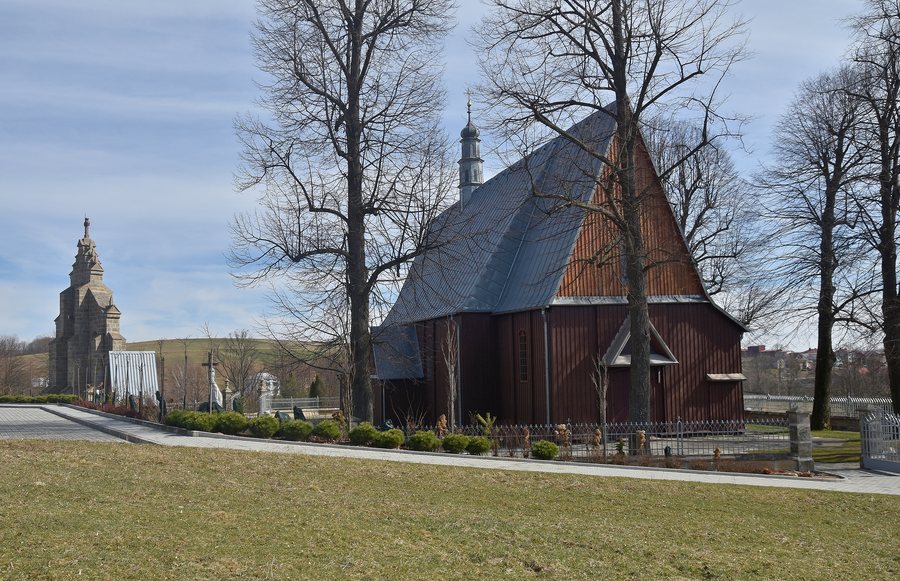 Olszyny, Church of the Exaltation of the Holy Cross
Photo: Henryk Bielamowicz via Source, CC BY-SA 4.0
Olszyny, Church of the Exaltation of the Holy Cross
Photo: Henryk Bielamowicz via Source, CC BY-SA 4.0
Olszyny at a glance
The parish of the Most Holy Trinity in Olszyny was established in 1979; an independent pastoral centre had already existed there. Nearby are the spring-fed mires of the Łojewek River Valley Reserve. Historical points of interest in the associated municipality include the forts in Piątnica Poduchowna. In Drozdowo, the Natural History Museum is housed in a former manor house.
What kind of landscape characterises the surrounding area?
The Łojewek River Valley Reserve contains spring-fed mires, particularly around the villages of Wyłudzin, Olszyny and Taraskowo. These areas are characterised by lush marsh and mire vegetation and a distinctive layer of moss. Thus, the area around Olszyny offers a landscape quite different from the region’s historic buildings.
This distinction can help you weigh your interests: the spring-fed mires represent a natural landscape, while the parish, forts and manor house tell stories of church history and architecture. You can consider these topics independently at first, without combining them into a single route.
What stories do the parish and forts tell?
The parish of the Most Holy Trinity in Olszyny was established on 1 January 1979 by Bishop Mikołaj Sasinowski of Łomża. It was created in an area where an independent pastoral centre had existed since 1974. This chronology places the founding of the parish within the development of local church life.
The three forts in Piątnica Poduchowna are located in the associated municipality. Embankments and ditches link them into the “Główna Osłona” complex; they are also part of the 19th-century fortifications of Łomża Fortress. Visitors can explore the above-ground sections. Underground passageways lead to forward fighting positions that defended the ditch. A small exhibition from the Fort Museum is also housed in a ready room bunker.
What can you learn about the manor house in Drozdowo?
The Natural History Museum in Drozdowo is housed in the former manor house of Stanisław Lutosławski. The building reveals distinct phases of construction: it combines the remains of an 18th-century manor house with a villa added later. This architectural history adds its own focus to the local church history and military structures.
When comparing accommodation, these different topics can help you decide what kind of destination interests you: landscape, history or architecture. Discover more destinations: Koziki, Łomża, Giełczyn, Wizna, Piątnica Poduchowna, Drozdowo, Nowogród, Kisielnica.
FAQ
When was the parish in Olszyny established?
Bishop Mikołaj Sasinowski of Łomża established the parish of the Most Holy Trinity on 1 January 1979. An independent pastoral centre had already existed locally since 1974.
What can you see when visiting the forts in Piątnica Poduchowna?
The visitor options described include the above-ground sections, underground passageways leading to forward fighting positions, and a small Fort Museum exhibition in a ready room bunker.
What is the architecture of the Natural History Museum in Drozdowo like?
The former manor house combines the remains of an 18th-century manor house with a single-storey Neoclassical villa added in 1895 to designs by Franciszek Lilpop.
For the broader travel overview: Łomżyński.

.jpg)