
Dziemiany
Accommodation in Dziemiany
Dziemiany combines a nature trail by Lake Rzuno with a multifaceted local history. The church, monument, and the memory of the Sophienwalde subcamp offer different points of interest for planning your trip.
Quick facts about Dziemiany
- The nature trail around Lake Rzuno is 3 km long and has twelve stops with information boards.
- The church was consecrated on October 22, 1923; it received Polish presidents in 1924 and 1995.
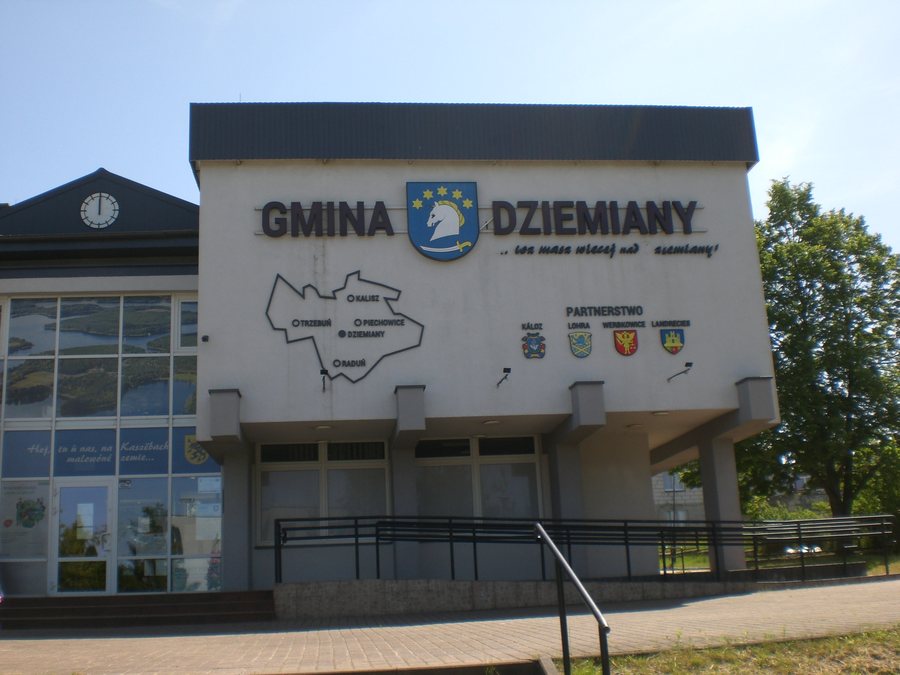
- The monument to the victims of the Sophienwalde camp stands in front of the municipal office and was erected in 2006.
- The subcamp of the Stutthof concentration camp operated in Dziemiany from August 1944 to February 1945.
What does the nature trail by Lake Rzuno offer?
At three kilometers long, the nature trail around Lake Rzuno provides a clear guide for anyone looking for a route with a manageable stated distance. Twelve stops with information boards add educational content to the route. If you enjoy learning about a nature-related topic while on the move, the trail gives you a concrete reason to include it in your travel plans.
The trail runs through the municipality of Dziemiany in the buffer zone of Wdzydzki Landscape Park. This places the route within a protected landscape in the municipality, without conflating it with other trails or locations. The lake and the stops provide a clear focus for the nature theme: you can choose a walk here based primarily on your interest in the landscape and information boards.
What stories do the church and monument tell?
The church’s history can be traced through several specific dates. On October 22, 1923, the church in Dziemiany was consecrated in a solemn ceremony presided over by the then Bishop Konstanty Dominik. The following year, in 1924, the church received Polish President Stanisław Wojciechowski. Polish President Lech Wałęsa visited in 1995. The consecration and the two visits provide three chronological landmarks if you are interested in the history of the place.
Another place of remembrance is the monument in front of the municipal office. It is dedicated to the victims of the Sophienwalde camp and was erected in 2006. German authorities operated the Sophienwalde subcamp of the Stutthof concentration camp in Dziemiany from August 1944 to February 1945. The monument and the camp’s history therefore belong to different periods: the camp is part of the history of 1944 and 1945, while the monument was erected in 2006.
What spiritual tradition is associated with Dziemiany?
Dziemiany’s history is also connected with the Extreme Way of the Cross (EDK). For more than ten years, during Lent, several thousand people set out from Dziemiany on routes of the Extreme Way of the Cross (EDK). Unlike the nature trail by the lake, with its information boards, these departures centered on a shared religious undertaking. If you are interested in the history of pilgrimage routes, this tradition is another aspect of local history.
A local description dated June 2, 2025, also mentions a tourist information center in a Kashubian cottage in Dziemiany and the option to rent bicycles there. If you want to include bicycle rental in your plans, check availability before your trip.
Discover more destinations: Stara Kiszewa, Sycowa Huta, Grabówko, Dębogóry, Lubań, Piątkowo, Liniewo, Kościerzyna.
FAQ
How long is the nature trail by Lake Rzuno?
The nature trail is 3 km long and has twelve stops with information boards.
Which dates are important in the church’s history?
The church was consecrated in 1923. It received Polish President Stanisław Wojciechowski in 1924 and Polish President Lech Wałęsa in 1995.
What should you know about bicycle rental?
A local description dated June 2, 2025, mentions bicycle rental at the Kashubian cottage. Check availability before your trip.
Go to the main travel overview: Berent.

