
Grabówko
Accommodation in Grabówko
Grabówko offers several different points of interest for a trip focused on history or outdoor activities: an early medieval Gródisko, a tumulus cemetery with preserved mounds, and a cycling route that passes through the village. This gives you the opportunity to decide which of these themes you would like to shape your stay.
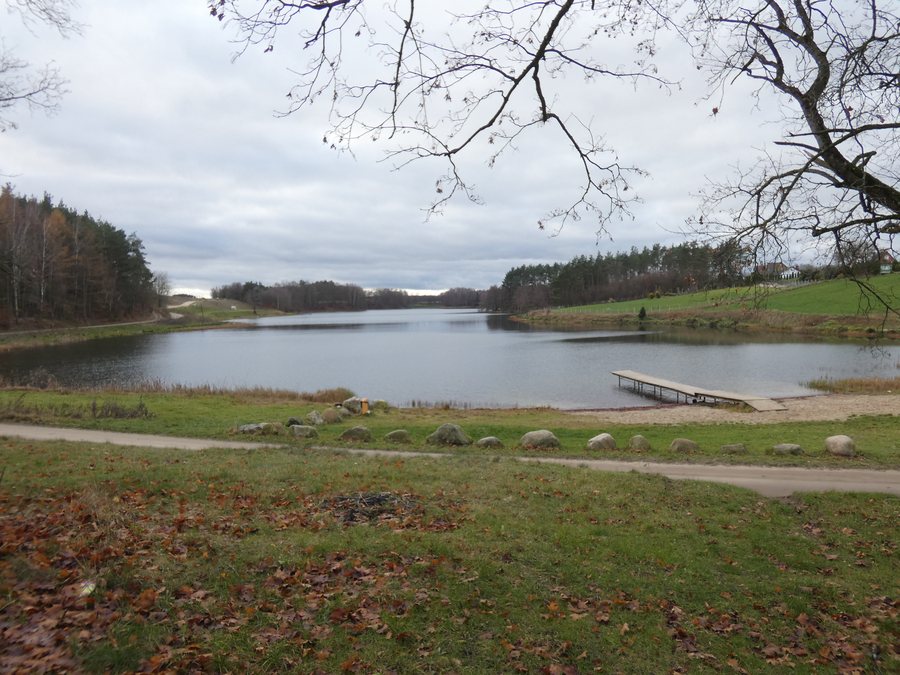
Grabówko at a glance
- The Gródisko dates from the early Middle Ages and is located on the western shore of Lake Grabówko.
- Ramparts and an inner courtyard have been preserved; the Gródisko is listed in the register and inventory of historic monuments.
- Four mounds remain today at the tumulus cemetery; originally, it consisted of seven burial mounds.
- Grabówko has a brick school building dating from the early 20th century.
- The “Szlak Kaszubskiej Żurawiny” cycling route passes through Grabówko.
What makes the Gródisko historically interesting?
The Gródisko is the early medieval highlight among the historic traces mentioned here. Its preserved ramparts and inner courtyard give a concrete impression of which parts of the site have survived. This makes it easy to distinguish the Gródisko from the other historic sites when planning your trip: here, the ramparts and inner courtyard take centre stage, while the tumulus cemetery is defined by its mounds.
Its location is also clearly identifiable: the Gródisko is on the western shore of Lake Grabówko. Its inclusion in both the register and inventory of historic monuments is another aspect of its classification. If you are interested in early history and preserved historic sites, you can make this a distinct focus of your exploration of Grabówko.
What other historic traces are there?
The tumulus cemetery complements the early medieval Gródisko with a different kind of historic trace. The cemetery originally comprised seven burial mounds; four mounds remain today. These two figures describe different states of the cemetery: the original number and the number that still exists today. This distinction gives you a concrete point of reference when comparing Grabówko’s historic sites.
Another feature is the brick school building dating from the early 20th century. It differs in both period and construction from the archaeological traces: the Gródisko dates from the early Middle Ages, the cemetery is characterised by its mounds, and the school building is a brick structure from the 20th century. Grabówko is also one of the historic settlement units in the municipality of Nowa Karczma. This classification adds a perspective on the settlement’s history to the individual sites.
What role does the cycling route play?
The “Szlak Kaszubskiej Żurawiny” cycling route passes through Grabówko. This means that, alongside the historic traces, a cycling route can also be a point of interest when deciding on your trip. If you are planning your trip around an interest in culture and history, the Gródisko and the tumulus cemetery may be suitable points of interest. If you would like to include cycling, you can also take into account that this named cycling route passes through Grabówko.
If you would like to continue your research with pages about other places, you can also find Schodno, Lipuska Huta, Przytarnia, Wielki Klincz, Dębogóry, Kościerzyna, Łubiana and Dziemiany here.
FAQ
Where is the Gródisko in Grabówko?
It is on the western shore of Lake Grabówko.
How many mounds remain at the tumulus cemetery?
Four mounds remain today. Originally, the cemetery consisted of seven burial mounds.
Which cycling route passes through Grabówko?
The “Szlak Kaszubskiej Żurawiny” cycling route passes through the village.
For the higher-level travel overview: Berent.

