
Roszczyce: Oaks, Church and Village History
Accommodation in Roszczyce
Roszczyce is a small village southeast of Łeba. Two English oaks designated as natural monuments, along with several tangible features at the church, churchyard and manor house, offer different points of reference for understanding the village. The tree measurements allow for an objective comparison; the crypt and architecture offer further perspectives on the village’s history.
Roszczyce at a glance
- A small village southeast of Łeba, on a local road connecting Maszewko and Ulinią.
- Two English oaks designated as natural monuments: one by the church, the other about 120 metres north of it by a small pond.
- The historical features described include the crypt of the Church of the Assumption of Mary, the Krokowski family tomb and a manor house.
How is Roszczyce situated geographically?
Its location southeast of Łeba places Roszczyce in its wider geographical context. In terms of local roads, the village lies on a route connecting Maszewko and Ulinią. For map orientation: Roszczyce lies southeast of Łeba on the road between Maszewko and Ulinią. Discover more destinations: Łeba, Żarnowska, Poraj, Łebień, Wicko, Dymnica, Sarbsk, Lebork.
Which natural monuments can be compared?
An English oak with a trunk circumference of 4.10 metres stands by the church in Roszczyce. A second English oak is located about 120 metres north of the church, by a small pond; its trunk circumference is 5.20 metres. The village’s descriptions thus focus on two distinct points of reference: the church and the pond.
The difference between the stated circumferences is 1.10 metres. This is the trunk circumference, not the height of the trees. Comparing the two natural monuments therefore means looking at two specific measurements and their different locations. Both English oaks are designated as natural monuments and are in very good condition. Their protected status and condition may change over time; check this information before visiting.
Which historical features shape the village?
According to a tourist description, the crypt of the Church of the Assumption of Mary in Roszczyce contains seven naturally mummified bodies of the local estate’s owners and their family members. The seven bodies are described in the tourist account as being remarkably well preserved.
Another tangible feature can be found in the churchyard: the Krokowski family tomb stands there, surrounded by an ornately decorated wrought-iron fence. Together with the crypt, it points to two distinct family connections: the relatives of the local estate’s owners and the Krokowski family. The manor house adds an architectural dimension to the village’s history.
What is the manor house like?
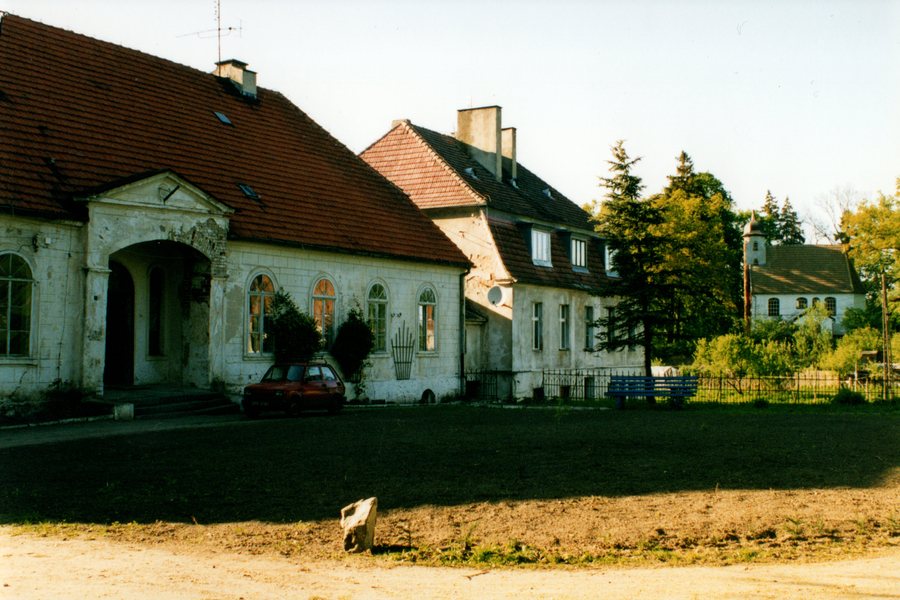
The manor house in Roszczyce is privately owned. It is a simple, east-facing, single-storey residence with a rectangular ground plan that is longer than it is wide, and a gabled roof with half-hipped ends.
A few architectural terms help explain the description: a rectangular ground plan is longer in one direction than it is wide; single-storey means that a building has one storey. A half-hipped roof adds shortened hip sections to the gabled roof at the gable ends. This makes the brief description of the house easier to understand, even without specialist knowledge.
FAQ
Where are the two English oaks?
One stands by the church in Roszczyce; the other is about 120 metres north of it, by a small pond.
What is reported about the crypt of the Church of the Assumption of Mary?
According to a tourist description, it contains seven naturally mummified bodies of the local estate’s owners and their family members.
What type of roof does the manor house have?
It has a gabled roof with half-hipped ends, meaning shortened hip sections at the gable ends.
For the wider travel overview: Lauenburg.

