
Dąbrowa Górnicza – Lakes, Trails and Culture
Accommodation in Dąbrowa Górnicza
Four Pogoria Lakes, marked routes and insights into the region’s mining history define Dąbrowa Górnicza.
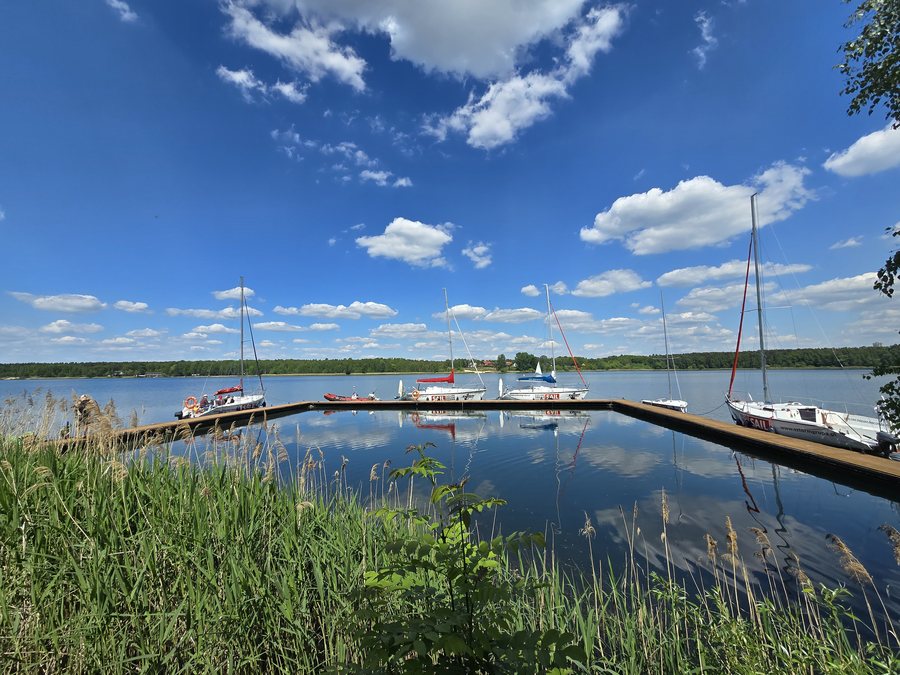
Quick facts about Dąbrowa Górnicza
- The Pojezierze Dąbrowskie comprises four Pogoria Lakes, which are used for tourism and recreation.
- A 14.5-hectare section of the Pustynia Błędowska lies within the city’s administrative boundaries.
- Marked trails and cycling routes surround each of the four lakes and are also suitable for younger children.
- Cultural attractions include the Muzeum Miejskie Sztygarka and the Kopalnia Ćwiczebna.
What experiences do the Pogoria Lakes offer?
The four lakes are a focal point for waterside recreation. Pogoria III is suitable for sailing and windsurfing. Several sailing and water sports clubs operate at the Pogoria reservoirs, including Fregata, Hutnik and Jacht Klub Pogoria III. These clubs offer training, courses and camps. Visitors interested in diving can find specific information about the depths at Pogoria III: divers descend to 17 metres, while the lake’s average depth is 6 metres.
Marked trails and cycling routes run around each of the four lakes. They are also suitable for younger children. Another way to access nature and water is from ul. Zakładowa to Pogoria II: the easy path ends at a floating pier that serves as a viewpoint for walkers and nature watchers. Pogoria II is also home to numerous fish, bird and plant species. You can therefore make water sports, exercise and nature watching different focuses of your trip.
Which trails and routes are available?
The green-marked Szlak XXV-lecia leads to Pogoria II and Pogoria III; around 18.5 kilometres of this trail lie within Dąbrowa Górnicza. The red Szlak Metalurgów also passes through the city and is 13 kilometres long. For a longer route, the Szlak Szwajcarii Zagłębiowskiej is another option: it is 35.5 kilometres long in total, of which 15.5 kilometres lie within the city. Along the way, pine forests, historic churches and clear streams shape the landscape. There are also sweeping views of the Pustynia Błędowska and the Pasmo Smoleńsko-Niegowonickie, as well as bends in the Biała Przemsza.
The 28.5-kilometre Szlak Pustynny PTTK starts at the Baza Biwakowo-Campingowo-Rekreacyjna. The wetland at this site is criss-crossed by boardwalks, making it possible to walk to otherwise inaccessible places. At 95 kilometres, the yellow-marked Szlak Zamonitu is considerably longer and passes through Dąbrowa Górnicza Gołonóg, as well as Ząbkowice, Łęka, Niegowonice, Centuria, Podzamcze, Giebło, Mokrus, Siamoszyce and Poraj.
What do the museums and buildings tell us?
The Kopalnia Ćwiczebna illustrates the practical training of intermediate mining staff. Visitors can see training stations for mechanics and electrical engineering, as well as areas for securing mine workings with special support structures. A reservation is required for a visit. Ordered tickets must be collected from the museum ticket office 15 minutes before the scheduled entry time. Children over six may visit the site when accompanied by an adult.
At the Muzeum Miejskie Sztygarka, a reconstruction offers a glimpse into part of a production settlement where silver and lead were smelted. The ethnographic section presents local folk culture through historic home furnishings, traditional costumes, farming equipment and folk art. Architecture is also part of what the city has to offer: the Church of Our Lady of the Angels was designed in the Neo-Gothic style by Józef Pomian-Pomianowski of Warsaw. The Pałac Kultury Zagłębia was entered in Poland’s National Register of Historic Monuments in 1979 as an outstanding example of Socialist Realist architecture. You must register in advance to visit the palace.
Which accommodation suits your travel interests?
When looking for a hotel or other accommodation, you can start by considering what you want to focus on during your stay: the lakes and their water sports, routes through a variety of landscapes, or museums and architectural history. The places and trails mentioned offer different reasons to explore Dąbrowa Górnicza; they do not, in themselves, indicate a particular area to stay in. If you would like to focus your accommodation search on the city, find more information at Dąbrowa Górnicza.
More destination pages: Ruda Śląska, Zawiercie, Częstochowa, Rybnik, Cieszyn, Będzin and Siemianowice.
FAQ
Which water sports are available at Pogoria III?
Pogoria III is suitable for sailing and windsurfing. Several sailing and water sports clubs at the Pogoria reservoirs offer training, courses and camps.
How long are the routes described?
About 18.5 kilometres of the Szlak XXV-lecia run within the city. The Szlak Metalurgów is 13 kilometres long, the Szlak Pustynny PTTK is 28.5 kilometres long, and the Szlak Szwajcarii Zagłębiowskiej is 35.5 kilometres long in total, of which 15.5 kilometres lie within Dąbrowa Górnicza. The Szlak Zamonitu is 95 kilometres long.
What should you know before visiting the Kopalnia Ćwiczebna?
A reservation is required for a visit. Collect your ordered tickets from the museum ticket office 15 minutes before the scheduled entry time. Children over six may visit the site when accompanied by an adult.
For the wider travel overview: Silesia.

