
Discover Czerwionka-Leszczyny
Accommodation in Czerwionka-Leszczyny
Czerwionka-Leszczyny offers a range of options for planning your trip: trails lead to historic sites, while ponds and waterbirds provide a distinct focus on nature. The routes and buildings described here can help you narrow down your interests for your stay.
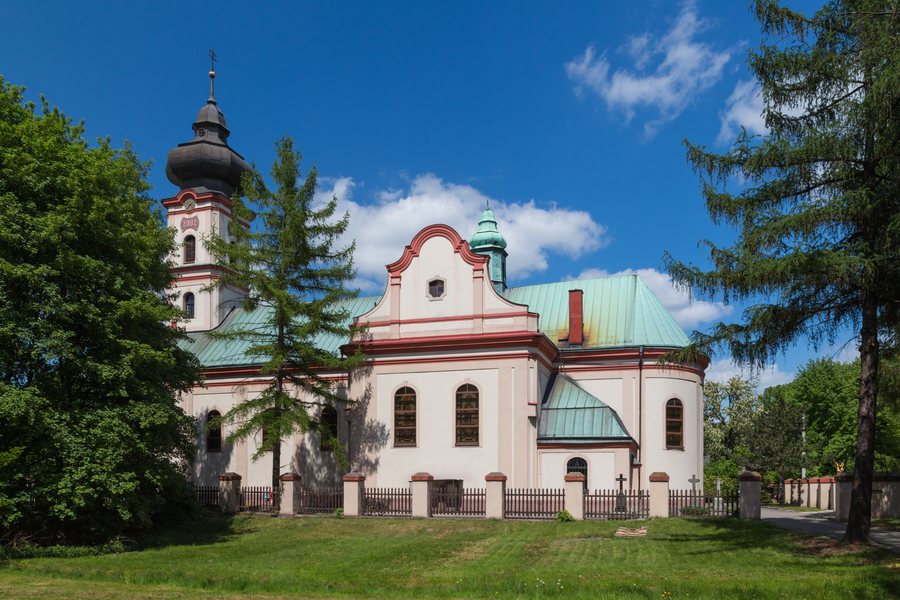 Saint George church in Czerwionka-Leszczyny
Photo: Marcin Konsek via Wikimedia Commons, CC BY-SA 4.0
Saint George church in Czerwionka-Leszczyny
Photo: Marcin Konsek via Wikimedia Commons, CC BY-SA 4.0
Czerwionka-Leszczyny at a glance
In the Leszczyny district, the “Wśród leszczyn i śladów Bartelta” nature and history trail is about 2 km long. The “Śladami Belka” educational trail starts in Bełk and is about 2.5 km long; the 3.5 km educational trail in Palowice ends at the ruins of the “Waleska” ironworks. Historical themes include manor houses and a memorial to 292 Auschwitz prisoners. In Palowice, the route along the Stawy Łańcuchowe also offers insights into aquatic succession and waterbirds.
Which trails have different points of focus?
The “Wśród leszczyn i śladów Bartelta” trail starts at the manor house in Leszczyny, known as the “Zameczek”, and passes through the manor park to a large pedunculate oak. It grows beside a pond and a residential building described as the town hall. At around 2 km, the route is shorter than the “Śladami Belka” educational trail, which is about 2.5 km long. That trail starts in the centre of Bełk. Its destinations are the historic wooden Church of St Mary Magdalene and the “Górka Lukasów” mound, built in 1866.
At 3.5 km, the educational trail in Palowice is the longest of the routes described here. It ends at the ruins of the “Waleska” ironworks beside the Jesionka. The approximate lengths give you an initial basis for comparing the routes; their destinations also differ considerably: the manor park and oak in Leszczyny, the church and mound in Bełk, and industrial ruins in Palowice.
Which historic sites define the area?
The Neoclassical manor house in Leszczyny is known as “Zamek”. Konrad von Bartelt had it built in 1882 on the site of an earlier wooden manor house. The “Wśród leszczyn i śladów Bartelta” trail leads from the so-called “Zameczek” through the manor park, bringing landscape and local history together along the way.
A 19th-century manor house building also survives in the Czerwionka district. It stands in a park with valuable trees, a remnant of the former manor park. In Leszczyny, the Szlak Historii Górnictwa Górnośląskiego also passes a memorial. It commemorates 292 Auschwitz prisoners who were murdered near the Rzędówka railway station in January 1945 during the evacuation of the camp. The historical themes therefore range from architecture and parkland to remembrance of a crime in the history of the camps.
What can you observe at the ponds in Palowice?
Along the Stawy Łańcuchowe, you can observe different stages of aquatic succession and waterbirds from the trail. At the same time, vegetation is changing the appearance of the ponds: some are becoming heavily overgrown with marsh and forest vegetation. This makes this section a different kind of nature experience from trails whose described destinations are mainly buildings or historic sites. Waterbird sightings are not guaranteed.
Discover more destinations: Rybnik, Bełk, Sumina, Piece, Żytna, Zwonowice, Jejkowice, Jankowice Rybnickie.
FAQ
How long is the nature and history trail in Leszczyny?
The “Wśród leszczyn i śladów Bartelta” trail is about 2 km long. It leads from the manor house, known as the “Zameczek”, through the park to a large pedunculate oak beside a pond.
What are the destinations of the educational trails in Bełk and Palowice?
The approximately 2.5 km route in Bełk leads from the centre to the wooden Church of St Mary Magdalene and the “Górka Lukasów” mound. The 3.5 km route in Palowice ends at the ruins of the “Waleska” ironworks.
What nature features can you explore in Palowice?
Along the trail beside the Stawy Łańcuchowe, you can observe different stages of aquatic succession and waterbirds. Some ponds are becoming heavily overgrown with marsh and forest vegetation.
Go to the main travel overview: Rybnik.

