
Discover Pszów: Pilgrimage, cycling routes and mining history
Accommodation in Pszów
Pszów combines an important pilgrimage destination with traces of Upper Silesian industrial history and two cycling routes of different lengths. When planning your trip, you can decide whether religious culture, architecture or a bike ride should take centre stage.
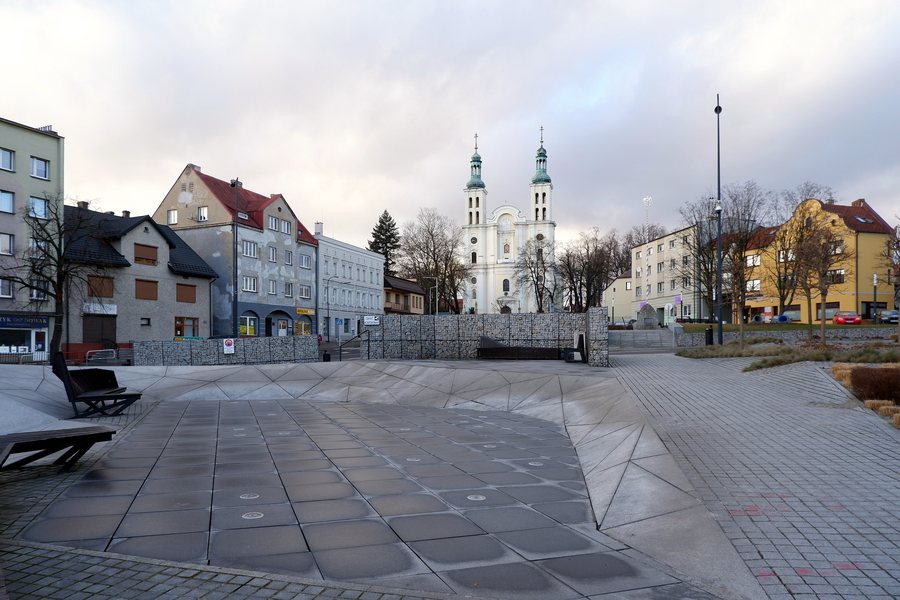 File:Pszów, Rynek (plac św. Jana Pawła II) i bazylika Matki Bożej Uśmiechniętej.jpg
Photo: Kamil Czaiński via Source, CC BY-SA 4.0
File:Pszów, Rynek (plac św. Jana Pawła II) i bazylika Matki Bożej Uśmiechniętej.jpg
Photo: Kamil Czaiński via Source, CC BY-SA 4.0
Key facts about Pszów
The Basilica of the Nativity of the Blessed Virgin Mary is also known as Bazylika Pani Uśmiechniętej and is one of Upper Silesia’s most important pilgrimage destinations. Kalwaria Pszowska comprises fourteen Neo-Baroque chapels. The industrial history is represented by the winding-engine house of the “Chrobry I” shaft and the building of the former directorate of the “Anna” mine. Two cycling routes offer distances of 2.6 and 18 kilometres.
What role does pilgrimage play in Pszów?
For 300 years, the faithful have made pilgrimages to Pszów to pray at the feet of Pani Uśmiechnięta and ask for grace. The icon of Matka Boska Pszowska became an object of great devotion and attracted numerous excursions from Upper Silesia. Pilgrimage is therefore one of the town’s central themes.
Another destination for those interested in religious art is Kalwaria Pszowska. The church complex comprises fourteen Neo-Baroque chapels, whose sculptural compositions depict the individual Stations of the Cross. The chapels and their depictions distinguish this place thematically from the traces of mining and industrial architecture.
What does the industrial architecture tell us?
The winding-engine house of the “Chrobry I” shaft, formerly known as “Rudolf”, was designed by Hans Poelzig. Work began in 1914 and the building was completed in 1916. On 19 November 2015, by a decision of the Silesian Voivodeship Conservator of Monuments, it was entered in the register of immovable monuments of the Silesian Voivodeship under number A/424/15. Its construction history and protected status make it a concrete starting point for exploring industrial architecture.
The building of the former directorate of the “Anna” mine offers another perspective on mining history. It documents both the history of the “Anna” hard-coal mine in Pszów and the history of Upper Silesian industry. At the same time, it is an important example of administrative architecture designed for the management and directorate of a major industrial enterprise. Those interested in the industrial past can therefore visit an administrative building as well as a winding-engine house.
Which cycling routes can you compare?
Black-marked cycle route No. 319 starts at the Basilica of the Nativity of the Blessed Virgin Mary in Pszów and ends at the border with Wodzisław Śląski. It is 2.6 kilometres long. Yellow-marked cycle route No. 323 is also a pilgrimage route: it connects the basilica in Pszów with the wooden Corpus Christi Church in Jankowice. The route is 18 kilometres long and considered easy, so beginners can manage it too.
The two routes described here differ both in length and character: No. 319 is the shorter route, while No. 323 combines cycling with a pilgrimage route and leads to another church. If you are considering a bike ride, take the length of each route into account when planning your day.
What elevation does the Wieża Widokowa Jan offer?
The Wieża Widokowa Jan is over 28 metres tall. Its highest viewing platform is more than 23 metres above the ground.
When looking for accommodation, you can start by deciding whether you want to include pilgrimage, industrial history or cycling in your trip to Pszów. Find more destination pages to help plan your trip under Mszana, Wodzisław Śląski, Radlin, Rydułtowy, Skrzyszów, Borowa, Syrynia and Połomia.
FAQ
What is Pszów known for as a pilgrimage destination?
The Basilica of the Nativity of the Blessed Virgin Mary, also called Bazylika Pani Uśmiechniętej, is one of Upper Silesia’s most important pilgrimage destinations. The faithful have been making pilgrimages there for 300 years.
How long is cycle route No. 323?
Yellow-marked cycle route No. 323 is 18 kilometres long. It is also a pilgrimage route and is considered easy, including for beginners.
When was the “Chrobry I” winding-engine house completed?
Work on the building designed by Hans Poelzig began in 1914; it was completed in 1916.
For the main travel overview: Wodzisław.

_i_bazylika_Matki_Bo%C5%BCej_U%C5%9Bmiechni%C4%99tej.jpg)