
Olszanica: Palace Ensemble, Park and History
Accommodation in Olszanica
Olszanica combines a well-preserved palace ensemble with a landscape park whose visible traces date back to an older fortification. Historical milestones and three Nordic walking routes in the municipality also help you get your bearings.
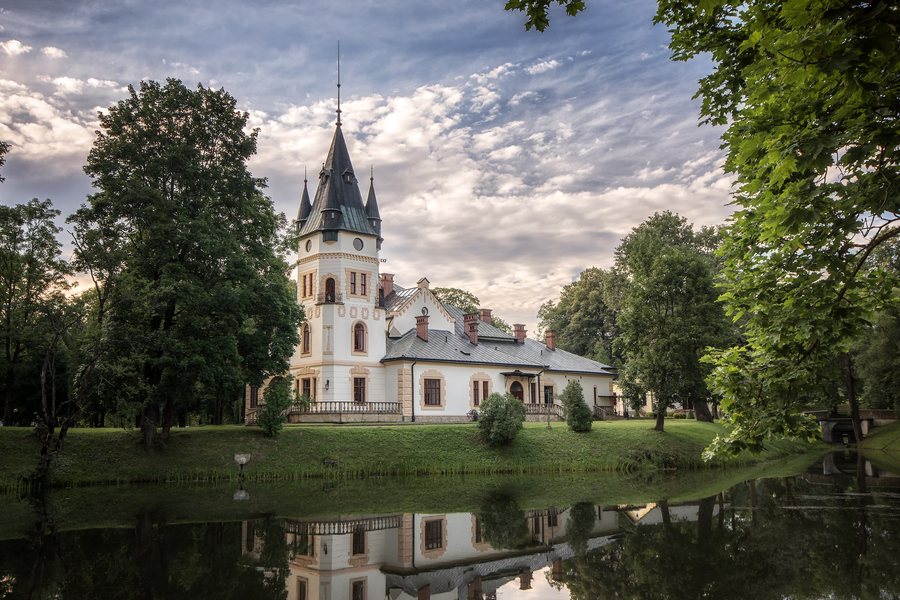
Olszanica at a Glance
The palace ensemble includes an imposing eclectic palace, an outbuilding, a bridge and a park with remains of fortifications. The complex dates back to the 17th century and is one of only a few of its kind in Lesko County. The landscape park was laid out in the 19th century; the municipality’s Nordic Walking Park offers three routes ranging from 4.9 to 9.3 kilometres.
What does the palace ensemble tell us about Olszanica?
The palace is the central building in an ensemble that also includes the outbuilding, bridge and park. Its various elements give the site more than one historical point of reference: the architecture, grounds and remains of the fortification are all part of a unified palace ensemble. Its origins date back to the 17th century; there are only a few complexes of this kind in Lesko County.
The historical records relate to different aspects of the site: in the 15th century, the village belonged to the Kmita family. The first archival references to a manor house in Olszanica date from 1580. The palace was built towards the end of the 19th century on an island surrounded by a moat. The Juścińskis, Olszanica’s last owners, remodelled it in 1905, giving it its present appearance.
What traces can you find in the landscape park?
The landscape park was created in the 19th century on the site of an older fortification. Traces of ramparts, embankments and moats are visible there. These features add the site’s earlier use to the picture of the palace ensemble: the fortification is not just part of its history, but also shapes the description of the park through its visible remains.
Another specific landmark is the upper ponds. The embankments surrounding them are home to the largest pedunculate oak, with a circumference of 610 centimetres. This links the parkland to a precisely identified tree species and a recorded measurement. Visitors interested in landscapes and historic sites can take in these details alongside the palace architecture, without reducing them to a single experience.
How do the Nordic walking routes differ?
The “Gmina Olszanica” Nordic Walking Park has three routes whose lengths and layouts are easy to compare: the green route is a 4.9-kilometre loop, the red route is a 9-kilometre out-and-back route, and the black route is a 9.3-kilometre loop. The green loop is the shortest; the red route goes out and back, while the black loop is the longest.
The starting points are also in different villages in the municipality: routes 1 and 3 can be accessed from Zwierzyń, near a bend in the San River; route 2 starts in Orelec. If your starting point matters, consider these location details as well as the colour and length of each route. The trails complement the cultural and park attractions by offering a distinct way to explore the municipality along designated routes.
Discover more destinations: Werlas, Wańkowa, Żerdenka, Buk, Terka, Zahoczewie, Baligród and Smerek.
FAQ
What is included in the palace ensemble?
It includes the eclectic palace, an outbuilding, a bridge and a park with remains of fortifications.
When were the palace and landscape park created?
The palace was built towards the end of the 19th century and was remodelled in 1905 to give it its present appearance. The landscape park was laid out in the 19th century.
Where are the starting points for the Nordic walking routes?
The starting points for routes 1 and 3 are in Zwierzyń; route 2 starts in Orelec.
For the broader travel overview: Leski.

.jpg)