
Opatów: Old Town, City Gate and Architecture
Accommodation in Opatów
Opatów’s historical highlights include its medieval market square, Brama Warszawska and the Collegiate Church of St. Martin.
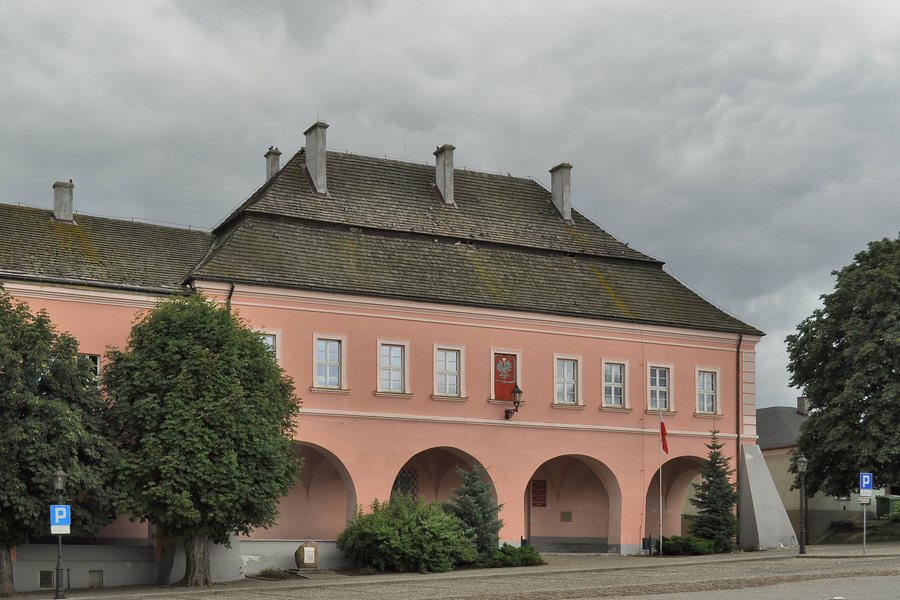
Opatów at a glance
- Brama Warszawska is the only one of Opatów’s four historic city gates to survive.
- The stone gate was built on a square plan between 1520 and 1530.
- The Old Town market square has retained its medieval layout.
- The Collegiate Church of St. Martin is Romanesque in character, with later Gothic, Renaissance and Baroque alterations and details.
What do the market square and city gate tell us about Opatów?
Brama Warszawska is part of the history of the city’s fortifications: it is the only one of the four historic city gates to have survived. Built of stone between 1520 and 1530, it has a square plan. Two specific features stand out: its place in the former defensive system and its clearly identifiable form.
The Old Town market square offers another glimpse into the past, having retained its medieval layout. Together, the square and the gate reveal different aspects of the city’s history: the preserved layout of the old centre on the one hand, and a surviving gate from the former fortifications on the other. If you enjoy learning about places through their architectural development, these details are a useful starting point for exploring Opatów.
The Collegiate Church of St. Martin cannot be attributed to a single period either. It is a Romanesque building that was later altered and embellished with Gothic, Renaissance and Baroque features. This sequence is what makes the church interesting to explore: its Romanesque character and later architectural styles are all part of its history.
What other cultural highlights are there in Opatów?
The Collegiate Church also houses the Lament Opatowski. The bas-relief depicts 40 figures mourning the death of Chancellor Krzysztof Szydłowiecki. It is one of two reliefs on the chancellor’s tomb, which is located on the left side of the transept in the Collegiate Church of St. Martin. Details about the subject, number of figures and location help place the work in the context of a particular tomb and church interior.
Another architectural highlight is the Bernardine Church of the Assumption of Mary and its monastery. The present church is a single-nave, late Baroque stone building, partly constructed of brick. A renovated wall surrounds the church and monastery; it is reinforced in places with buttresses and has loopholes. The complex has a much longer history: the first wooden church was built in 1040 on the site of the settlement of Żmigród at that time. This date refers to the early wooden church, not the present late Baroque building.
The Museum of Geodesy and Cartography complements the architectural and church history with the fields of surveying and cartography. It preserves instruments from the pre-digital era and has nearly 1,000 exhibits, including an extensive collection of cadastral maps. The collection is displayed in multimedia-equipped rooms and in an office furnished in retro style and modelled on that of a licensed surveyor.
What experiences and routes might suit your trip?
The local confectionery tradition may also be part of your travel plans: Krówkarenka offers workshops where you can learn about the artisanal production of “Krówka Opatowska” sweets. Before your trip, check whether a workshop is currently available. This makes it a possible addition to your itinerary without relying on a specific date.
There are several points of reference for cycling trips. The Sandomierz–Opatów cycle route is 34.1 kilometres long and ends in Opatów. A yellow-marked cycle route runs through the Opatówka Valley along roads with light traffic. Opatów itself lies in a valley on the Opatówka. These route descriptions give you concrete points of reference if you are considering cycling as part of your trip.
How can you plan your journey to Opatów?
For road access, Opatów is located at the intersection of National Roads 9 and 74. National Road 9 runs from Radom to Barwinek, while National Road 74 runs from Sulejów to Hrubieszów. In addition, Provincial Road 757 starts in Opatów and runs via Iwaniska and Staszów to Stopnica. These details identify road connections without specifying a particular journey time or distance for your own trip.
If you are looking for hotels in Opatów, you can start by choosing according to the themes that matter to you: historic architecture, church history, the museum or a cycling route. Then compare specific options based on your own needs. The historical and cultural highlights can help you decide what to include in your travel plans.
Discover more destinations: Karsy, Iwaniska, Skolankowska Wola, Wyszmontów, Podole, Ożarów, Ćmielów and Jakubowice.
FAQ
When was Brama Warszawska built?
The stone gate, built on a square plan, dates from between 1520 and 1530. It is the only one of Opatów’s four historic city gates to have survived.
Which architectural styles are reflected in the Collegiate Church of St. Martin?
The church is Romanesque in character, with later Gothic, Renaissance and Baroque alterations and details.
What can you discover at the Museum of Geodesy and Cartography?
The museum preserves surveying and cartography instruments from the pre-digital era. Its collection of nearly 1,000 exhibits also includes numerous cadastral maps.
Could a Krówka Opatowska workshop be part of your trip?
Krówkarenka offers workshops on the artisanal production of the sweets. Before your trip, check whether a session is currently available.
Go to the main travel overview: Opatów.

