
Discover Rasząg: Church, Chapels and Local History
Accommodation in Rasząg
Rasząg offers specific themes to explore during a stay: a Neo-Romanesque fieldstone church, two roadside chapels, and routes connected with lakes and cycling. This allows you to include architectural history, local heritage and the routes described as distinct interests when planning your trip.
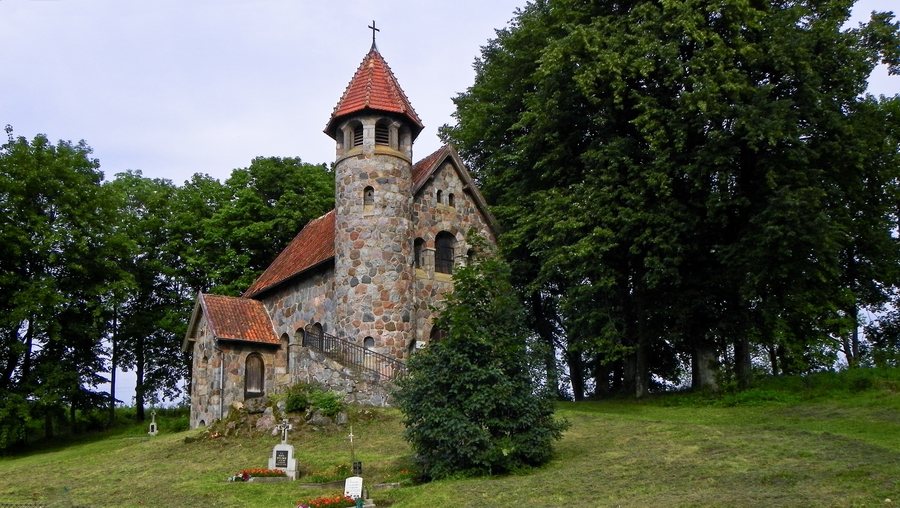 File:Rasząg, kościół ewangelicko-augsburski.jpg
Photo: Alfista33 via Wikimedia Commons, CC BY-SA 3.0 pl
Rasząg at a glance
- The branch church is Neo-Romanesque, dates from the early 20th century and is built of fieldstone. Its shape is reminiscent of a small castle; it has an oval corner tower with a conical roof.
- Two roadside chapels in Rasząg date from the 19th to 20th centuries.
- A route description from 2009 locates a memorial plaque for Jan Liszewski (1852–1894) at the school.
- An older route description mentions a boat landing next to Jezioro Rasząg. An unmarked cycling route runs through Rasząg.
Which buildings define Rasząg?
The branch church brings together several clearly identified architectural features: it is built of fieldstone, has the shape of a small castle and an oval corner tower with a conical roof. The church dates from the early 20th century and is Neo-Romanesque. Anyone interested in architectural forms can consider the material, overall shape and tower as distinct aspects of the same building.
The two roadside chapels add to this architectural picture. They date from the 19th to the 20th century, while the church dates from the early 20th century. In Rasząg, you will therefore encounter buildings with different points of reference in time. The church’s described castle-like shape stands out clearly from the brief description of the chapels as roadside chapels.
What does the memorial plaque tell us about Jan Liszewski?
A route description dated 2009 locates a memorial plaque for Jan Liszewski (1852–1894) at the school in Rasząg. It identifies him as the founder of Gazeta Olsztyńska in 1886 and as a teacher in Rasząg and Bredynki. His biography thus connects the memory of his work as a teacher in both places with the founding of the newspaper.
The years have different meanings: 1852 and 1894 mark Liszewski’s lifespan, 1886 is the founding year of Gazeta Olsztyńska, and 2009 is the date of the route description. This distinction helps put the historical details in context, without confusing the newspaper’s founding year with the plaque or the school.
Which routes and waterside locations are described?
An older route description mentions a boat landing in Rasząg next to Jezioro Rasząg. If the landing is important to your plans, check its condition on site. A route description places Jezioro Rzeckie two kilometres along the access path described. In the surrounding area, it mentions a bathing spot reached via a turnoff onto an unpaved path. Check conditions on site before planning this detour.
There is also a specific route detail for cyclists: a description from 2009 shows the unmarked Biskupiec–Rasząg–Kobułty–Biskupiec cycling route passing through Rasząg. When planning, consider which type of route is relevant to you: the cycling route is described as unmarked, access to the bathing spot is via an unpaved path, and it is advisable to check the condition of the landing before visiting. Check current conditions in each case before planning a ride or detour.
Discover more destinations: Majdy, Gmina Gietrzwałd, Butryny, Przykop, Dywity, Skolity, Stawiguda, Kajny.
FAQ
What is special about the branch church in Rasząg?
The Neo-Romanesque church, dating from the early 20th century, is built of fieldstone. Its shape is reminiscent of a small castle; it also has an oval corner tower with a conical roof.
Where is the bathing spot described?
A route description places Jezioro Rzeckie two kilometres along the access path described. It mentions a bathing spot in the surrounding area, reached via a turnoff onto an unpaved path. Check conditions on site.
What should you bear in mind about the cycling route?
The 2009 route description gives an unmarked cycling route that goes via Biskupiec, Rasząg and Kobułty and returns to Biskupiec. It passes through Rasząg. Check current conditions before setting off.
For the overview of the wider area: Allenstein.

