
Krąg: Podewils Castle, Church and Nature Trails
Accommodation in Krąg
The history of Podewils Castle, the furnishings of the Church of the Annunciation and the marked trails offer specific themes to guide your trip planning. Krąg combines historic architecture with a landscape of parks and lakes.
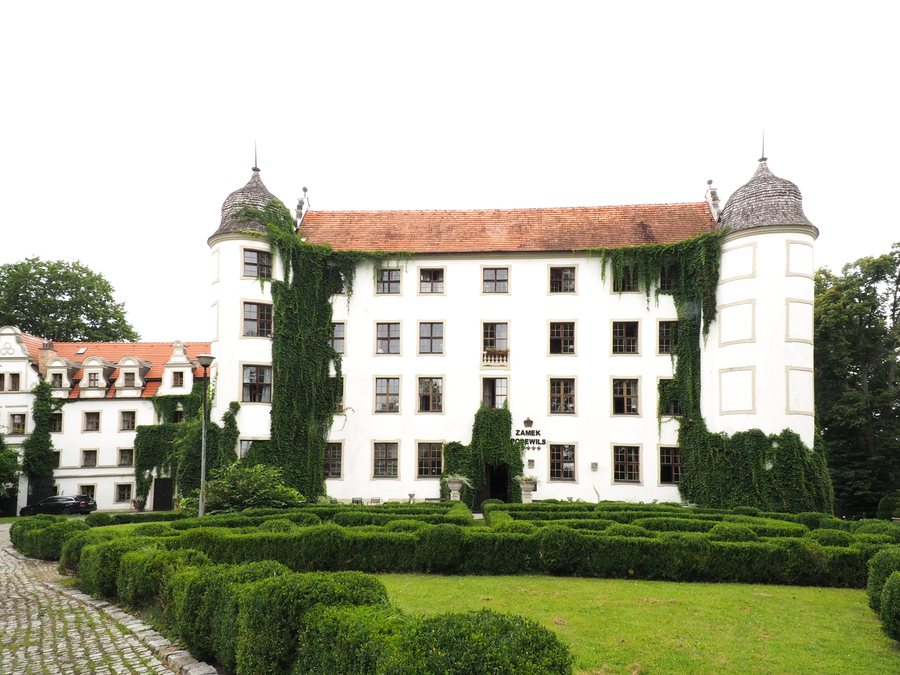
Krąg at a glance
- Podewils Castle was built as a knight’s seat in the early 15th century, rebuilt in 1580 and given its final form at the end of the 19th century.
- The almost circular Jezioro Zamkowe lies north of the castle in the 2.6-hectare historic castle park.
- The single-nave, masonry Church of the Annunciation was built in 1580.
- A riding trail about 113 kilometres long passes through Krąg; other trails in and around the village are also mentioned.
What does Podewils Castle tell you about Krąg’s history?
The castle’s history spans several phases of construction. The Podewils family had it built as a knight’s seat in the early 15th century. In 1580 it was demolished down to its foundations and rebuilt in the Renaissance style. The building took its final form at the end of the 19th century. If you are interested in the development of historic buildings, you can explore these stages as distinct themes while visiting the village.
Before the war, the castle was known as the “Flower Castle” because of its beautiful flower gardens. The park also preserves a 16th-century chapel with Baroque furnishings. Several historic elements thus stand side by side on the castle grounds: the main building’s architectural history, the park and the older chapel.
The historic park covers 2.6 hectares. It extends to the road and the shore of Jezioro Zamkowe, which lies north of the castle. The lake’s almost circular shape complements the clearly described layout of castle, park and water. This makes it possible to understand the surroundings not only through the castle’s architectural history, but also through the relationship between park and lake.
What historic details can you find in the church?
The Church of the Annunciation is single-nave and built of masonry. The owners of the nearby castle had it built in 1580 in a Baroque-Renaissance style. Its older section preserves a rich collection of Renaissance furnishings, including the altar, pulpit, baptismal font and patron’s gallery. These furnishings give the church its own historical perspective, distinct from the castle’s construction phases.
A burial chapel was added to the east side of the church in 1700. It contains the original Baroque sarcophagi of the founders Heinrich von Podewils, who died in 1696, and Adam von Podewils, who died in 1697. The burial chapel thus brings together a precisely dated architectural feature and the preserved tombs of the two founders.
Which trails and landscapes are relevant to trip planning?
Several different trail descriptions are useful for exploring outdoors. The riding trail of approximately 113 kilometres named after Captain Marek Roszczynialski passes through Krąg and connects Biały Bór, Drzewiany, Krąg, Polanów, Staniewice and Jarosławiec. Another marked riding trail runs through the area around Krąg and Komorowo. A further tourist trail connects Wielin, Buszyno, Krąg and Borkowo in the municipality of Malechowo. This is described as a tourist route, without specifying a particular mode of transport.
The nature trails behind the buildings of Podewils Castle Hotel are another specific way to experience the landscape: they start directly behind the buildings and lead to a second, entirely natural forest lake. This trail description can be distinguished from the location of Jezioro Zamkowe in the castle park. If historic architecture is your main priority when planning your trip, the castle and church offer several distinct points of interest; if you would like to include nature and trails, you can also visit the park and lakes and explore the routes mentioned.
For a broader comparison of destinations, you can also consider Krąg alongside the destination pages for Świeszyno, Łazy and Sieciemin. More destination pages are available for Wielin, Dobrzyca, Gozd, Kłos and Sucha Koszalinska.
FAQ
How has Podewils Castle changed over time?
It was built as a knight’s seat in the early 15th century, demolished down to its foundations in 1580 and rebuilt in the Renaissance style. It took its final form at the end of the 19th century.
What is inside the church’s burial chapel?
The chapel, added to the east side of the church in 1700, contains the preserved Baroque sarcophagi of the founders Heinrich and Adam von Podewils. Heinrich’s sarcophagus is made of brass, while Adam’s is made of marble and decorated with sculptures.
Which places does the riding trail through Krąg connect?
The riding trail of approximately 113 kilometres named after Captain Marek Roszczynialski connects Biały Bór, Drzewiany, Krąg, Polanów, Staniewice and Jarosławiec.
For the wider travel overview: Koszalin.

