
Discover Stargard: City Walls, Culture and Hotels
Accommodation in Stargard
Stargard combines medieval city walls, St. Mary's Church and a long history as a town with a walking trail through the Old Town and a cycling route into the surrounding area. When planning your trip, it helps to distinguish Stargard from destinations in Stargard Gmina and nearby places.
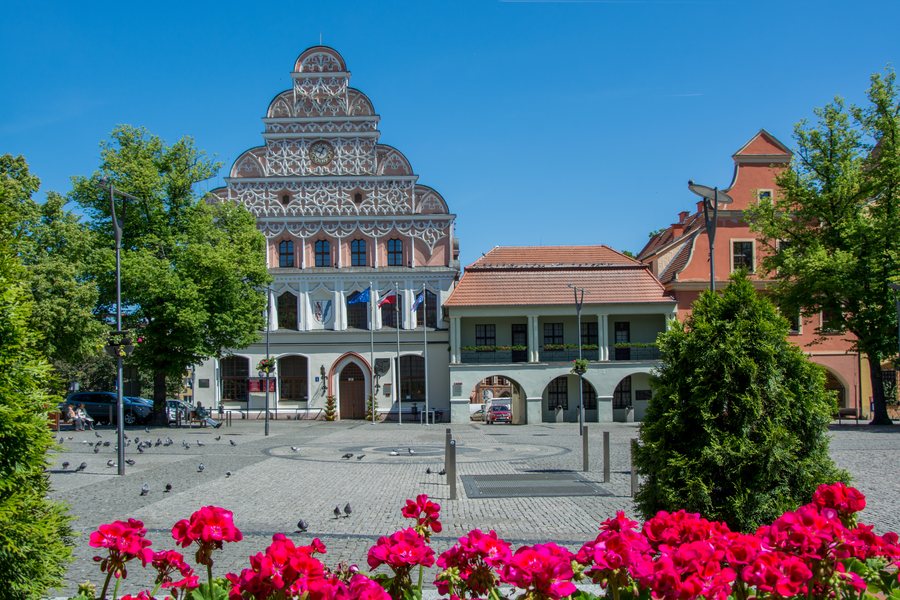 File:Ratusz Miejski w Stargardzie - Nr rejestru zabytku A-1475+A1469.jpg
Photo: Małgorzata Jakubowska via Wikimedia Commons, CC BY-SA 4.0
Stargard at a glance
- St. Mary's Church and the medieval city walls were designated a Monument of History in 2010.
- The city walls have been preserved with fortified gates and bastions along almost their entire length.
- The “Stargard – Jewel of Pomerania” walking trail passes through the Old Town and is about 3 kilometres long.
- A museum exhibition covers the town's history from the 13th century to the beginning of the 18th century.
What do the city walls and museum tell us?
On 17 September 2010, a regulation issued by the President of the Republic of Poland designated St. Mary's Church and Stargard's medieval city walls as a Monument of History. The fortifications are also notable within West Pomerania: only a few examples of medieval urban fortifications in the region have been preserved with fortified gates and bastions along almost their entire length. Thus, the historic character is shaped not just by individual buildings, but by a largely continuous stretch of city walls.
A museum exhibition spans a broad period, presenting the town's history from its founding in the 13th century to the beginning of the 18th century. Together with the view of the fortifications, it offers two different ways to explore the town's history: Stargard's development over several centuries and the surviving elements of its medieval layout.
What routes and events are there?
The “Stargard – Jewel of Pomerania” walking trail passes through the Old Town and is approximately 3 kilometres long. Another option for planning a route is the red “Through the Drumlins of the Stargard Region” cycling route. It runs from Stargard via Lipnik, Zieleniewo, Morzyczyn, Grzędzice, Żarowo, Rogowo and Lubowo, returning to Stargard. While an approximate length is given for the walking trail, the cycling route is described by its course and the places it passes through.
Since 2014, the Archaeological and Historical Museum has organised the “In the Land of the Griffin” Historical Festival as part of Stargard Days, in Piast Park near the bastion. It is considered an event for whole families, history enthusiasts and people looking to spend an active weekend in June.
Which nearby destinations complement a visit to Stargard?
The landscapes also vary across Stargard Gmina: its western part lies in the Pyrzyce Plain, while the eastern part is in the Nowogard Plain. Lake Miedwie, one of Poland's five largest lakes, lies in the west of the gmina. In the eastern part, the Ina and its tributaries, the Krąpiel and Mała Ina, flow through the area. These geographical features are part of the gmina and add regional context to the city of Stargard.
One geological feature in the gmina is the 4.7-hectare Ozy Kiczarowskie reserve. It lies south of Kiczarowo on Road 149 between Stargard and Chociwel and was established in 1962. This inanimate nature reserve comprises glacial sands and gravels that form ridge-like crests and elongated hills. Near Małkocin, about 7 kilometres north of Stargard, lies a disused narrow-gauge railway line from Stargard to Dobra Nowogardzka.
Buildings and works of art are also found across the gmina. Barzkowice Palace is a 19th-century eclectic building, extended in 1911, with Neoclassical and Neo-Renaissance motifs. The village also has a 12.7-hectare park with notable tulip trees; a lime-tree avenue and an elm-tree avenue are recognised as communal natural monuments. The murals in Grzędzice are among the unique and oldest examples of their kind in West Pomerania. In Poczernin stands the Church of St. Michael the Archangel, built from erratic boulders in the 15th century and featuring a wooden tower cupola from 1850. It also houses a late Gothic altar with a crucifix from the 16th century, as well as three Gothic portals.
Further destinations lie nearby. The castle in Pęzino. Pęzino Castle is about 13 kilometres east of Stargard and is considered one of the best-preserved residential and defensive buildings in Pomerania. The Knights Hospitaller built it in its original form around the turn of the 14th and 15th centuries. In Koszewo, on the eastern shore of Lake Miedwie, about 15 kilometres from Stargard, there is an unguarded bathing area.
How do you choose a hotel and a base?
This lets you choose a base that suits your plans without conflating destinations in the city and the gmina.
Discover more destinations: Insko, Dobrzany, Stargard Szczeciński, Rekowo, Żukowo, Granica, Chociwel, Koszewko, Oświno, Brudzewice and Sowno.
FAQ
What is special about Stargard's city walls?
They are among the few medieval urban fortifications in West Pomerania that have been preserved with fortified gates and bastions along almost their entire length. Together with St. Mary's Church, they were designated a Monument of History in 2010.
How long is the “Stargard – Jewel of Pomerania” walking trail?
The walking trail passes through the Old Town and is about 3 kilometres long.
Which destinations lie east of Stargard?
Pęzino lies about 13 kilometres east of Stargard and is home to a historic castle. In Koszewo, on the eastern shore of Lake Miedwie, about 15 kilometres from Stargard, there is an unguarded bathing area.
Go to the main travel overview: West Pomerania.

