
Discover Cunța: Culture, Landscape and Butea
Accommodation in Cunța
Cunța can be explored through specific cultural, landscape and traditional customs. The monument, river course, gentle hills and a Christmas custom offer different ways of discovering the place. People and events with specific dates and locations are also part of this picture.
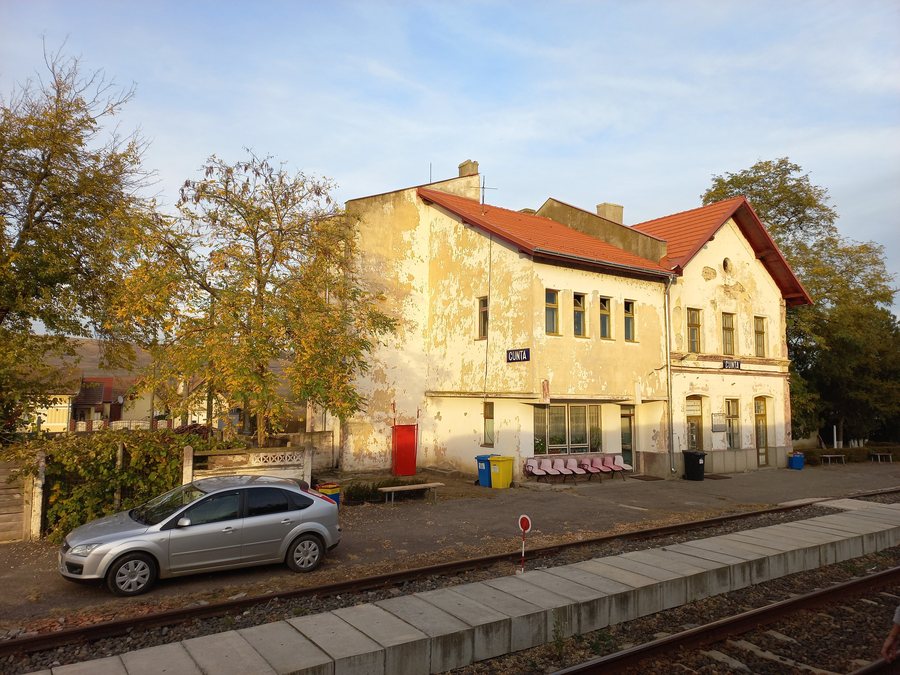 File:Gespreng (Șpring - Cunta)-railway station-01ASD.jpg
Photo: Asurnipal via Wikimedia Commons, CC BY-SA 4.0
File:Gespreng (Șpring - Cunta)-railway station-01ASD.jpg
Photo: Asurnipal via Wikimedia Commons, CC BY-SA 4.0
Culture
One cultural landmark in Cunța is the Albu-Ilie Monument. It commemorates Albu Ilie, who fell in Iași during the Second World War on May 10, 1944. The monument is made of cement and mosaic and is crowned by a cross with rounded arm ends. The combination of personal remembrance, specific materials and a clearly described form gives the structure several historical and design-related points of reference.
Nicolae Muntean, an artist born in Cunța, is another central cultural figure. Muntean is a folk icon painter and, in 2013, received the title “Living Human Treasure” (“Tezaur Uman Viu”) from the Romanian Ministry of Culture. Another cultural reference is linked to a specific date: in 1728, the villagers of Cunța bought a book for their church. There is also a hypothesis that the ancestors of the family of musician Dimitrie Cunțan came from Cunța in Alba County.
The years 1728, 1944 and 2013 help distinguish Cunța’s cultural references chronologically. They represent different contexts: church life, personal remembrance and the recognition of an artist.
Landscape
The Secașul sudic flows through Cunța and empties into the Sebeș River. Gentle hills descend from Vingard via Șpring and Drașov towards Cunța. The spatial setting is therefore defined by a watercourse and a hilly landscape described through several locations.
The transport connections are also clearly specified. County road DJ 106 I runs from Cunța via Șpring and Vingard to Berghin. The Sibiu–Vințu de Jos railway line passes through the southern part of Cunța. The road and railway routes provide different levels of orientation; when planning your own trip, you can consider them separately. The road connects several named locations by land, while the railway places Cunța on a connection between Sibiu and Vințu de Jos.
When comparing hotels in Cunța, travel dates, room category and cancellation conditions can be considered as separate details. They complement Cunța’s local references; the information about the monument, Butea, the watercourse and transport routes addresses different aspects of travel planning.
Traditions
Butea is a Christmas-season custom that has been preserved in Cunța. On Christmas Eve, the young people of Cunța gather in the “oastea Domnului,” choose a leader known as the “primar,” and set out with the “Butea.” In Cunța, the participants in the Butea wear traditional folk costumes and go from house to house.
The custom therefore combines a fixed time, specific terms for the community and its leadership, and a described sequence of events. For personal travel planning, seasonal traditions and permanently visible landscape or cultural features can be considered as separate topics.
For the broader travel overview: Comuna Șpring.

-railway_station-01ASD.jpg)