
Ștei between the Apuseni Mountains and urban history
Accommodation in Ștei
Ștei lies at the foot of the Apuseni Mountains and directly next to Apuseni National Park. The Ștei Depression is crossed by the Crișul Negru River. The transport connections can also be clearly identified: the DN76 runs through Ștei and connects Oradea with Deva; the town is also connected to railway line 316. For route planning, you can consider the road and rail connections as separate points of reference alongside one another.
Culture
The Church of the Holy Apostles Peter and Paul in Ștei was built in 1923. During restoration work between 2008 and 2017, a new iconostasis, a new electrical installation, central heating and new frescoes were added, among other improvements. The Holy Trinity Church in Ștei was built between 1995 and 2006. The first church recorded in Ștei was built around 1780.
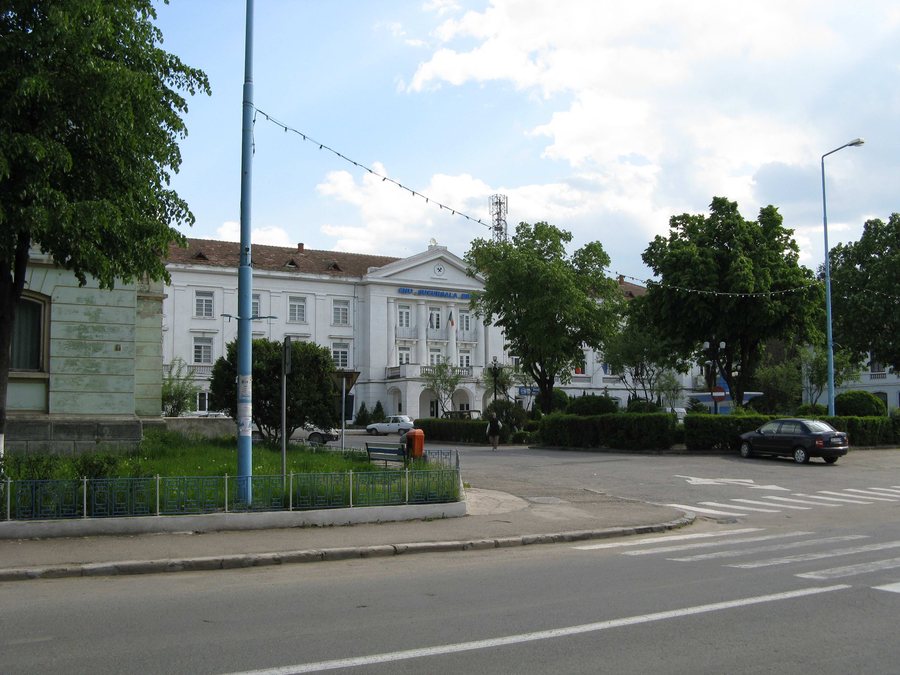
The Community House of Culture is a central element of Ștei’s historic urban ensemble. The building is designed in the neoclassical style with a monumental colonnade. Its foyer contains Corinthian columns and a monumental staircase. A monumental fountain with lion heads stands in the central square in front of the Administrative Palace.
At the opposite end of the main road axis lies the Sports Complex with the Community Swimming Pool; it forms a counterpart to the Administrative Palace. The Sports Complex was laid out in a cross-shaped plan and comprises a central gymnasium and two changing rooms. The Community Swimming Pool has preserved its pool and the adjacent diving board.
History
The standardized B.W. wooden houses are among the defining historic buildings. They were imported from the USSR and built in the 1950s. Ștei is presented as an open-air museum because the town has preserved its original appearance almost completely and displays architecture shaped by the spirit of the 1950s on the eastern edge of the Iron Curtain. The B.W. wooden houses are still considered functional and comfortable today.
The Administrative Palace was formerly the militarized headquarters of the commandant’s office and housed the offices of the managers, engineers and geologists of the Soviet-Romanian company “Sovrom - Kwartit”.
Experiences and townscape
Cycle paths and pedestrian areas have been completed in Ștei’s Unirii, Prieteniei, Mihai Eminescu, Sportului, Cuza Vodă, Andrei Mureșanu, Tineretului and George Enescu streets. The municipal operating regulations for Ștei’s Multifunctional Leisure Centre provide for user access during operating hours upon payment of an admission fee. When choosing a hotel in Ștei, travel dates, room category and cancellation conditions can be considered separately. These three details represent different practical parameters for travel planning and remain independent of the town’s cultural, historical and scenic information.
Other local destination pages are Finiș, Stâna de Vale, Băile 1 Mai, Cordău, Biharia, Sâmbăta, Padiş and Şoimi.
The Casa Memorială “Miron Pompiliu” memorial house in Ștei was acquired by the Ștei town administration from Miron Pompiliu’s descendants after lengthy negotiations.
For the higher-level travel overview: Bihor.

