
Rugi: Church, Watermill and Local History
Accommodation in Rugi
Rugi reveals itself through tangible evidence of architectural history and rural craftsmanship. The “Adormirea Maicii Domnului” Church stands on a hill; today it is situated in an isolated position on the outskirts of Rugi, after the village houses were relocated farther down the slope. Thus, the church building and settlement history stand directly alongside one another. The church’s location is defined by its elevated position, the present-day edge of the village, and the earlier relocation of the houses.
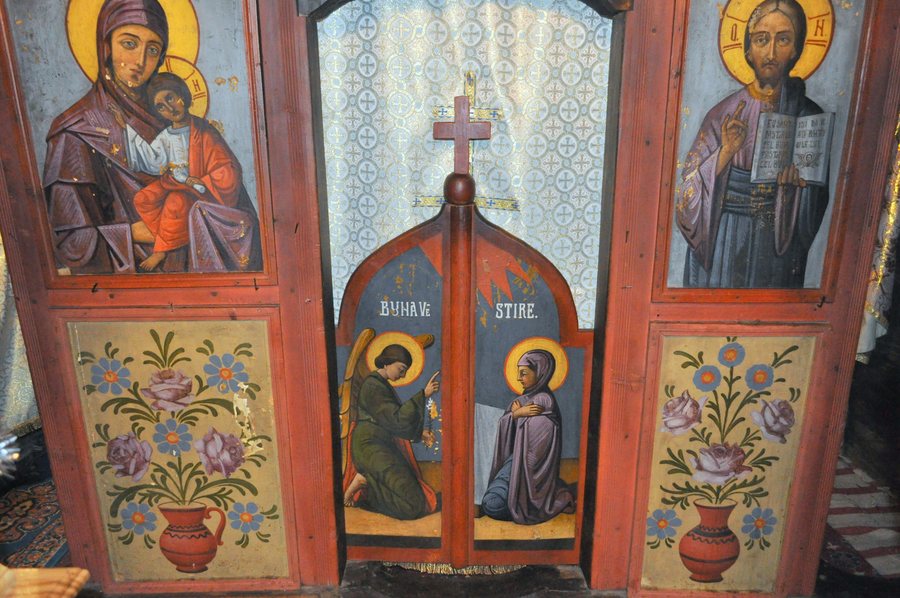 File:RO GJ Biserica de lemn din Rugi (1).jpg
Photo: Țetcu Mircea Rareș via Wikimedia Commons, CC BY-SA 4.0
File:RO GJ Biserica de lemn din Rugi (1).jpg
Photo: Țetcu Mircea Rareș via Wikimedia Commons, CC BY-SA 4.0
Culture
The “Adormirea Maicii Domnului” Church in Rugi was built in 1901. It has a single-nave floor plan with a tower and measures 25 metres in length and 8 metres in width. Following restoration work, it was reconsecrated on 6 July 2011. The single-nave floor plan describes the clear arrangement of the church interior; the tower and dimensions supplement the architectural description with specific structural details. The year of construction, restoration, and reconsecration mark different points in the documented architectural history.
During the second week of the Triodion, spiritual evenings with services and religious talks were held in the Rugi parish. The Rugi parish occasionally organises pilgrimages to monasteries in the country. Rugi is one of the 38 localities in Caraș-Severin County where traditional Rugis take place on 15 and 16 August. The forms mentioned thus range from time-bound parish events and occasional trips to a festival date in August. As independent cultural references, they stand alongside the church building.
History
Rugi was first mentioned in documents in 1517 under its former name, Rusz. The predecessor of the “Adormirea Maicii Domnului” Church in Rugi was an 18th-century church that burned down in 1788 during the Austro-Turkish War. The local and ecclesiastical history therefore includes both an earlier place name and a predecessor building with a documented history of destruction. The present-day church belongs to a later construction phase and is also connected with this earlier ecclesiastical development.
Geographical Setting
DJ 587 runs from Păltiniș on DN 58 through Rugi and other localities to Duleu on DJ 585.
Rural Craftsmanship
The watermill in Rugi is one of the few remaining mills with a vertical water wheel in Caraș-Severin County. The vertical water wheel identifies the mill’s technical design, while its classification among the few surviving facilities describes its documented state of preservation. The church and mill thus represent two different material spheres: a sacred building and water-powered technology.
The type locality of the Formaţiunea de Rugi also includes Dealul Cetăţii in the municipality of Rugi in Timiş County. This geological designation refers to a named location within the municipality and adds another specialist classification to the historical, ecclesiastical, and technical information.
When choosing accommodation in Rugi, travel dates, room category, and cancellation conditions are particularly relevant for personal planning. These details provide a practical framework, while the church, mill, and local history define the content-related focus of the stay.
Other places: Turnu Ruieni, Băile Herculane, Poneasca, Poiana Marului, Brebu, Buchin, Sasca Montană, Bocșa
For the higher-level travel overview: Caraş-Severin.

.jpg)