
Grossau: Discover Culture, River and Mountain Landscapes
Accommodation in Grossau
Grossau combines sacred architectural history, village everyday culture, a river crossing and paths into the mountain landscape. This allows you to get to know Cristian from several different perspectives.
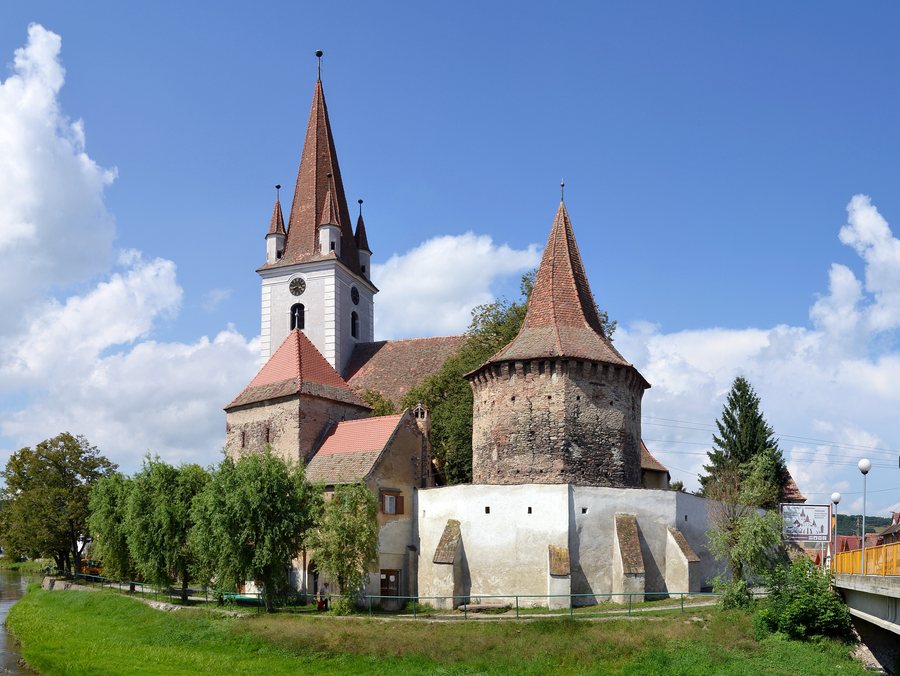
The fortified church stands in the centre of Cristian. In the first half of the 16th century, a peasant fortress with two rings of fortifications and towers was built around the church. This combination of sacred architecture and a defensive complex gives the place a clear historical focus. Cristian is also situated in a depression at the foot of the mountains. For an initial orientation, both the history of the place and the landscape are therefore important: the view is directed not only towards individual buildings, but also towards the location of the town between built-up areas and the mountain world.
What can you see at the fortified church?
Climbing the bell tower of the fortified church allows you to view Cristian from a height of around 63 metres. The approximate height provides a specific reference point for perceiving the town. You see Cristian not only from the perspective of its streets and squares, but can also view the town from an elevated position. Those who like to combine architectural features with an overview of the respective place while travelling will therefore find an individual focal point at this church.
What history does the village museum tell?
The Cristian Village Museum is a historic monument featuring Franconian architecture. It opened on 10 July 1969. The furnished rooms reflect the way of life and activities of the local population. The focus is therefore not only on the external design of the building, but also on the everyday life illustrated by the rooms. The village museum may consequently be particularly interesting if you want to understand a destination through its local way of life and are not looking exclusively for major individual monuments. Architecture and furnishings represent two interconnected levels here: the building points to a Franconian building tradition, while the furnished rooms direct attention to the life and work of the people in Cristian.
Which other churches and architectural forms are part of the townscape?
The Orthodox Buna Vestire Church in Cristian dates from 1790. Its construction date adds another clearly dated chapter of the town’s history to the older fortified church. If you would like to compare different religious and architectural testimonies when planning your trip, Cristian therefore offers more than a single historical perspective. This distinction is especially useful for private travellers who prefer to select cultural destinations on the basis of specific dates rather than generalised judgements.
Casa Drotleff also represents several architectural layers: the building features medieval elements, interpretations of Austrian Baroque and modern extensions. This combination draws attention to changes that can be read in a single building. Casa Drotleff can therefore offer a different approach for selecting cultural sights than the fortified church or the village museum. The focus is not only on a single stylistic classification, but on the coexistence of medieval, Baroque and modern design elements.
What does the river landscape around Cristian offer?
Visitors can cross the Cibin via the Puntea lui Sepp pedestrian bridge. Its location provides views of the river’s meanders. This specific place therefore combines a practical crossing with an opportunity to observe the landscape. If you are weighing up a cultural programme and an experience of nature, the bridge offers its own distinct aspect: here, the Cibin appears not merely as a body of water on a map, but in its winding course. The meanders draw attention to the shape of the landscape and complement Cristian’s buildings with an open setting shaped by the water.
The depression at the foot of the mountains defines Cristian’s basic spatial setting. For travellers comparing destinations according to their interests, this leads to a clear distinction: Cristian is neither merely a place for architectural observation nor exclusively a starting point for exploring the landscape. Churches, the museum, the river and the mountains create different points of emphasis that you can take into account when putting together your personal priorities.
How can you organise your interests in Grossau?
A culture-focused itinerary leads to the fortified church, the village museum, Buna Vestire and Casa Drotleff. Each of these places represents different forms of architectural and everyday history: fortification, Franconian architecture, Orthodox church construction and the combination of several architectural influences. A landscape-focused itinerary, by contrast, directs attention to the Cibin and Cristian’s mountain setting. The two perspectives are not mutually exclusive. Depending on your travel group and the time available, you can decide whether you would primarily like to focus on historic architectural forms, village life, the waterscape or the transition to the mountain world.
For further comparisons with other places, you can also visit Şelimbăr, Sadu, Valea Viilor, Heltau, Tălmaciu, Mohu, Arpaşu De Sus and Șura Mică.
FAQ
When are the livestock markets held in Cristian?
Two livestock markets are held in Cristian every year: on the first Sunday in May and the last Sunday in September. Livestock breeders from the municipality and from Mărginimea Sibiului meet there to sell animals and products from their households.
What is Cristian called in connection with storks?
Cristian is also known as the “Stork Capital of Romania”. This designation identifies a particular association with the place, without specifying a concrete number of storks or a particular nature-related offering.
What architectural influences does Casa Drotleff display?
Casa Drotleff features medieval elements, interpretations of Austrian Baroque and modern extensions. It is precisely the coexistence of these three design levels that shapes the building’s architectural statement.
What has been marked for tourists from the old shepherds’ route?
A section of the old shepherds’ routes has been marked for tourists. The Mărăjdia Valley follows the old route taken by the inhabitants of Cristian into the Cindrel Mountains.
For the higher-level travel overview: Sibiu.

.jpg)