
Nemenikuće: Churches, Monastery and Cultural Heritage at Kosmaj
Accommodation in Nemenikuće
Nemenikuće can be explored through its church and monastery history, the Borikića Watermill and its location in the Kosmaj area. This gives the place a specific cultural focus for planning your trip: sacred architecture, archaeological traces and local heritage can be explored according to different interests.
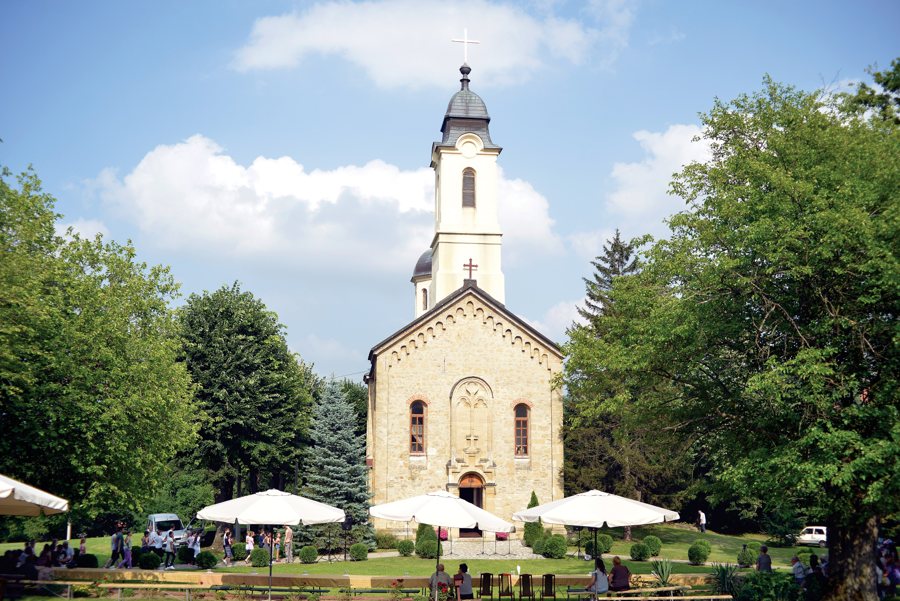
Nemenikuće at a glance
- A historic church was built in 1708; the present church building dates from 1868.
- Kastaljan Monastery lies on the eastern slope of Kosmaj in the Nemenikuće area and is now in ruins.
- The Borikića Watermill was built in 1884 and is among the important protected cultural assets of the Kosmaj region.
- Parts of the cadastral area of Nemenikuće lie within the “Kosmaj” protected area.
How should you understand the church’s history?
The history of the place encompasses several important dates. The historic church was built in 1708 and restored in 1832; services have been held there continuously since that restoration. The present church building was completed in 1868 and dedicated to the Apostles Peter and Paul. The early building history and the construction of the present building thus stand as distinct points in time.
The traditional event “Dani Milovana Vidakovića” is also associated with this church: it takes place in its churchyard on Petrovdan. In 2024, the program concluded with an exhibition by the “Nemenikuće 2024” artists’ colony in the churchyard. This offers a different perspective on Nemenikuće’s cultural history from its enduring architectural and religious history: it is a cultural program tied to a specific date.
What is notable about Kastaljan Monastery?
Kastaljan lies on the eastern slope of Kosmaj in the Nemenikuće area. The monastery, dedicated to Saint George the Great Martyr, is now in ruins. Its church was a stone, single-nave building measuring 12.5 meters long and 6 meters wide. It had a semicircular apse at the eastern end and a rectangular narthex at the western end. “Single-nave” refers to a single main space; the differently shaped ends indicate the building’s orientation.
Archaeological excavations carried out between 1969 and 1971 uncovered a larger monastery complex. In addition to the church, it included a konak, a refectory and the remains of a necropolis. The konak included accommodation for caravans and travelers, which could be used without entering the monastery grounds. This describes a historical function of the complex and is not a statement about present-day accommodation.
What other cultural sites shape the place?
The Borikića Watermill in Nemenikuće was built in 1884 and is considered one of the important protected cultural assets in the Kosmaj area and its wider surroundings. An associated event date is firmly in the past: the “Living Watermill” program was scheduled for September 20, 2024, at the mill in Nemenikuće, at the foot of Kosmaj, at 5 Vuka Karadžića Street.
Another local landmark is the Cleopatra Fountain. It was built in 1856 by order of Prince Aleksandar Karađorđević as a gesture of gratitude to the girls and residents of Nemenikuće. The mill and the fountain thus complement the sacred buildings with two other perspectives on local history: craft heritage and a specific historical event.
How is Nemenikuće connected to the Kosmaj protected area?
Parts of the cadastral area of Nemenikuće lie within the “Kosmaj” protected area. Its northern boundary includes, among other features, the church in Nemenikuće and the Trnava River. This boundary helps clarify the relationship between the place and the protected area: it refers to parts of the cadastral area and a named boundary, not to the entire Nemenikuće area as a whole.
If you are looking for accommodation, you may want to consider Nemenikuće as a destination if you are particularly interested in church and monastery history and local cultural heritage. These historical themes offer a concrete point of reference for matching the place to your own travel interests.
Discover more destinations: Zemun, Sremčica, Sopot, Dobanovci, Babe, Belgrade, Jakovo and Železnik.
FAQ
When was the present church building completed?
The present church building in Nemenikuće was completed in 1868 and dedicated to the Apostles Peter and Paul. A historic church at the site had already been built in 1708 and was restored in 1832.
What are the architectural features of the church at Kastaljan Monastery?
It was a stone, single-nave building measuring 12.5 meters long and 6 meters wide. It had a semicircular apse to the east and a rectangular narthex to the west.
When does “Dani Milovana Vidakovića” take place?
The event traditionally takes place on Petrovdan in the churchyard of the Church of the Holy Apostles Peter and Paul in Nemenikuće at Kosmaj. In 2024, the program there concluded with an exhibition by the “Nemenikuće 2024” artists’ colony.
What was uncovered during the excavations at Kastaljan?
Between 1969 and 1971, excavations uncovered a complex comprising a church, a konak, a refectory and the remains of a necropolis.
For the broader travel overview: Belgrade.

