
Discover Sughd: Culture, Mountains and Lakes
Accommodation in Sughd
Sughd is a region for travelers who want to combine cultural history, landscapes and personal interests. Sarazm, the structures of Khujand and Istaravshan, Iskanderkul and high-altitude lakes offer different focal points. This gives you a versatile basis for deciding how to balance culture, nature, activity and regional characteristics in your personal travel plans.
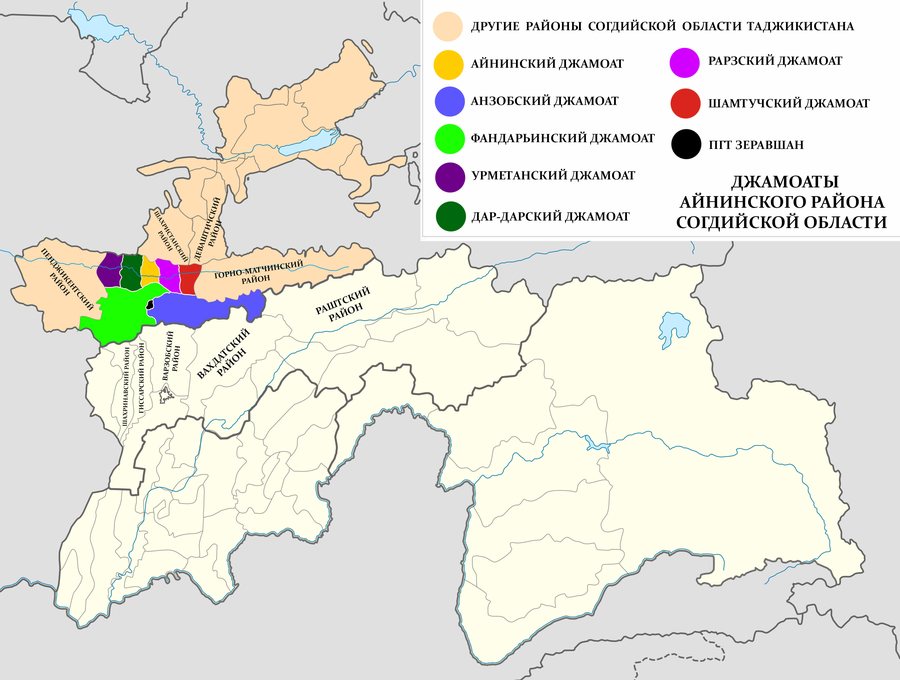 File:Jamoats of the Ayni District of the Sughd Region of Tajikistan.jpg
Photo: Mikhail Mezentsev via Wikimedia Commons, CC BY 4.0
File:Jamoats of the Ayni District of the Sughd Region of Tajikistan.jpg
Photo: Mikhail Mezentsev via Wikimedia Commons, CC BY 4.0
Sarazm represents early trade and cultural contacts, while places such as the Arbob Cultural Palace, Kok-Gumbaz and the Rudaki Historical Museum make different chapters of regional history visible. In terms of landscapes, the examples range from the deep waters of Iskanderkul and the Seven Lakes to bodies of water shaped by glacial melt.
Which cultural sites shape Sughd's character?
The Proto-urban Site of Sarazm was added to the UNESCO World Heritage List in 2010. It dates from the 4th and 3rd millennia BC and has borne witness since the 4th millennium to trade and cultural exchange between the nomadic pastoral peoples of the mountains of Central Asia and the agricultural peoples of Transoxiana. Sarazm is therefore a concrete example that the region's history was shaped not only by individual settlements, but also by connections between different ways of life.
The fortress of Khujand has a history closely linked to the Great Silk Road. The Arbob Cultural Palace provides a different architectural accent: it was built on Arbob Hill in the 1950s, modeled on Peterhof Palace and incorporating elements of Tajik architecture. The museum in the Arbob Cultural Palace presents exhibitions on the region's history and the lives of its inhabitants. Together, these sites offer different approaches to the past: an early settlement, a fortress connected to the Silk Road and a 20th-century cultural palace.
The design of the Arbob Cultural Palace is also part of the visiting experience. Visitors can stroll along shady avenues, admire fountains and view sculptures. In the old town of Istaravshan, artisans continue centuries-old traditions of woodcarving and metalworking in open workshops. Fresh fruit and spices are sold at Panjshanbe Bazaar. Those who want to experience not only historic buildings but also craftsmanship and regional everyday culture will find several clearly distinct points of interest here.
Which landscapes can be included in your plans?
Iskanderkul combines a specific size with a distinctive watercourse. The lake covers 3.4 square kilometers and is 72 meters deep. The Iskandardarya flows out of Iskanderkul and forms a 38-meter-high waterfall. This combination of lake, river and waterfall works as a distinct landscape focus within a trip, without requiring a particular trip duration or route.
The Seven Lakes are a group of seven high-altitude lakes at approximately 3,000 meters above sea level. The approximate elevation is important because it describes the character of this landscape as a high-mountain region without claiming an exact shared altitude. The Kulikalon Lakes were formed by glacial melt and are part of a unique ecosystem. Both examples represent waterscapes whose impact derives not only from the individual lake, but also from elevation, formation and natural context.
The Yagnob River is fed by meltwater from glaciers. For your personal selection, you can therefore distinguish between focusing on the measurable dimensions of Iskanderkul, a group of high-altitude lakes, an ecosystem shaped by glacial melt or a river fed by glacial water.
Which experiences complement culture and nature?
At the Arbob Cultural Palace, architecture combines with a more leisurely form of sightseeing: shady avenues, fountains and sculptures make the grounds a place where you can experience the cultural palace as more than just a building. The museum adds to this impression with exhibitions on the region's history and the lives of its inhabitants. This allows the same place to be experienced from several perspectives without reducing its cultural significance to a single attraction.
The different types of landscapes in Sughd also allow you to plan a trip around your interests. Those interested in culture can view Sarazm, Khujand, Arbob and Istaravshan as different historical points of access. Nature enthusiasts will find equally varied subjects in Iskanderkul, the Seven Lakes, the Kulikalon Lakes and the Yagnob River. For couples or families with several interests, this range can help establish shared priorities without giving every day of the trip the same type of experience.
What regional orientation is helpful for planning?
The Dushanbe–Panjakent route is one of the routes regularly operated by travel companies to Tajikistan's tourist areas. Your choice of accommodation should match your chosen focus; however, the destinations discussed here do not provide a basis for determining specific features, distances or availability of individual hotels.
For additional regional orientation, you can visit the pages on Panjakent, Panjakent, Shughnon, Chkalovsk, Kairakkum, Ghafurov and Khujand. If you want to compare destinations beyond Sughd, Gorno-Badakhshan also offers another regional perspective.
FAQ
What is known about Kok-Gumbaz?
Kok-Gumbaz is an architectural complex with a mausoleum, a mosque and a madrasa. Kok-Gumbaz is believed to have been built in the 15th century; the exact construction date is unknown. The dome is decorated with geometric patterns and Arabic inscriptions.
What is the significance of Panjakent and the Rudaki Historical Museum?
The ancient settlement of Panjakent is a cultural monument from the pre-Islamic Sogdian period, dating from the 5th to the 8th century. The collection of the Rudaki Historical Museum includes artifacts from the Sogdian, Islamic and Soviet eras.
Which activities are possible in the Yagnob Valley and at the Kayrakkum Reservoir?
In the Yagnob Valley, you can go hiking, horseback riding and mountaineering. At the Kayrakkum Reservoir, you can plan activities such as water skiing, kitesurfing, windsurfing and fishing.
For the higher-level travel overview: Tajikistan.

