
Goranxi: Monasteries, Gorge and Prehistoric Traces
Accommodation in Goranxi
Goranxi combines sacred buildings, a striking gorge and traces of human use from prehistoric times through the Roman period. The village is one of the significant villages of Dropull and Pogon, preserving traditional architectural features as well as characteristic churches and residential buildings of the southern region.
Culture
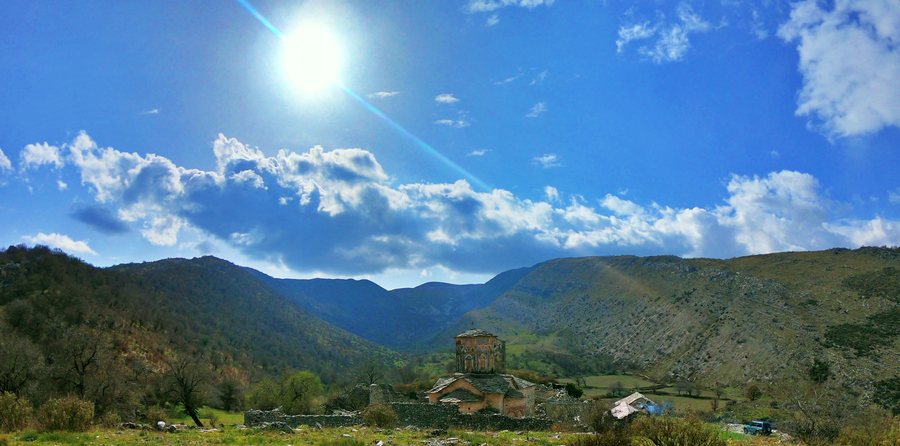
The main church of Goranxi is the Church of Saint Mary of Ravenjë, built around 1600. The Church of Saint Mary's Monastery is also located in the village and was built in 1600 by the hieromonk Christopher. An inscription above the western gate inside the narthex confirms the year of construction. The church was painted in 1600 and consists of a nave, a narthex and an exonarthex. Four columns with plant-decorated capitals form a square central space beneath a dome on a tall drum.
Saint Mary's Monastery has served for centuries as a place of pilgrimage for believers from the surrounding area and bears witness to the continuity of the Orthodox faith and Orthodox tradition in this region. It is a Category I cultural monument. A fountain in a rock cave near Saint Mary's Monastery also has this status. In the area around the Goranxi Gorge, there is also a small Late Byzantine church with frescoes on a hill near the mouth of the gorge.
Nature
The Goranxi Gorge lies immediately north of the village and cuts dramatically into the mountainside. Its rock shelters were used during the Upper Paleolithic and Mesolithic periods to produce flint tools. Many thousands of flint flakes have been found in the gorge; the prehistoric flint pits are visible on the northern gorge wall. Among the remains of the ancient flint-working sites near the Goranxi Gorge are stone dwellings from the Hellenistic and Roman periods.
Hiking
The hiking activity “Ravena Monastery: A Hike Through History & Nature” begins with transport by vehicle in the direction of the village of Goranxi. The hike to Ravena Monastery follows an easy route into a dry stream bed surrounded by two massive rocks. The ascent gains about 300 metres in elevation to a small plateau overlooking the Drino Valley.
The ascent to Ravena Monastery passes through Mediterranean shrubland and an area with mountain tea, sage, oregano, lemon balm, lavender and wild rose. The route passes a karst massif that closes off the gorge to the north and is considered one of the rarest natural attractions in the Drino Valley. The church of Ravena Monastery is located 300 metres above the village of Goranxi in the Dropull area. The Ravena Monastery complex was surrounded by stone walls.
When planning a stay in Goranxi, a straightforward comparison of hotel offers can be helpful. Travellers can also compare included services, individual price components, and booking and cancellation conditions. By carefully weighing travel costs, they can determine which services are included in the price and which additional conditions apply. You can then view and compare offers for Goranxi.
More destinations
Other destinations for the regional selection include Gjirokastër, Përmet, Sheper and Peshtan.
For the overarching travel overview: Gjirokastra County.

