
Ostrov Nad Ohří: Hotels and Accommodation
Accommodation in Ostrov Nad Ohří
The Zámek Ostrov complex originated from a fortified town castle that Kašpar Šlik had converted into a Renaissance château around the turn of the 15th and 16th centuries.
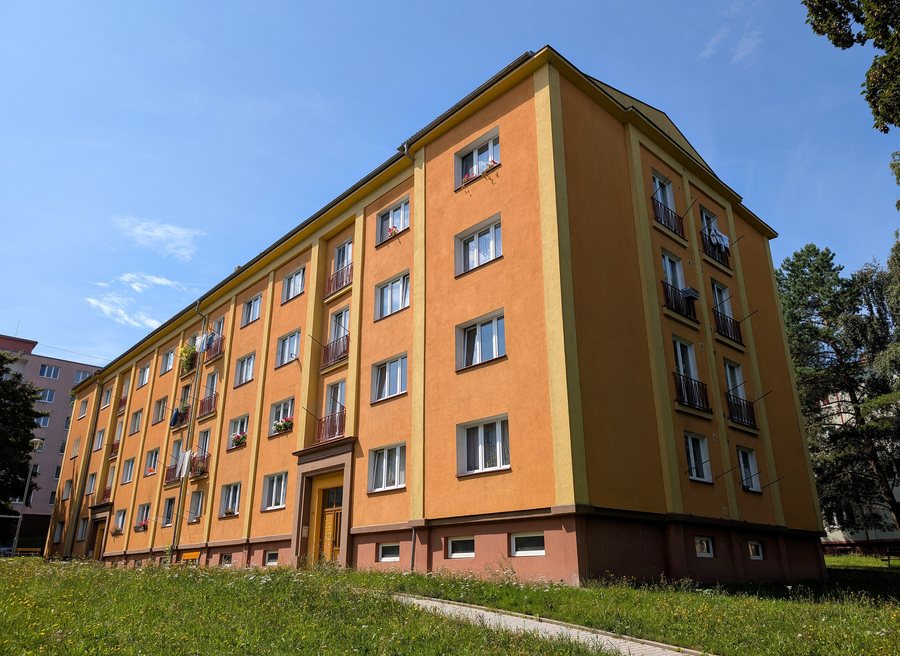 File:Panelový dům soustavy G32 (Ostrov nad Ohří).jpg
Photo: CsuklosTrolibusz via Wikimedia Commons, CC BY-SA 4.0
File:Panelový dům soustavy G32 (Ostrov nad Ohří).jpg
Photo: CsuklosTrolibusz via Wikimedia Commons, CC BY-SA 4.0
Culture and History
In the Dvorana at Zámek Ostrov, visitors can access an exhibition on the history of the château as well as an exhibition on Ostrov porcelain from the once-famous, now defunct Pfeiffer and Löwenstein Schlackenwerth porcelain manufactory. In the Klášter Ostrov – Posvátný okrsek monastery grounds, all buildings except the monastery convent are now open to the public and serve as museum exhibitions.
The Letohrádek Ostrov houses a branch of the Galerie umění Karlovy Vary, which presents works by Czech artists in temporary exhibitions, predominantly from the first half of the 20th century. Letohrádek Ostrov also houses a permanent porcelain exhibition whose collection documents porcelain production from its beginnings in the 19th century through the second half of the 20th century. Letohrádek Ostrov is open seasonally from May to October.
Stará radnice Ostrov is a Gothic-Renaissance building in the historic city centre on Staré náměstí. The “Clock Movements and Mechanisms” exhibition at Stará radnice Ostrov displays clock movements whose history dates back to the 16th century; regular exhibitions by local and regional artists are also held there.
Nature
Borecké rybníky consists of a group of nine ponds created in the 16th century, originally used for fish farming and irrigating the surrounding fields. Today, it is a protected natural monument offering opportunities for walking and sports, as well as an educational trail.
Zámecký park forms part of the grounds of Zámek Ostrov, Palác princů and Letohrádek, extending on both sides of the Jáchymovský potok stream. It is particularly inviting in spring and summer for walks and relaxation on benches or on the grass.
Additional Insights
In the nearby area, in Dolní Žďár u Ostrova, Rudá věž smrti is a national cultural monument of the Czech Republic and commemorates the period of intensive uranium ore mining in the Jáchymov area after the Second World War. Visits are possible by prior arrangement with the owner, the Confederation of Political Prisoners of the Czech Republic.
Other Places
Welchau, Töppeles, Landeck, Neu Rohlau, Gängerhof, Gießhübel B. Buchau, Schönwald, Großfürwitz
For the higher-level travel overview: Karlovy Vary District.

.jpg)