
Császártöltés: Festival and Vörös-mocsár
Accommodation in Császártöltés
In Császártöltés, a recurring festival rooted in Swabian-German tradition meets the nature and cultural themes of Vörös-mocsár. Here you can find guidance on visiting conditions and ideas for placing the town and other destinations within the wider Bács-Kiskun travel destination in context.
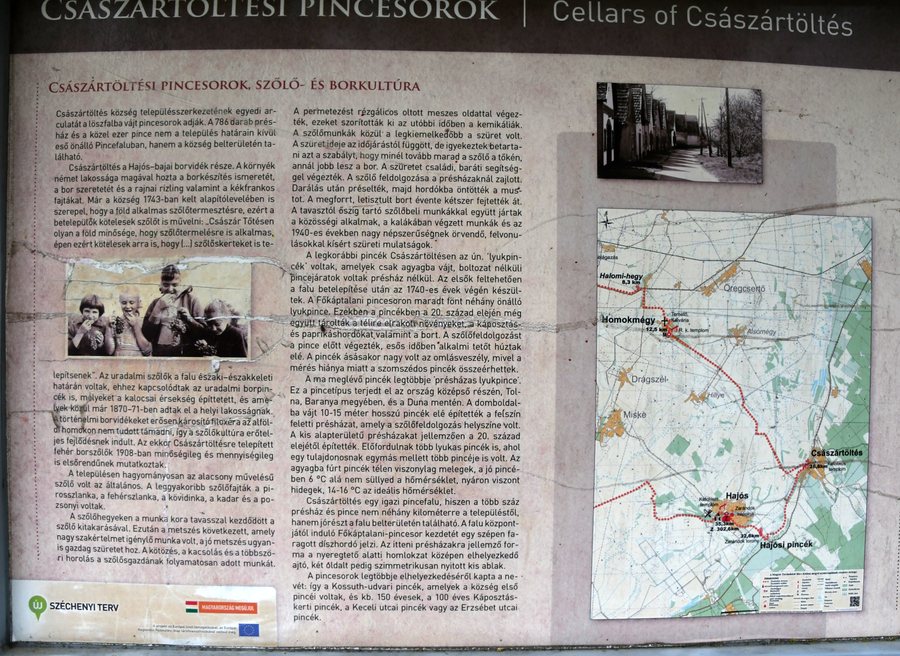 File:Császártöltés, főkáptalani pincesor 2022 07.jpg
Photo: Pasztilla aka Attila Terbócs via Source, CC BY-SA 4.0
File:Császártöltés, főkáptalani pincesor 2022 07.jpg
Photo: Pasztilla aka Attila Terbócs via Source, CC BY-SA 4.0
Quick facts about Császártöltés
- In 2026, the Sváb Ételek Fesztiválja will be held in Császártöltés for the sixth consecutive year.
- The festival showcases typical foods, drinks, and customs of Hungary’s German minority communities.
- Vörös-mocsár can be dangerous for visitors unfamiliar with the area. Visits are recommended only along the designated route or with an expert guide.
- The Vörös-mocsár tanösvény presents the area’s history and wildlife, the fishing culture typical of the region, and land use in Őrjeg.
What can you experience in Császártöltés?
The Sváb Ételek Fesztiválja combines food and drink with the customs of Hungary’s German minority communities. Its focus is therefore not limited to cuisine: traditions and community customs are also part of the festival. In 2026, the festival will take place in Császártöltés for the sixth consecutive year. If you want to plan your visit around a specific event date, check the latest festival dates before making plans.
A second focus is Vörös-mocsár. The local educational trail covers both the area’s history and wildlife and the fishing culture typical of the landscape, as well as land use in Őrjeg. This lets you explore nature alongside the history and use of the landscape. Bear the visitor guidance in mind: the area can be dangerous for visitors unfamiliar with it, so only the designated route or an expert-guided tour is recommended. Plan your visit with this restriction in mind.
What other themes does Bács-Kiskun offer?
The wider Bács-Kiskun travel destination also offers cultural and nature-related themes to suit other interests. In Tiszaalpár, the Tiszaalpár, Földvár educational trail presents the history of the Bronze Age fortification and the way of life of people in the Bronze Age. A reconstruction of an Árpád-era village shows the settlement layout discovered during local excavations. Tiszaalpári Földvár is also a specially protected archaeological site in Bács-Kiskun; it received this designation under Decree 3/2003. (I. 25.) NKÖM.
Another cultural attraction is the Kiskunhalasi Csipkeház és Csipkemúzeum, where visitors can learn about the history of Halas lace, which began in 1902, admire lacework dating back centuries, and see the lace-embroidering process. In Kecskemét, Cifrapalota currently serves as an exhibition venue for the Kecskeméti Katona József Museum. Those interested in nature education can visit the Kiskunság National Park visitor center at Természet Háza in Kecskemét. It provides information about educational trails, visiting conditions in protected areas, ecotourism programs, and forest schools.
The landscape and how it is interpreted offer a range of options, too: Lake Szelidi is a natural oxbow lake that developed from a branch of the Danube after the Ice Age. An educational trail about the lake’s blue-green algae is accessible year-round on foot and by bicycle; its twelve information stations cover the lake’s development, the properties of its water, the organisms living there, and the surrounding wildlife. The Boróka educational trail in Bugac is 1,100 meters long and combines information boards with interactive stations such as a forest xylophone and a toy telescope.
How do you choose suitable destinations and accommodation?
The themes associated with Császártöltés and the examples from Bács-Kiskun can be distinguished by your interests: the town focuses on festival traditions and the history, wildlife, and landscape use of Vörös-mocsár; other places mentioned offer, among other things, archaeology, lace art, and nature education. If you plan to explore several of these themes, treat the places mentioned as separate itinerary stops and choose accommodation based on the locations you actually want to visit. If you plan to attend the festival, it is also a good idea to check the event date before booking.
Explore more destinations: Fülöpszállás, Akasztó, Bócsa, Soltvadkert, Kecel, Körösch, Izsák and Tabdi.
FAQ
What is showcased at the Sváb Ételek Fesztiválja?
The festival showcases typical foods, drinks, and customs of Hungary’s German minority communities. In 2026, it will be held in Császártöltés for the sixth consecutive year.
What should visitors unfamiliar with Vörös-mocsár keep in mind?
The area can be dangerous for visitors unfamiliar with it. Visits are therefore recommended only along the designated route or with an expert guide.
What themes does the educational trail in Vörös-mocsár cover?
The Vörös-mocsár tanösvény covers the area’s history and wildlife, its typical fishing culture, and land use in Őrjeg.
What nature-related themes does Lake Szelidi offer within the wider Bács-Kiskun travel destination?
The lake is a natural oxbow lake that developed from a branch of the Danube after the Ice Age. The educational trail about blue-green algae, accessible year-round on foot and by bicycle, has twelve information stations about the lake, its water, organisms, and wildlife.
View the wider travel overview: Kiskőrösi.

