
Discover Balatonszabadi: history and vineyards
Accommodation in Balatonszabadi
Balatonszabadi combines historical landmarks with a landscape shaped by viticulture. The town offers several clear points of interest to help you plan your trip: a Kossuth statue of particular significance, a Reformed church with historic furnishings, and the ruins of Pusztatorony.
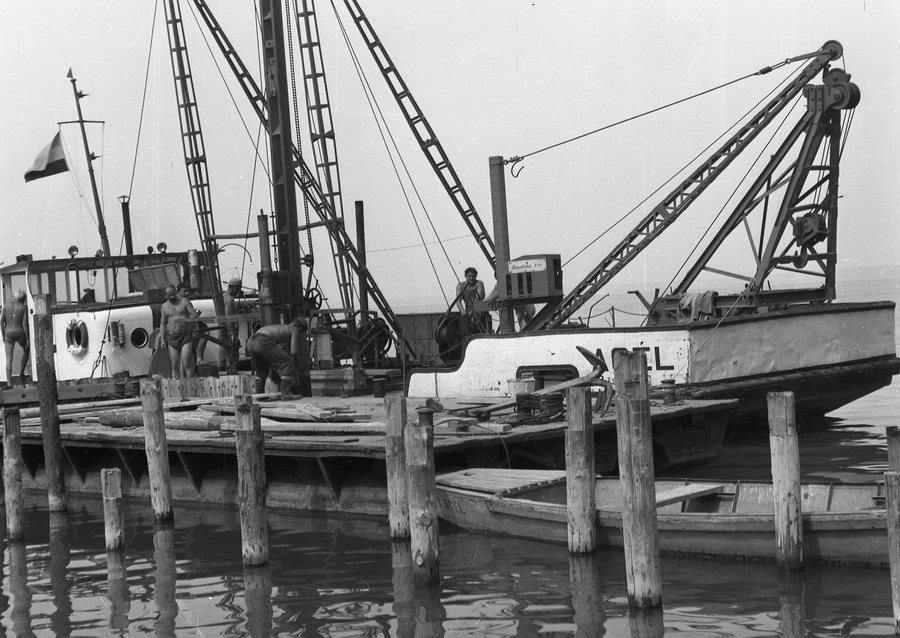 File:Balatonszabadi, az Acél nevű cölöpverő hajó. Fortepan 29477.jpg
Photo: FOTO:Fortepan — ID 29477 : Adományozó/Donor: Korenchy László. via Source, CC BY-SA 3.0
Balatonszabadi at a glance
- The Kossuth statue in Siómaros was unveiled in 1894 as Hungary’s first public statue of Kossuth and was built with voluntary donations from local residents.
- The Reformed church was built in 1800 and preserves furnishings from the late 18th century.
- Near Pusztatorony, the ruins of a medieval church stand on a prominent hill.
- Four vineyard areas lie outside the town: Külső-hegy, Öreg-hegy, Józan-hegy and Pusztatorony.
Which historical landmarks define the town?
The statue commemorates Lajos Kossuth and the public recognition he received in the 19th century. It was brought to Siómaros on 26 June 1894; Siómaros is now part of Balatonszabadi. The statue still stands at the junction of Kossuth Lajos utca and Enyingi utca, facing Enying. The fact that local residents financed its construction through voluntary donations also gives the monument a local connection.
The Reformed church in Balatonszabadi offers a different glimpse into history. A Reformed church was built in Siómaros in 1800. Its furnishings include a Moses pulpit, a brick pulpit and pews dating from the late 18th century. The church is protected as a historic monument and is considered one of the municipality’s most significant historic and religious buildings. Here, a building from the early 19th century stands alongside furnishings from an earlier period.
At Pusztatorony, the ruins of a single-nave medieval church stand on a hill that rises noticeably above its surroundings. The church is dated to the mid-12th century and had a semicircular apse. It was 20 metres long and 5 to 6 metres wide. At Pusztatorony, the focus is on the form of a church building; at the Reformed church, on its furnishings; and at the statue, on the memory of a person.
How do the historical landmarks differ?
The historical landmarks span several periods: the medieval church at Pusztatorony, the Reformed church’s furnishings from the late 18th century, the church building of 1800 and the Kossuth statue of 1894. This sequence offers a simple way to orient yourself if you are interested in different eras. The landmarks also differ in type: Pusztatorony is described as a ruin, the Reformed church is notable for its furnishings and protected status, and the statue for its unveiling and present location.
What role do the vineyards play?
The cultural landscape is also part of the town’s character: outside Balatonszabadi lie Külső-hegy, Öreg-hegy, Józan-hegy and Pusztatorony, four vineyards or vineyard areas. Viticulture continues to be significant there. This adds an agricultural dimension to the historic buildings. If you are weighing cultural history against landscape when planning your trip, these offer two different local perspectives.
What does the wider South Balaton region offer?
The wider South Balaton destination includes other landscapes that you can consider separately from Balatonszabadi’s local attractions. The Zselici Tájvédelmi Körzet (Zselic Landscape Protection Area) received the International Dark Sky Park title in 2009 because of its low light pollution; the Zselici Csillagpark was established in the heart of the protected area. Somogy County includes Kis-Balaton, Zselici Tájvédelmi Körzet, Barcsi Ősborókás and Babócsai Basakert, among other places. Baláta lies between Kaszó and Szenta and is among Somogy’s especially valued natural assets.
The wider Dráva network for active tourism offers another regional perspective: its section in Somogy County includes stops for water tourism. Individual facilities may change during development.
Discover more destinations: Sosto, Nagyberény, Som, Töreki, Balatonszéplak, Zamárdi, Siofok and Ságvár.
FAQ
Where is the Kossuth statue?
It stands in Siómaros at the junction of Kossuth Lajos utca and Enyingi utca, facing Enying.
What is known about the Reformed church?
A Reformed church was built in Siómaros in 1800. Its surviving furnishings from the late 18th century include a Moses pulpit, a brick pulpit and pews.
How large was the church at Pusztatorony?
The single-nave medieval church was 20 metres long and 5 to 6 metres wide. Its ruins stand on a hill that rises noticeably above its surroundings.
For the wider travel overview: Siófoki.

