
Plungė
Accommodation in Plungė
Plungė combines a park with cascade ponds and old trees with distinctive buildings and a rich cultural history. If you are looking for a hotel in Plungė, these places offer a concrete sense of the themes you can include in your trip.
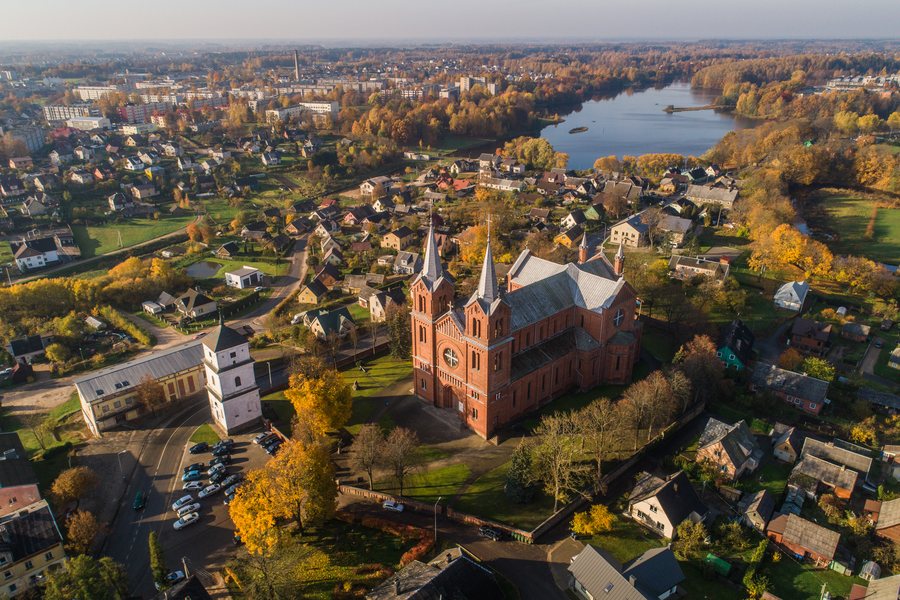 Plungė St John the Baptist church building complex and Lourdes replica with a sculpture of the Holy Virgin Mary 34-P
Photo: Žemaitijos kelias via Source, CC BY-SA 4.0
Plungė St John the Baptist church building complex and Lourdes replica with a sculpture of the Holy Virgin Mary 34-P
Photo: Žemaitijos kelias via Source, CC BY-SA 4.0
Key facts about Plungė
The Babrungas flows through Plungė Park; seven cascade ponds were created there on the orders of Duke M. Oginskis. The visitor route through the park begins at the main entrance near the Plungė District Tourism Information Centre. Its views include the ponds, old trees and shrubs, and the Neo-Renaissance palace visible among the trees.
The cityscape also includes the Neo-Romanesque Church of St. John the Baptist, with a Latin cross plan and two towers, as well as a 12-metre-high red-brick clock tower. The Žemaičiai Art Museum is located in the Palace of Mykolas Oginskis.
What can you discover in Plungė Park?
The visitor route offers a glimpse of the landscaped park: it leads to views of the cascade ponds and the old trees. The seven ponds are connected by stone bridges or sluices, while the Babrungas River also runs through the park.
In the central part of the park, near the Oginskis Palace, stands the Perkūnas Oak. It was declared a natural monument in 1960. The park also contains a monument to Mikalojus Konstantinas Čiurlionis, beside the Palace of Mykolas Oginskis. It symbolises the connection between the two figures. Those interested in this cultural connection can also note that Čiurlionis studied at the orchestra school on the M. M. Oginskis estate in Plungė from 1889 to 1892 and played the flute in its orchestra.
Which buildings tell the story of Plungė?
The clock tower is the city’s oldest red-brick building. Its design resembles a smaller version of the Palazzo Vecchio in Florence. The clock has only one hand, and a bell chimes every hour. After restoration and reconstruction work in 2012, the Plungė Clock Tower Library moved into the castle. The clock tower thus brings together its architectural design, time display, and the castle’s later use as a library.
The present stone Church of St. John the Baptist was built from 1902 to 1933. Its design is by engineer Steponas Stulginskis and was revised from Karl Strandman’s original design. The church complex buildings are considered the main attraction of the Old Town. The bell tower is an integral part of the complex; Count P. Zubov had it built in 1850.
On the old cemetery stands the stone Catholic Chapel of St. John the Baptist, also known as the All Saints Chapel or Zubov Chapel. It was built in 1858 in the Romantic Classicist style. The Freedom Monument, meanwhile, was erected in 1928 to commemorate a decade of Lithuanian independence. It was dismantled after the Second World War and rebuilt in 1992.
What cultural places and connections are there?
The Žemaičiai Art Museum in the Palace of Mykolas Oginskis preserves and fosters the traditions of Mykolas Oginskis’s estate. Guided tours for groups of up to 25 people are offered in English or Russian for 20 euros. If you would like to include a tour in your plans, take note of the specified group size, language, and fee.
M. K. Čiurlionis’s story is also connected to Plungė: he and Sof. Čiurlionienė-Kymantaitė lived in the city’s old rectory in 1909. Another religious site is the restored Plungė Lourdes Grotto, with a copy of the statue of the Virgin Mary. It was solemnly consecrated on 20 October 1990. There is also a Lourdes grotto beside the gymnasium on the shore of Plungė’s “sea”.
For comparisons with other destinations, you can also find Ubiškė, Rapaliai, Telšiai, Varniai, Mažeikiai, Gečaičiai, Plateliai and Luokės Seniūnija.
FAQ
Which languages are available for group tours at the Žemaičiai Art Museum?
Group tours are offered in English or Russian. A group may have no more than 25 people; the tour costs 20 euros.
What is unusual about the clock in Plungė’s clock tower?
The 12-metre-high clock has only one hand. A bell chimes every hour.
When was the Freedom Monument rebuilt?
After being dismantled following the Second World War, the monument was rebuilt in 1992.
For the broader travel overview: Telšiai District.

