
Discover Žabljak: Lakes, Trails and Culture
Accommodation in Žabljak
Žabljak combines the glacial lakes of Durmitor National Park with marked trails, winter activities and cultural heritage.
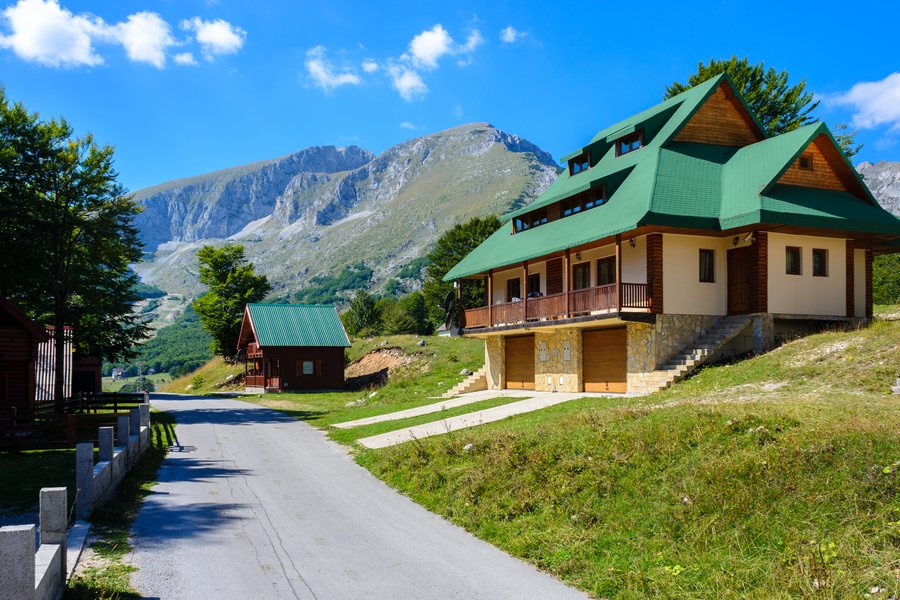 File:Zabljak (26334145194).jpg
Photo: Nick Savchenko from Kiev, Ukraine via Wikimedia Commons, CC BY-SA 2.0
Žabljak at a glance
- Black Lake lies 3 km southwest of Žabljak at an altitude of 1,418 m. It is the largest and best-known of the 18 glacial lakes in Durmitor National Park, Montenegro’s second-largest mountain lake, and is under UNESCO protection.
- Vražje Lake is part of Durmitor National Park, lies within the municipality of Žabljak and is a glacial lake with crystal-clear water.
- Zminje Lake is located in the Pitomine neighbourhood and is connected to Veliko Crno jezero by the Mlinsko stream.
Which lakes shape the landscape?
Black Lake displays a rare bifurcation: its water flows underground into the Tara and Piva rivers. The lake is therefore not only emblematic of the lake landscape of Durmitor National Park, but also of a distinctive hydrological phenomenon.
Zminje Lake is connected to Veliko Crno jezero, which lies 100 m lower, by the 2.6 km-long Mlinsko stream. This water connection should be distinguished from a footpath: it refers to the stream between the lakes, not a hiking route.
In Montenegro’s broader landscape, Durmitor is a limestone massif in the north of the country. Around fifty peaks in the national park rise above 2,000 metres; the glacial lakes of Durmitor are known locally as the “Eyes of the Mountains”.
What trails and winter activities are available?
Black Lake is the starting point for several marked hiking and walking trails. A constructed footpath leads from there to Zminje Lake. Together with the stream connection, this offers two different perspectives on the same waters: a named route and a hydrological connection.
A road leads to Jablan Lake as far as the Momčilov grad restaurant. From there, an easy uphill footpath runs through a pine forest. The route is suitable for those seeking relaxation and for families with children.
The Savin kuk ski area is nearby, 6 km from the centre of Žabljak. Durmitor National Park offers alpine, Nordic and ski touring, as well as snowshoe tours. A marked cross-country ski trail near the sports centre in Žabljak forms a circuit through a landscaped forest belt back to the town, ending at the health centre.
What does Žabljak offer culturally?
The Wild Beauty Art Festival is a multidisciplinary arts event held every summer in Žabljak. It provides a recurring seasonal highlight alongside the region’s architectural heritage.
Žabljak’s registered religious heritage includes single-nave stone churches with bell towers on their façades. They date from the first half or the end of the 19th century. This classification helps place the churches as examples of different building periods.
How can you narrow down your accommodation search?
When searching for hotels in Žabljak, you can start by choosing according to your trip’s focus: lakes and marked trails, winter sports nearby or cultural heritage. For an overview of the region, you can also visit the pages for the sub-areas Žabljak, Njegovuđa, Polje, Motički Gaj, Uskoci and Zminica.
FAQ
Where are the stećci located?
UNESCO-protected medieval tombstones known as stećci are located near Riblje Lake in the village of Novakovići.
Which trails continue from Black Lake?
Black Lake is the starting point for several marked hiking and walking trails. A constructed footpath leads from there to Zminje Lake.
How is the Durmitor Ring scenic road signposted?
The Durmitor Ring scenic road is signposted in both directions.
For the broader travel overview: Montenegro.
More destinations
More places within the same destination:

