
Obrzycko on the Warta: Church and Town Hall
Accommodation in Obrzycko
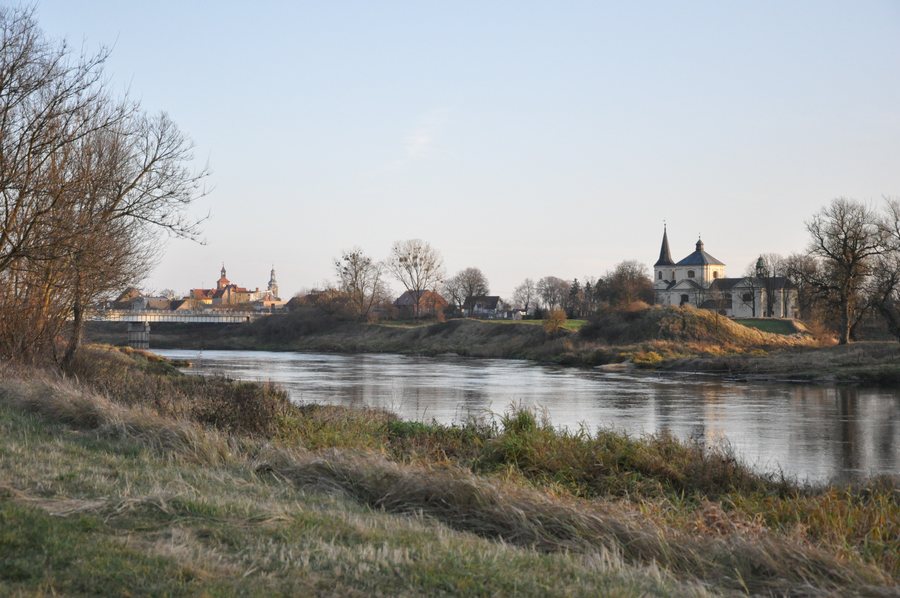
Obrzycko lies on the left bank of the Warta. At the confluence of the Sama and the Warta is an early medieval fortified settlement site; the church and town hall also give the town a distinctive architectural history. You can therefore understand the destination in terms of both its riverside setting and its architecture and sacred art.
Key facts about Obrzycko
- Obrzycko lies on the left bank of the Warta.
- An early medieval fortified settlement site is located at the confluence of the Sama.
- The Church of Saints Peter and Paul is a Baroque building by Pompeo Ferrari.
- The town hall dates from the mid-17th century and has a Renaissance marble window surround.
How do the Warta and the Sama shape the town’s location?
The location on the left bank of the Warta is a clear geographical reference point for Obrzycko. The Sama also flows into the Warta here: the early medieval fortified settlement site is located at the confluence. The riverside setting and archaeological site thus offer two different perspectives on the area—the river landscape and early settlement.
The wider area of the associated municipality should be distinguished from this. The forests of the Puszcza Notecka extend across its northern part. This landscape reference applies to the municipality, not solely to the town of Obrzycko. So, when placing a destination in the context of its townscape and landscape, it is worth keeping these two spatial levels separate.
What do the church and town hall tell us about the architectural history?
The Church of Saints Peter and Paul was built from 1714 to 1756 to a design by Pompeo Ferrari. Its floor plan is in the shape of a Greek cross. In 1906, a nave designed by Roger Sławski was added on the west side. These details distinguish the original ground plan from a substantially later extension.
The furnishings also bring together several periods: the Rococo interior furnishings date from 1780 and were probably executed from earlier designs by Ferrari. The parish church also houses Eugenio Caxés’ 1609 painting “The Last Supper.” It comes from the Jeronimos Monastery in Guadalupe, Spain. The tomb of Ignacy Raczyński, Archbishop of Gniezno, is also part of the church’s heritage.
The town hall was built in the mid-17th century in the Baroque style. A distinctive feature is its Renaissance marble window surround: it bears the date 1527 and was brought here from the Batalha Monastery in Portugal by Atanazy Raczyński in 1843. The town hall and window surround therefore belong to different periods. The town hall tower also has a sandstone plaque bearing the Nałęcz-Raczyński coat of arms and the inscription “Vitam Impendere Vero.”
What other buildings are in the surrounding area?
In the immediate vicinity of Obrzycko, in Obrzycko-Zielona Góra, a castle and park complex lies within a landscape park on the high northern bank of the Warta. The complex is considered a valuable example of a residential estate. It includes an eclectic palace built for the Raczyński family in 1856–1857 and a pheasantry dating from 1910. These dates help place the different parts of the ensemble in time.
Another feature of the townscape is the tower of a currently unused Protestant church in Obrzycko. It adds a different historical reference to the religious buildings and should not be confused with the parish church, which remains in use.
How should you approach the search for accommodation?
When looking for a hotel in Obrzycko, you can first consider whether you are more interested in the town’s history, religious art, or its landscape setting by the Warta. These priorities can help you choose a destination; selecting a specific place to stay is a separate step in your planning.
Discover more destinations: Podrzewie, Niewierz, Nojewo, Grzebienisko, Chojno-Młyn, Sokolniki Wielkie, Chojno-Wieś, Szamotuły.
FAQ
When was the Church of Saints Peter and Paul built?
The Baroque building was constructed from 1714 to 1756 to a design by Pompeo Ferrari. In 1906, it was extended to the west with a nave designed by Roger Sławski.
What is special about the town hall’s window surround?
The Renaissance window surround is made of marble and bears the date 1527. In 1843, Atanazy Raczyński had it brought to Obrzycko from Batalha Monastery in Portugal.
What historic complex is located nearby?
In Obrzycko-Zielona Góra, there is a castle and park complex with a palace built for the Raczyński family in 1856–1857 and a pheasantry dating from 1910.
Go to the main travel overview: Szamotuły.

