
Skoki: Architecture and Natural Monuments
Accommodation in Skoki
Skoki offers several specific points of interest for planning a trip: the elongated Plac Powstańców Wielkopolskich, the Neo-Gothic former Evangelical Church of Saints Peter and Paul with protected pedunculate oaks on the slope of the Mała Wełna, and an eclectic manor house with a landscape park. A route to wooden churches provides a broader regional perspective. This brings local architecture and natural monuments together with a wider cultural theme.
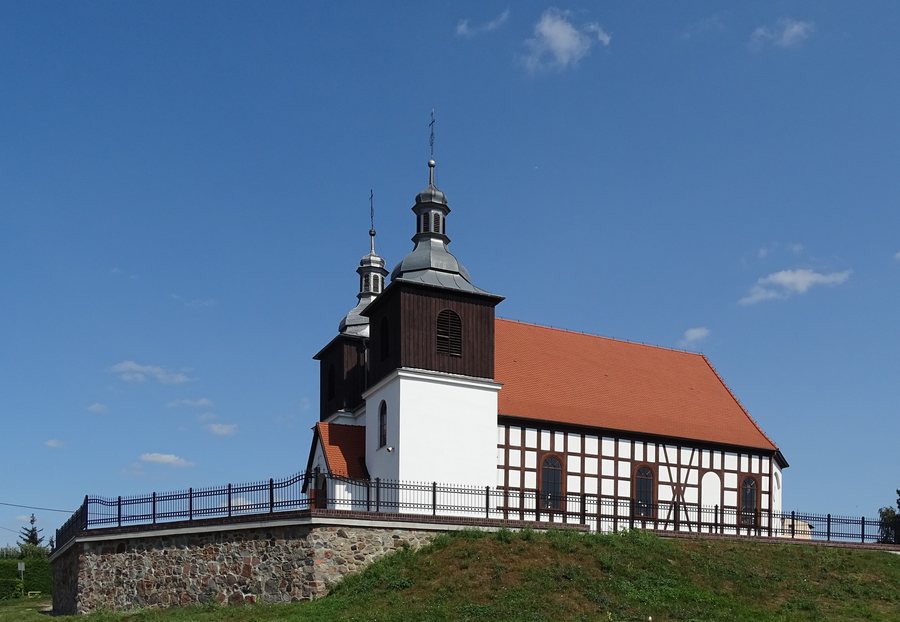 Skoki, Wągrowiec County, Poland. Church of St. Nicholas
Photo: Andreas Ederus Thorunensis via Wikimedia Commons, CC BY-SA 4.0
Skoki at a glance
- Plac Powstańców Wielkopolskich is 130 m long and about 40–45 m wide; streets lead off from each corner.
- The Church of Saints Peter and Paul is Neo-Gothic and was formerly an Evangelical church.
- Behind the church, two protected pedunculate oaks stand on the slope of the Mała Wełna; their trunk circumferences are 520 cm and 650 cm.
- Skoki has an eclectic manor house with a landscape park.
- The regional Szlak Kościołów Drewnianych wokół Puszczy Zielonki was established on the initiative of the “Puszcza Zielonka” Municipal Association and opened in 2008.
What does the square’s shape tell you?
At 130 m long and approximately 40 to 45 m wide, Plac Powstańców Wielkopolskich is considerably longer than it is wide. That is roughly a three-to-one ratio; since the width is given as a range, this comparison is approximate too. Streets lead off from each corner. Together, the length, width and streets at the corners give a clear picture of the elongated layout and its structure. If you assess squares by their design, these proportions provide a specific point of reference without having to describe the square simply as large or small.
How can the church, oaks and manor house be understood?
The Church of Saints Peter and Paul can be understood in two different ways: it is Neo-Gothic and was formerly an Evangelical church. “Neo-Gothic” refers to the revival of Gothic forms, while “formerly Evangelical” describes its previous religious affiliation. This makes it possible to consider the church both architecturally and historically.
Directly behind the church, two pedunculate oaks stand on the slope of the Mała Wełna and are protected as natural monuments. Their trunk circumferences of 520 cm and 650 cm differ by 130 cm; the larger measurement is therefore a quarter greater than the smaller one. Trunk circumference is measured around the trunk and is not the same as its diameter. Here, architecture, the riverside setting and protected trees come together in a clearly defined context.
Another architectural and landscape feature is the eclectic manor house with its landscape park. The term “eclectic” generally refers to a combination of different design influences. This distinguishes the description of the manor house from that of the Neo-Gothic church; the landscape park complements the building with a designed parkland setting. Visitors interested in culture can therefore compare the two buildings through their different style terms.
What role does the regional wooden church route play?
The “Szlak Kościołów Drewnianych wokół Puszczy Zielonki” was established on the initiative of the “Puszcza Zielonka” Municipal Association and opened in 2008. Its name refers to a route of wooden churches around Puszcza Zielonka. The route is part of the wider region and has a different focus from the former Neo-Gothic Evangelical church in Skoki: here, the focus is on a single church building, while the route concerns wooden churches across the region. Its opening in 2008 places the route’s creation in time.
Which Skoki features can help you plan your trip?
If you are considering Skoki as a place to stay, you can start by thinking about which themes matter most to your trip. If you are interested in architecture, the church and manor house represent different styles; the protected pedunculate oaks bring natural monuments and the setting along the Mała Wełna into the picture. The wooden church route adds a regional perspective. This distinction helps you assess Skoki according to your own interests rather than combining its different cultural and natural features into a single experience.
Discover more destinations: Sławica, Przysieczyn, Kobylec, Mikołajewo, Wągrowiec, Legowo, Gołaszewo, Grzybowo.
FAQ
How long and wide is Plac Powstańców Wielkopolskich?
The square is 130 m long and about 40–45 m wide. Streets lead off from each corner.
Where are the protected pedunculate oaks?
They stand behind the former Evangelical Church of Saints Peter and Paul, on the slope of the Mała Wełna. Their trunk circumferences are 520 cm and 650 cm.
Which styles are mentioned for the church and manor house?
The former Evangelical church is Neo-Gothic; the manor house is described as eclectic and has a landscape park.
When did the regional wooden church route open?
The “Szlak Kościołów Drewnianych wokół Puszczy Zielonki” opened in 2008. It was established on the initiative of the “Puszcza Zielonka” Municipal Association.
For the wider travel overview: Wongrowitz.

