
Bucz: Wooden Church, Palace and Circular Route
Accommodation in Bucz
For trip planning in Bucz, the focus is on a historic wooden church, a Neoclassical palace and a named circular route. The buildings and the route offer different points of interest: you can first explore the town’s architectural history or consider Bucz as part of the longer circular route.
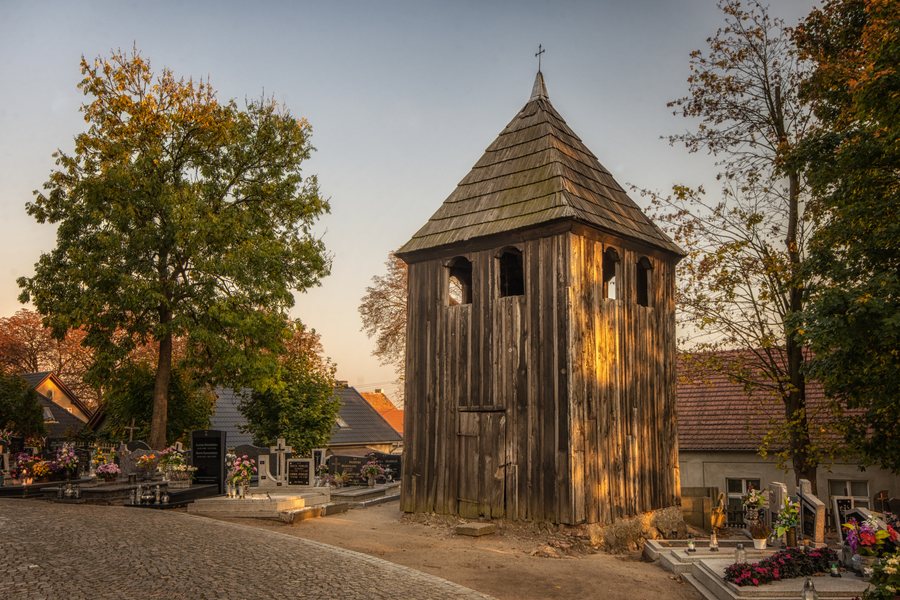 File:SM Bucz Kościół św Barbary-dzwonnica 2018 (0).jpg
Photo: Sławomir Milejski via Wikimedia Commons, CC BY 3.0
File:SM Bucz Kościół św Barbary-dzwonnica 2018 (0).jpg
Photo: Sławomir Milejski via Wikimedia Commons, CC BY 3.0
Key facts about Bucz
- St. Barbara’s Church is a wooden church dating from 1782 and is described as Baroque.
- The Neoclassical palace was built by the Petzel family in the 19th century.
- The red Szlak Górski is a 21.8-kilometre circular route that passes through Bucz.
What architectural history shapes St. Barbara’s Church?
St. Barbara’s Church in Bucz combines a distinctive floor plan with notable architectural features: its floor plan is in the shape of a Latin cross, its roof is covered with shingles, and its tower has an onion-shaped cupola. Together with its date of 1782 and its Baroque classification, these details offer several specific points of interest for learning about the building.
The furnishings also encompass various historical influences. They include a Baroque main altar, probably dating from the mid-17th century, and two Late Baroque side altars from the late 18th century. The pulpit has fragments dating from the 12th century; the Rococo baptismal font dates from the second half of the 18th century. The dates therefore range from the older fragments on the pulpit to several furnishings from the 18th century.
What does the Petzel Palace add alongside the church?
The Neoclassical palace in Bucz was built by the Petzel family in the 19th century. This means two distinct historic buildings are associated with the town: the Baroque wooden church and the Neoclassical palace. They offer two different themes for exploring Bucz’s architectural history, distinguished by style and period.
For the church, details include not only its year of construction but also its floor plan, roof, tower and furnishings. For the palace, the recorded details are its Neoclassical style, the century in which it was built and the Petzel family as its builders. If you take historic architecture into account when planning your trip, these details let you focus on different aspects rather than assigning both buildings to the same period.
How does the circular route pass through Bucz?
The red Szlak Górski is described as a 21.8-kilometre circular route. From Przemęt, it runs via Siekówko, Siekowo, Kluczewo, Bucz Nowy, Bucz and Bucz-Dębina, before returning to Przemęt. Bucz is therefore part of a longer sequence of places; the stated distance refers to the complete circular route.
For route planning, it is helpful to distinguish this information from the details about the buildings: the 21.8 kilometres describe the entire circuit, while the details about St. Barbara’s Church and the palace concern individual historic buildings in Bucz. If you are considering Bucz as a destination or a stop as part of a broader itinerary, you can weigh these two aspects separately. Check current local route conditions before setting out.
What information can help you decide about your trip?
The historical details emphasize different aspects: the church’s architectural form and several furnishings are described in more detail, while the palace is presented in terms of its style, period of construction and the Petzel family. The circular route, by contrast, offers a separate planning metric, with a stated total distance and a sequence of place names. This lets you decide whether your interest lies more in Bucz’s architectural history or in the complete route, without treating the two topics as equivalent.
Discover more destinations: Godziszewo, Tuchorza, Boruja, Solec Nowy, Wolsztyn, Grójec Mały, Chorzemin, Wilcze.
FAQ
What year does St. Barbara’s Church date from?
St. Barbara’s Church in Bucz is a wooden church dating from 1782 and is described as Baroque.
What distinctive architectural features does the church have?
It has a floor plan in the shape of a Latin cross, a shingle-covered roof and a tower with an onion-shaped cupola.
How long is the red Szlak Górski?
The circular route is 21.8 kilometres long and passes through several places, including Bucz, before returning to Przemęt.
Go to the broader travel overview: Wollstein.

.jpg)