
Boruja: Wooden Architecture and Cycling Route
Accommodation in Boruja
Boruja is home to historic wooden buildings from various periods, and a 20-kilometre cycling route passes through the village. Other features include its location on the Szarka stream and historic sites such as a chapel in the former school building. These themes give you concrete points of reference for balancing cultural and cycling interests when planning your trip.
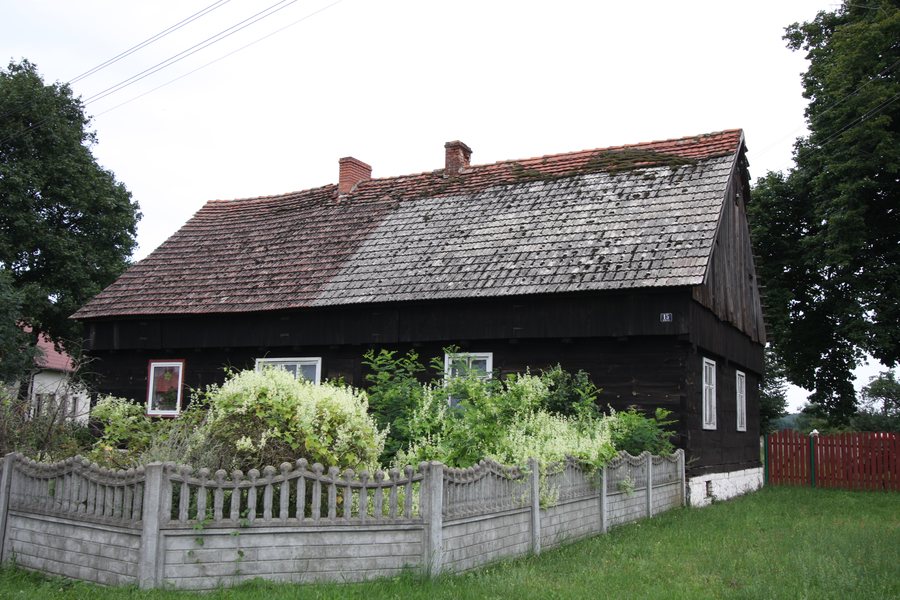
Boruja at a glance
- The “Drewniane budownictwo ludowe” cycling route is 20 kilometres long, with a stated cycling time of four hours.
- A significant historic building complex consists mostly of wooden buildings from the first half of the 19th century.
- Boruja lies on the Szarka stream; its buildings extend southwards in a regular street village.
What defines the character of Boruja?
Boruja lies on the Szarka stream. The buildings extending southwards form a regular street village whose origins date back to the Olęder colonisation. So it is not only a single building that tells the story of the village: the shape of the settlement is also part of its historic character.
The Olęder village has wooden houses with old lime and ash trees growing in front of them. Along with its location on the Szarka, this offers a landscape perspective on Boruja alongside its architectural history. To understand the village, you can therefore consider individual farmsteads, the streetscape, and the surroundings along the stream.
Which historic buildings tell the story of local architecture?
Boruja has preserved a significant complex of historic buildings, most of which are wooden structures from the first half of the 19th century. Pracownia Boruja is an Olęder farmstead dating from 1830 and is listed in the conservation authority’s register of monuments. It links a specific date with the history of Olęder architecture, an important subject for the village.
Hanka & Jurek in Boruja has a cottage built in 1870. It preserves an example of the wooden architecture of the Dutch and German colonists who were brought to Boruja at the end of the 18th century. These dates mark different points in time: the colonists’ historic background goes back to the late 18th century, while the cottage dates from 1870. The 1830 Pracownia and the older building complex add to this timeline, although not all the buildings belong to the same period.
What other places add to the village’s history?
The former school building in Boruja houses the Chapel of the Black Madonna of Częstochowa. The school building was constructed at the beginning of the 20th century. To place it in time, distinguish between the construction of the building and its present-day description as the site of the chapel.
The remains of a Protestant cemetery dating from the second half of the 19th century lie on the southern edge of Boruja, on the road to Tuchorza. The chapel and cemetery represent different religious sites and periods within the village: the former school building from the beginning of the 20th century, and the cemetery remains from the late 19th century.
How can you plan for the cycling route?
The “Drewniane budownictwo ludowe” route passes through Boruja and is 20 kilometres long. The Region Kozła Municipal Association also publishes a cycling time of four hours. These two figures help with different planning questions: the distance describes the extent of the route, while the stated time provides an estimate for the ride. Apply the four hours to the route itself, not to the length of a stay in Boruja.
This gives you two clearly defined themes to consider when deciding on your trip: the cycling route, with its stated distance and cycling time, or the village’s history, which can be traced through buildings from different periods. If you are looking for hotels for a stay in Boruja, you can first consider which of these themes matters more to your plans.
What natural features can you find in Boruja?
At the edge of a field in Boruja stands an oak named Gumsiowe Drzewo, said to be 300 years old. Its location differs from that of Pracownia Boruja: the oak stands at the edge of a field, while the farmstead is in the Olęder village among wooden houses, lime trees, and ash trees. Together with the Szarka stream, these features offer a connection with nature alongside the historic buildings.
Discover more destinations: Bucz, Wolsztyn, Tuchorza, Kopanica, Godziszewo, Solec Nowy, Chorzemin and Barchlin.
FAQ
How long is the cycling route through Boruja?
The “Drewniane budownictwo ludowe” route is 20 kilometres long. The Region Kozła Municipal Association gives a cycling time of four hours.
Which periods do the historic buildings date from?
The preserved building complex consists mostly of wooden buildings from the first half of the 19th century. Pracownia Boruja dates from 1830, the cottage at Hanka & Jurek from 1870, and the former school building from the beginning of the 20th century.
Where is Gumsiowe Drzewo?
The oak stands at the edge of a field in Boruja. Its age is given as 300 years.
For the broader travel overview: Wollstein.

