
Discover Złotoria
Accommodation in Złotoria
Złotoria brings together distinctive cultural landmarks and a described hiking route to the castle ruins. This puts both local history and specific waypoints at the heart of your planning; the route details help you gauge the scope of the excursion.
Złotoria at a glance
- The mural in Złotoria covers an area of 120 m².
- Yellow Route 2 is 7 km long and runs from Lubicz Dolny to the ruins of Kazimierz Wielki's castle.
- Plac Flisaka has an information board about Złotoria's history, a carved fish-shaped bench and seating.
Which cultural landmarks define Złotoria?
The 120 m² mural is a striking cultural landmark in the town. Another symbol of Złotoria is the Flisak sculpture at Plac Flisaka. It commemorates the centuries-old tradition of river rafting and the arduous work of the rafters. The symbol was ceremonially unveiled on 15 September 2013.
The square is at the entrance to the town. A board there provides information about Złotoria's history, while the carved fish-shaped bench also reflects the rafting theme. Seating is provided for walkers and people using the cycle path. The mural, sculpture and board each offer a different perspective: a large-scale image, a memorial to work on the water and historical context at the square.
What can you expect on yellow Route 2?
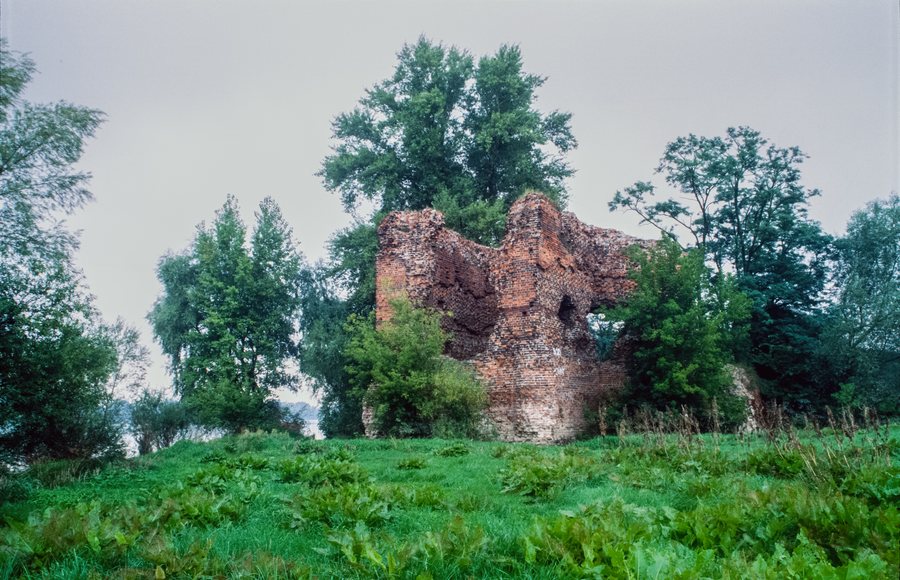
Yellow Route 2 runs from Lubicz Dolny to the castle ruins in Złotoria and is 7 km long. Along the way, it crosses the historic wooden bridge over the Drwęca and continues to St. Adalbert's Church. From there, it follows an unpaved path along the Drwęca; after about 1,000 m, the route reaches the ruins of Kazimierz Wielki's castle.
The named waypoints make the route easy to picture: the wooden bridge, the church and, finally, the ruins mark its stages. The approximate distance of 1,000 m refers to the path from the church to the ruins, not to the entire route. As trail conditions can change, check the route before setting out.
What history is associated with the castle ruins?
The ruins are more than just the destination of the yellow route. In their vicinity, Jagiełło, his brother, the Lithuanian Grand Duke Vytautas, and Grand Master Heinrich von Plauen met in May 1411. At the meeting, they exchanged documents that had already been sealed, completing the signing of the First Peace of Thorn. A visit to the ruins is thus linked to a specific event in regional history.
You can connect this historical highlight with the route when planning your trip: the route ends at the ruins, and the story of the meeting gives this destination historical significance. The church and wooden bridge are other named points along the way; in the route description, they feature alongside the main destination, the castle ruins.
What does the leisure park offer?
The family recreation and leisure park in Złotoria invites visitors to stroll, play and be active, and provides a place to meet. This offers a different focus from the route to the ruins: here, the emphasis is on spending time, activities and being together, while the yellow route follows a specific path to a historic destination.
If you would like to compare different places as you plan your trip, explore Zębowo, Wielka Nieszawka, Łysomice, Lulkowo, Lubicz Dolny, Mała Nieszawka, Toruń and Steklin.
FAQ
How long is yellow Route 2?
The route is 7 km long and runs from Lubicz Dolny to the ruins of Kazimierz Wielki's castle in Złotoria.
What does the Flisak sculpture commemorate?
It commemorates the centuries-old tradition of river rafting and the arduous work of the rafters. The symbol was unveiled at Plac Flisaka on 15 September 2013.
What happened at the meeting in May 1411?
Jagiełło, his brother, Vytautas and Heinrich von Plauen met near the castle ruins and exchanged documents that had already been sealed, completing the signing of the First Peace of Thorn.
For the broader travel overview: Toruński.

.jpg)