
Discover Włocławek
Accommodation in Włocławek
Włocławek combines the city’s history with cultural attractions and designated cycling routes. During your stay, you can choose between museum visits, large-scale murals, events and tours of varying lengths.
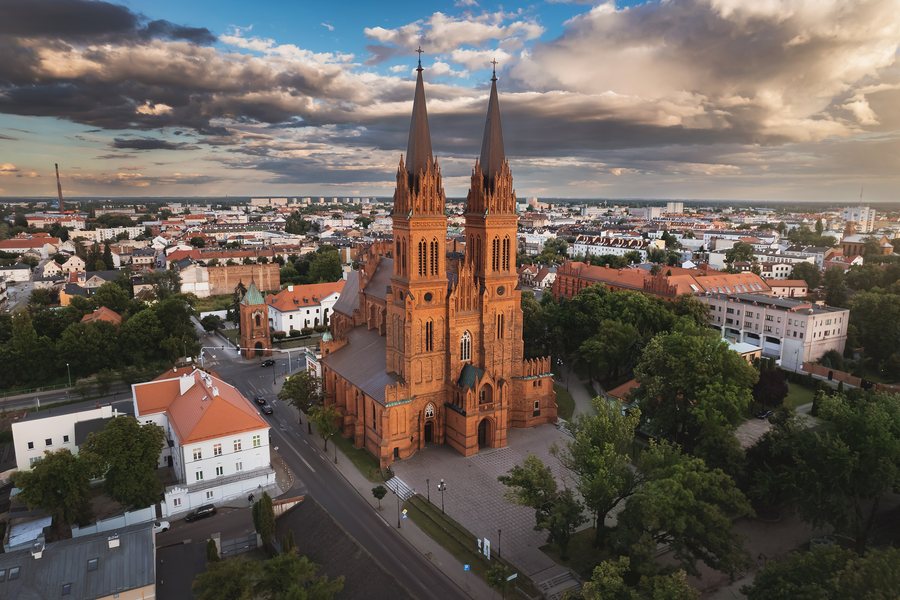 Cathedral Basilica of the Assumption of the Blessed Virgin Mary in Włocławek, aerial view
Photo: Aneta Pawska via Wikimedia Commons, CC BY-SA 4.0
Cathedral Basilica of the Assumption of the Blessed Virgin Mary in Włocławek, aerial view
Photo: Aneta Pawska via Wikimedia Commons, CC BY-SA 4.0
Włocławek at a glance
The city’s history is a particular focus: the Muzeum Historii Włocławka features permanent exhibitions spanning from prehistory to the period of the Polish People’s Republic. Other attractions include a mural trail, the Browar B. cultural center and the interactive Skarbiec Fajansu center. For outdoor activities, choose from urban options and signposted cycling routes with specified distances.
The experiences also differ in nature: at the museum, exhibitions explore the history of Włocławek and the region; the murals depict the city’s history on a large scale across its walls. Browar B. adds to this range with events, art exhibitions, courses and group activities.
Which cultural attractions and city scenes can you discover?
The Muzeum Historii Włocławka opened in 1972 as a department of the Muzeum Ziemi Kujawskiej i Dobrzyńskiej. It is housed in three listed townhouses at the junction of Stary Rynek and ul. Szpichlerna in Włocławek. Its permanent exhibitions trace the history of Włocławek and the region from prehistory to the period of the Polish People’s Republic. This covers a long span of time, including a more recent historical era.
The large-scale murals along the mural trail take the city’s history as their theme. Most of the works are in the immediate Śródmieście area. Listed addresses include Żabia 14/16, Wojska Polskiego 3, Piekarska 15, Cyganka 9, Żabia 2, and Bulwary Marszałka Józefa Piłsudskiego 22 and 25. If you want to see the murals, you can use these specific locations to find your way around.
The interactive Skarbiec Fajansu cultural center presents the 150-year history of Włocławek’s faience craft. For a different way to experience the city’s cultural life, visit Centrum Kultury Browar B., which hosts music concerts and theater performances, contemporary art exhibitions, and regular courses and group activities. This makes it easy to consider history, art and events as different interests to pursue during a stay in the city.
Which routes suit your interests?
In Włocławek, the urban walking route Miejski Spacerowy Szlak Obiektów Zabytkowych is signposted and passes historic buildings. It offers a dedicated walking option for anyone interested in architecture and the city’s history. There are also two cycling routes with clearly differing lengths and itineraries: the black Jezioro Wikaryjskie–Włocławek–Wieniec cycling route is 20 km long. The red Nadwiślański cycling route runs from Włocławek via Nieszawa to Ciechocinek and is 38 km long. The distances and named places can help you factor each route into your plans.
The Włower city bike-share system is another way to include cycling in your travel plans. It has nearly 100 modern bicycles and 22 stations spread across different parts of Włocławek. A viewing tower at the highest point in the city offers another perspective on the surrounding area. From there, panoramic views extend over the city and its immediate surroundings; free telescopes are available on platforms at 3.5 m, 7.7 m, 11.9 m and 16.1 m.
These are distinct from the hiking and cycling routes in the wider region: the area covered by the Kujawski PTTK branch in Włocławek has 160.5 km of signposted hiking trails and 40 km of signposted cycling routes. These regional figures describe more than just the routes in the city. If you’re planning a trip primarily around the city’s history and culture, the museum, murals and cultural attractions are relevant options to compare; if you’re planning a more activity-focused visit, the designated cycling routes and bike-share system are useful points of reference.
More local pages to compare: Chotel, Mikołajki, Kruszyn, Skoki Duże, Antoniewo, Huta Chodecka, Kowal, Szczutkowo, Baruchowo, Augustynowo, Wieniec, Markowo, Smólnik, Lubień Kujawski, Skórzno, Grodztwo, Brzezie, Mieczysławowo, Izbica Kujawska, Włocławek.
FAQ
What can you see at the Muzeum Historii Włocławka?
The permanent exhibitions cover the history of Włocławek and the region from prehistory to the period of the Polish People’s Republic.
How long are the cycling routes described?
The black Jezioro Wikaryjskie–Włocławek–Wieniec route is 20 km long. The red Nadwiślański cycling route via Nieszawa to Ciechocinek is 38 km long.
What does the viewing tower offer?
It offers panoramic views of Włocławek and the surrounding area. Free telescopes are located on platforms at 3.5 m, 7.7 m, 11.9 m and 16.1 m.
For the main travel overview: Kuyavia-Pomerania.

