
Discover Kacwin: Sypańce, churches and hiking trails
Accommodation in Kacwin
Kacwin brings together a distinctive building style, church-building history and two hiking options of different lengths. Traditional Sypańce take centre stage at the open-air museum; beyond it, All Saints’ Church and the waterfall on the Kacwin stream offer further points of reference for the town’s history and landscape. For planning a trip, culture and walking time can be considered as separate interests.
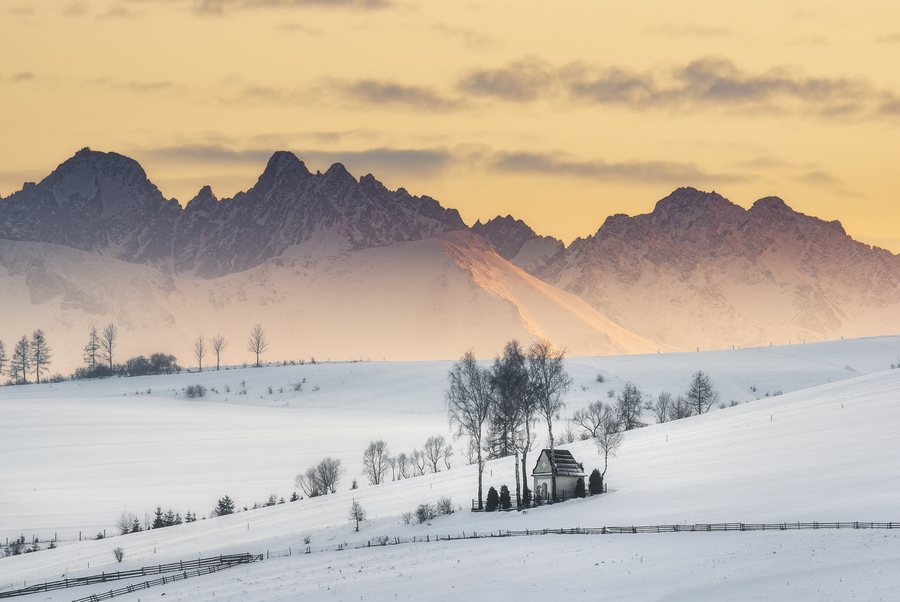 File:Kaplica Matki Boskiej Śnieżnej w Kacwinie.jpg
Photo: Gswito via Wikimedia Commons, CC BY-SA 4.0
Kacwin at a glance
- The open-air museum showcases traditional Sypańce: plastered wooden buildings on stone foundations with movable pitched roofs.
- All Saints’ Church is Gothic and was remodelled in the Baroque period. The Berzewicz family had it built around 1400.
- A circular route through Kacwin takes approximately an hour and a half.
- A blue hiking trail leads from Kacwin to the Nad Łapszanką Pass; the walking time is three hours.
- There is a waterfall on the Kacwin stream near a church and a bridge.
What do the Sypańce and the church reveal about Kacwin’s architectural history?
The Sypańce at the open-air museum can be recognised by several specific construction details: they are wooden buildings plastered with clay, set on stone foundations and topped with movable pitched roofs. These features make the building style easy to understand without requiring specialist terminology. Anyone interested in construction methods can consider the individual elements separately: wood as the structural material, clay plaster on the walls, the stone foundation and the movable roof. Together, they describe what distinguishes the Sypańce on display.
Two different clues come together in the history of All Saints’ Church. It is a Gothic church, but it was remodelled in the Baroque period. The Berzewicz family had it built around 1400. Their coat of arms—three roses on a shield on the keystone of the presbytery vault—is considered evidence of this connection. The church can therefore be understood not only through its stylistic classification; its coat of arms is another specific detail to look for when exploring its architectural history.
How do the hiking trails differ?
A circular route through Kacwin is listed as taking approximately an hour and a half. The blue hiking trail leads from Kacwin to the Nad Łapszanką Pass; its walking time is three hours. These time estimates offer a straightforward comparison for planning your day: the circular route is the shorter option, while the trail to the pass allows more time for walking and has a different destination. They do not, however, indicate anything about the level of difficulty.
When choosing between the two options, you can first compare the time you would like to spend walking with your destination: a loop through the town or a hike to the pass. The estimates help you gauge the time involved, but they do not replace checking the current trail markings and conditions for the blue hiking trail. You should also avoid interpreting its approximate duration as an indication of pace or personal suitability; the time estimate alone does not support such conclusions.
Where is the waterfall located?
The waterfall is on the Kacwin stream, near a church and a bridge in Kacwin. Together, the stream, church and bridge provide a specific sense of the waterfall’s location. This natural feature adds another perspective to the town’s architectural history: here, the focus is on a body of water rather than a building. For travellers interested in both culture and landscape, these are distinct topics that can be considered separately while planning a visit.
When choosing a destination, it can help to decide what you want to focus on during your stay: are you mainly interested in architectural history, or would you also like to set aside time for a hike? Kacwin offers a range of options, from the Sypańce and All Saints’ Church to two hiking routes.
Discover more destinations: Bańska Niżna, Mizerna, Nowy Targ, Raba Wyżna, Niedzica, Falsztyn, Chochołów, Chyżne.
FAQ
What are the Sypańce at the open-air museum?
They are traditional wooden buildings plastered with clay, set on stone foundations and topped with movable pitched roofs.
What is the historical context of All Saints’ Church?
The Gothic church was remodelled in the Baroque period. The Berzewicz family had it built around 1400; their coat of arms with three roses is considered evidence of this.
How long do the hiking trails take?
The circular route through Kacwin takes approximately an hour and a half. The blue hiking trail to the Nad Łapszanką Pass takes three hours; check the trail markings and conditions locally.
For the broader travel guide, see: Nowotarski.

