
Discover Zubrzyk
Accommodation in Zubrzyk
Zubrzyk offers several points of interest to help you plan your trip: sandstone formations nearby, a former Greek Catholic church in the village, and the Smerczynowa Dziura fissure cave. These details help you distinguish between nature and culture interests.
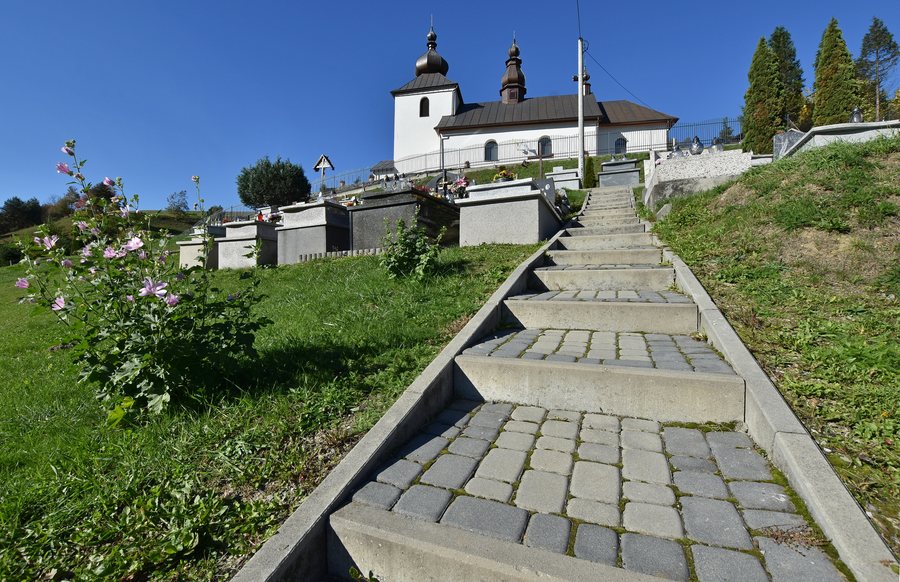 File:Zubrzyk, cerkiew św. Łukasza (HB9).jpg
Photo: Henryk Bielamowicz via Wikimedia Commons, CC BY-SA 4.0
File:Zubrzyk, cerkiew św. Łukasza (HB9).jpg
Photo: Henryk Bielamowicz via Wikimedia Commons, CC BY-SA 4.0
Zubrzyk facts
Zubrzyk is home to the former Greek Catholic Church of St. Luke, now a filial church of the Exaltation of the Holy Cross. Nearby are the Pusta Wielka I and II sandstone formations and the Smerczynowa Dziura cave. The two rock formations differ in shape; the cave lies on the southeastern slopes of Wierch Zubrzy.
How do the natural formations differ?
Pusta Wielka I consists of natural rock steps and small rock ledges amid a largely natural forest. The formation covers about 3 ha. Pusta Wielka II, by contrast, forms a rocky ridge with rock outcrops and faults. It includes a stand of trees with characteristics of a natural forest.
The two nearby sandstone formations can therefore be distinguished by their described features: Pusta Wielka I is characterized by steps and smaller rock ledges, while Pusta Wielka II is characterized by a ridge with outcrops and faults.
What cultural and geological points of interest can you find?
St. Luke’s Church links its former Greek Catholic use with its current role as a filial church of the Exaltation of the Holy Cross. The listed historic complex also includes the cemetery grounds, the surrounding wall, and the trees. For travelers interested in culture, the site therefore encompasses more than the church building alone: these features are also part of the complex.
Another natural point of interest is Smerczynowa Dziura, a difficult-to-find but fairly large fissure cave. It is 17 m long and 3 m deep, and lies on the wild southeastern slopes of Wierch Zubrzy. From Zubrzyk, an indistinct, unmarked path leads to it in a southwesterly direction.
How can you choose a focus for your trip?
If you would like to compare geological formations, Pusta Wielka I and II offer two clearly distinct features nearby. For a cultural focus, the church and its complex provide a suitable point of reference; the cave, in turn, combines a specific size with a cautiously described route. This lets you organize the available information according to your interests without treating different places and topics as interchangeable.
Discover more destinations: Gródek Nad Dunajcem, Brzyna, Zarzecze, Mochnaczka Niżna, Łącko, Krynica-Zdrój, Cieniawa, Kąclowa.
FAQ
How do Pusta Wielka I and II differ?
Pusta Wielka I consists of natural rock steps and small rock ledges across about 3 ha. Pusta Wielka II is a rocky ridge with outcrops and faults; it includes a stand of trees with characteristics of a natural forest.
What is the role of St. Luke’s Church today?
The former Greek Catholic church now serves as a filial church of the Exaltation of the Holy Cross. The listed historic complex also includes the cemetery grounds, the surrounding wall, and the trees.
How is Smerczynowa Dziura described?
The fissure cave is 17 m long and 3 m deep. It lies on the southeastern slopes of Wierch Zubrzy; from Zubrzyk, an indistinct, unmarked path leads to it in a southwesterly direction.
To the main travel overview: Nowy Sącz.

.jpg)