
Górka Pabianicka: Church and Cemetery
Accommodation in Górka Pabianicka
In Górka Pabianicka, the parish church and parish cemetery bring together two closely connected themes: architectural history and former use. The present-day brick church combines Neo-Gothic exterior architecture with an interior that is predominantly Baroque and Rococo in style; the cemetery adds an older chapel and historic gravesites to this picture. If you want to plan your trip around architectural and local history, this pairing offers a specific focus.
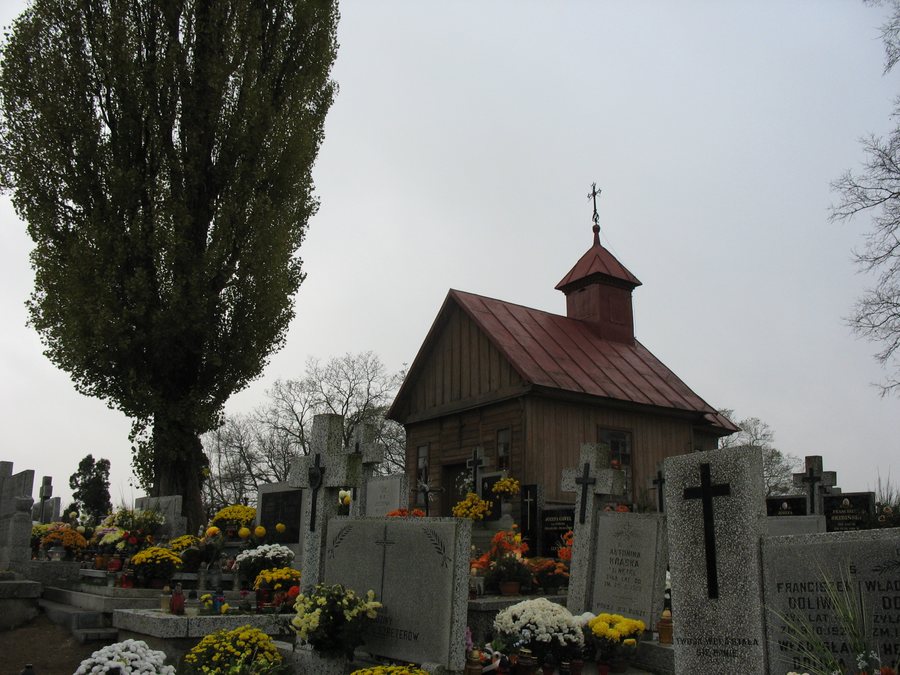 Cemetery in Górka Pabianicka
Photo: Mariusz Rzepkowski (MariuszR) via Wikimedia Commons, CC BY-SA 3.0
Cemetery in Górka Pabianicka
Photo: Mariusz Rzepkowski (MariuszR) via Wikimedia Commons, CC BY-SA 3.0
Key facts about Górka Pabianicka
- The present-day brick Neo-Gothic parish church was built between 1872 and 1875 to a design by Tadeusz Mankiewicz.
- The church interior is predominantly Baroque and Rococo in style.
- The parish cemetery was established on a small hill at the beginning of the 19th century.
- Górka Pabianicka is the fifth stop on the “Historia blisko Ciebie” educational trail.
What defines the parish church?
The parish church stands on a hill formed during the Ice Age. It has a single nave and a square tower at the front. The present-day brick building was constructed between 1872 and 1875 to a design by Tadeusz Mankiewicz. At the time, Józef Bazyli Nowicki was the parish priest. These details place the church’s construction in time and give it a concrete connection to local history: the present-day church was built after the old church burned down in 1858.
What details define the interior?
The parish church’s interior is predominantly Baroque and Rococo in style. Its furnishings include three altars, a 19th-century painting of the Crucifixion, a Rococo feretory featuring an image of Saint Mary Magdalene, a Rococo crucifix, and Stations of the Cross. There are also three bells dating from 1946. Outside and inside, you will encounter distinct periods of design: the building is Neo-Gothic, while its furnishings bear mainly Baroque and Rococo characteristics.
What stories does the parish cemetery tell?
The Roman Catholic parish cemetery stands on a small hill and was established at the beginning of the 19th century. Its grounds are home to the simple wooden cemetery chapel of Saint Mary Magdalene. It was built in the second half of the 19th century at the initiative of the parish priest at the time, Ignacy Papiewski. After the old church burned down in 1858 and until the present-day brick church was completed, services were held in the chapel for several years. This former use connects the cemetery’s history with the transition to the present-day church building.
Next to the chapel is the historic tomb of the Smulski family, who owned an estate in Świątniki. The grave of Tomasz Błociszewski, owner of an estate in Wymysłów, is also in the cemetery. The two graves point to different connections with estate owners. The parish cemetery is also listed in the Łódź Voivodeship register of monuments.
What role does the educational trail play?
Górka Pabianicka is the fifth stop on the “Historia blisko Ciebie” educational trail. Its position on the route helps you place the site within this thematic context. If you plan to follow the trail, check the latest route information in advance.
Discover more destinations: Giemzów, Brójce, Dobryszyce, Leśne Odpadki, Andrespol, Łódź, Pławno, Załęcze Wielkie.
FAQ
Who designed the present-day parish church?
The present-day brick church was built between 1872 and 1875 to a design by Tadeusz Mankiewicz. Józef Bazyli Nowicki was the parish priest at the time.
What defines the parish church’s furnishings?
The interior is predominantly Baroque and Rococo in style. Its furnishings include three altars, several religious works of art, and Stations of the Cross; the church also has three bells dating from 1946.
What was the cemetery chapel used for in the past?
After the old church burned down in 1858, services were held there for several years, until the present-day brick church was completed.
Which stop on the educational trail is Górka Pabianicka?
Górka Pabianicka is the fifth stop on the “Historia blisko Ciebie” educational trail.
For the broader travel overview: Lodz.

