
Discover Łowicz: City History and Folk Art
Accommodation in Łowicz
Łowicz combines a medieval triangular city layout with museums, religious history and regional folk art. You can tailor your stay to your cultural interests and choose between city history, art, architecture and routes.
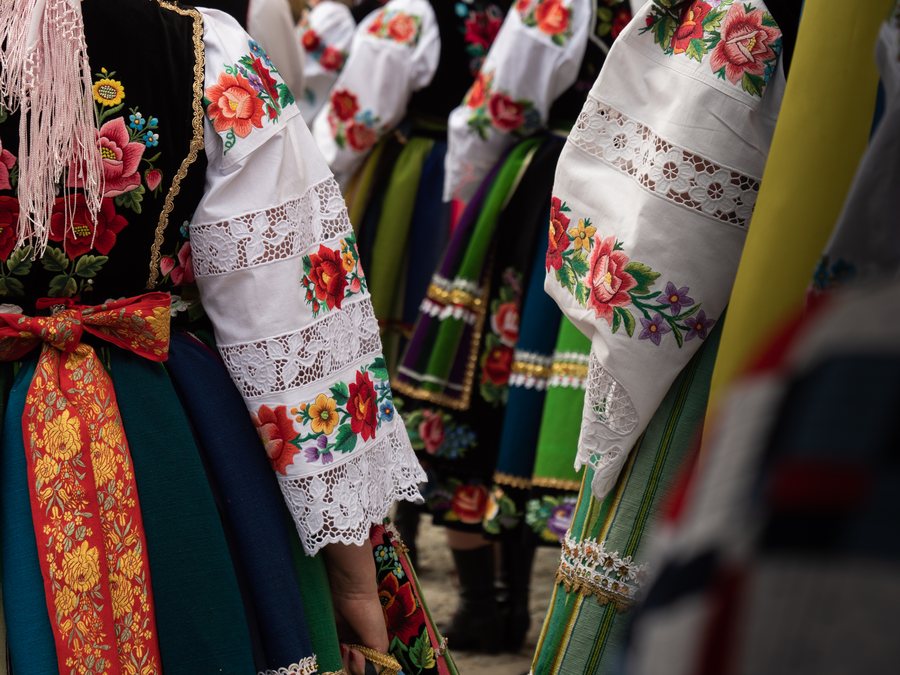 Łowicz traditional costume, Poland 01.jpg
Photo: Emilia Wiśniewska via Wikimedia Commons, CC BY-SA 4.0
Łowicz: Key Facts
- Nowy Rynek preserves a medieval city layout on a triangular plan.
- The Muzeum w Łowiczu features permanent exhibitions on the history of the city and region, as well as the ethnography of the Duchy of Łowicz.
- The green-marked Szlak Ziemi Łowickiej is 123 kilometres long and includes Łowicz.
Which cultural themes shape Łowicz?
At Nowy Rynek, the layout of the historic city itself provides a point of interest for anyone interested in urban history: the square preserves a medieval triangular plan. This makes the city’s layout—not just an individual building—a subject in its own right.
Łowicz and the surrounding region are known for colourful striped folk costumes and folk-art papercuts. The costumes and cut-paper works represent distinct forms of artistic expression. If you’re exploring regional culture, both offer tangible points of interest that are easy to distinguish from one another.
Which museums and buildings are part of Łowicz’s cultural profile?
The Muzeum w Łowiczu features permanent exhibitions on the history of the city and region, as well as the ethnography of the Duchy of Łowicz. The former Chapel of St. Charles Borromeo also houses a permanent exhibition of Polish Baroque art. Together, these bring city and regional history, ethnography and Baroque art into focus.
Next to the museum is a small open-air museum with two rural homesteads and a coach house. These three elements complement the exhibitions with a different way to engage with cultural heritage: here, the focus is on rural buildings and another structure rather than paintings and historical subjects.
The romantic Gen. Klicki complex comprises a defensive tower, a palace, a chapel and a gatekeeper’s house. The palace houses the contemporary painting gallery of Zofia and Roman Artymowski, as well as a memorial room dedicated to Gen. Klicki. The different elements make the complex interesting as an ensemble; the palace brings art together with the memory of Gen. Klicki.
The cathedral also offers several points of interest in cultural history. The mortal remains of twelve Polish primates rest in its crypts. Its viewing terrace is 35 metres high and offers views of Łowicz and the surrounding area.
What should you know about museum visits and routes?
The Diocesan Museum in Łowicz can only be visited with a guide. It is open Monday to Friday from 10:00 to 15:30 and Saturday from 10:00 to 14:00. A guided tour must be arranged in advance for Saturdays. Before travelling, the museum asks visitors to get in touch so that available times can be checked.
Two different details may help you choose a route: the Szlak Ziemi Łowickiej is 123 kilometres long, marked in green, runs through the north-western part of Łowicz County and includes Łowicz. The Szlak Książęcy overlaps with the Łowicz section of the Way of St. James along one part of the route. Check the latest route information before setting out.
Which events and traditions are associated with Łowicz?
The food festival “Księżackie Jadło” is a regular part of the city’s cultural calendar. Its name and status make it a distinct topic alongside the museums, buildings and folk art. Check the specific event dates before planning your trip.
The Corpus Christi procession is part of Łowicz’s intangible heritage. It is attended by residents of the city and surrounding area, as well as tourists from Poland and abroad. The festival and the procession represent different aspects of cultural life: one is the named food festival, while the other is a procession that forms part of the city’s heritage.
Discover more destinations: Łowicz, Brzozów, Nieborów, Pertikau, Łask, Zgierz, Tomaszowski and Sieradz.
FAQ
Which permanent exhibitions does the Muzeum w Łowiczu feature?
The museum features exhibitions on the history of the city and region, as well as the ethnography of the Duchy of Łowicz. The former Chapel of St. Charles Borromeo also houses a permanent exhibition of Polish Baroque art.
What does the Gen. Klicki complex include?
The romantic complex includes a defensive tower, a palace, a chapel and a gatekeeper’s house. The palace houses the contemporary painting gallery of Zofia and Roman Artymowski, as well as a memorial room dedicated to Gen. Klicki.
When can you visit the Diocesan Museum?
The museum is open for guided visits Monday to Friday from 10:00 to 15:30 and Saturday from 10:00 to 14:00. Guided visits must be arranged in advance for Saturdays; visitors are asked to get in touch before travelling to check available times.
Which routes are connected with Łowicz?
The 123-kilometre-long, green-marked Szlak Ziemi Łowickiej includes Łowicz. One section of the Szlak Książęcy overlaps with the Łowicz section of the Way of St. James.
For the broader travel overview: Lodz.

