
Kraśnik Dolny
Accommodation in Kraśnik Dolny
Kraśnik Dolny combines historical landmarks with a rural village character and connections to several cycling routes. This highlights two distinct areas to consider when planning your trip: cultural and historical sites in the village, and routes connecting Kraśnik Dolny with other places.
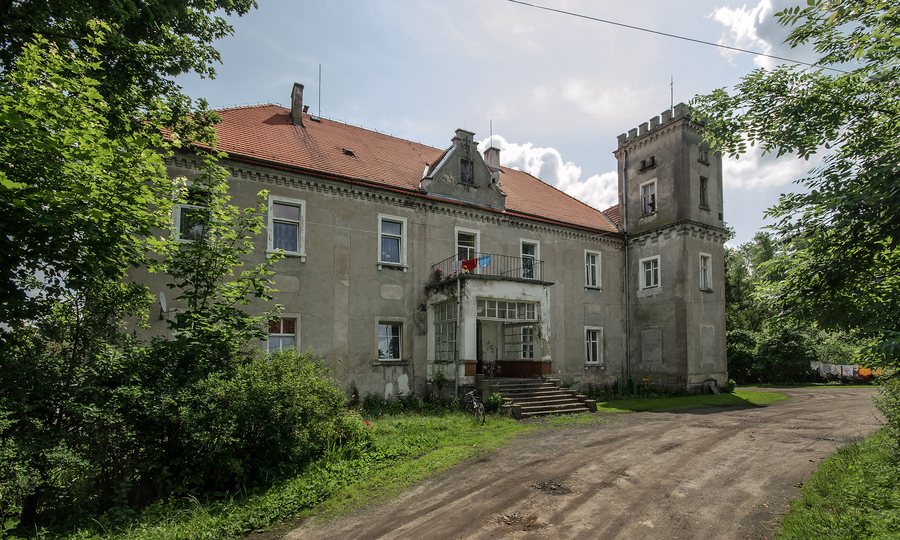 File:SM Kraśnik pałac (1) ID 590302.jpg
Photo: Sławomir Milejski via Wikimedia Commons, CC BY-SA 3.0 pl
File:SM Kraśnik pałac (1) ID 590302.jpg
Photo: Sławomir Milejski via Wikimedia Commons, CC BY-SA 3.0 pl
Kraśnik Dolny at a glance
Kraśnik Dolny is a linear village on the Bobrzyca River. Its historical sites include a Protestant cemetery with a bell tower dating from 1900, the ruins of a Protestant church dating from 1724, and residential and farm buildings from the 18th and 19th centuries. The village is also mentioned in connection with two cycling routes: Route 703 “Dolina Bobru” and the Bolesławiec–Trzebień pedestrian and cycling path.
What shapes the character of the village?
The term “linear village” describes the settlement pattern of Kraśnik Dolny. Together with its location on the Bobrzyca River, it offers a brief guide to the local landscape and layout.
This means Kraśnik Dolny may be of particular interest if you would like to explore rural settlement patterns and historical landmarks. The Bobrzyca is part of the village’s geographical description; the historical buildings and cemetery mentioned above provide specific points of interest for those interested in cultural history.
What historical landmarks are there?
The Protestant cemetery is one of Kraśnik Dolny’s most important historical sites. It includes a bell tower dating from 1900. The ruins of a Protestant church dating from 1724 are another trace of the village’s history. The cemetery, bell tower and church ruins are distinct sites: the year 1900 refers to the bell tower, and 1724 to the church.
Historical residential and farm buildings from the 18th and 19th centuries are also part of the architectural heritage. In addition, a property designated “pałac, ob. dom” is protected in both the monuments register and the monuments inventory. For travelers interested in culture, this offers a picture of several kinds of historic buildings, rather than a single standout structure. Consider the designation of the protected property as a separate registry entry alongside the residential and farm buildings.
Which cycling routes are connected with Kraśnik Dolny?
The section of cycling route 703 “Dolina Bobru” in Kraśnik Dolny is part of a connection between Kraśnik Dolny, Dąbrowa Bolesławiecka and Golnice. The village is therefore named as part of a cycling route whose described connection covers several places. If you are planning a cycling trip, these three place names can help you get your bearings along the route.
Kraśnik Dolny is also included in the first construction section of the Bolesławiec–Trzebień pedestrian and cycling path. This section is 8.7 km long and was opened for use by residents. The route connects, among other places, Kraśnik Dolny. The 8.7 km figure refers to this first construction section; it is not the length of cycling route 703. The two routes therefore provide separate points of reference for planning a cycling trip.
Where can you find a rest and meeting point?
The MOR Kraśnik Dolny rest and meeting point is located at the Dom Ludowy (People’s House). This is a specific location for visitors looking for this named point. Alongside the cycling route information, it adds another aspect to finding your way around the village’s historical sites.
If you would like to compare other destinations, find Bolesławiec, Zebrzydowa, Kruszyn, Nowogrodziec, Kliczków, Osiecznica and Raciborowice Górne.
FAQ
Which historical sites are mentioned in Kraśnik Dolny?
They include the Protestant cemetery, its bell tower dating from 1900, the ruins of a Protestant church dating from 1724, and historical residential and farm buildings from the 18th and 19th centuries.
How long is the first construction section of the Bolesławiec–Trzebień pedestrian and cycling path?
The first construction section is 8.7 km long and was opened for use by residents. It connects, among other places, Kraśnik Dolny.
Where is the MOR Kraśnik Dolny rest and meeting point?
It is located at the Dom Ludowy (People’s House).
For the broader travel overview: Bolesławiec County.

_ID_590302.jpg)