
Stara Kamienica: Castle Ruins, Church and Routes
Accommodation in Stara Kamienica
Stara Kamienica brings together castle ruins in the town center, a Baroque Hercules Gate, a parish church rich in history and two routes of different lengths. The town’s features offer a range of starting points for planning your trip: historic buildings, architectural details and specific route itineraries.
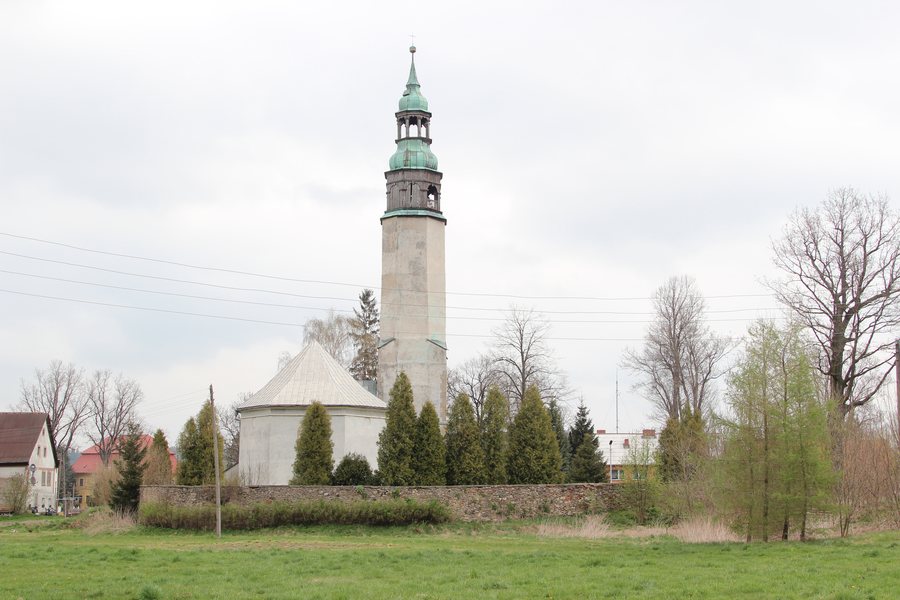 File:Stara Kamienica church of Saint John the Baptist 2015 P02.JPG
Photo: Pnapora via Wikimedia Commons, CC BY-SA 4.0
Stara Kamienica at a glance
- The ruins of a castellan castle stand in the center; the castle was first mentioned as early as 1242.
- The castle includes barrel-vaulted cellars, a tower preserved up to the third floor, remnants of sgraffito decoration, sections of the curtain wall, a moat and a bridge.
- The Baroque Hercules Gate dates from 1705 and depicts Hercules fighting a lion.
- The parish church of the Beheading of St. John the Baptist was first mentioned in 1370; it contains a sandstone baptismal font dating from 1562.
- The blue trail runs for 48 kilometers from Mirsk via Stara Kamienica to Świeradów-Zdrój. The yellow trail runs for 18.8 kilometers from Stara Kamienica to Rozdroże Izerskie.
What features make up the castle ruins?
The castellan castle in the center is mentioned as early as 1242 and has been associated with the Schaffgotsch family since its construction. This historical connection and the surviving structures offer two different ways to explore the site: one through its history, the other through its architecture.
The remains include barrel-vaulted cellars and a tower preserved up to the third floor. Remnants of sgraffito decoration can also be found on the tower. Short sections of the curtain wall, as well as a moat and a bridge, complete the remains. The description therefore covers not only the tower but also other parts of the castle complex. The year 1242 refers to the first mention of the castle; it is not a construction date.
Which historic buildings and dates shape the town?
The Hercules Gate adds a clearly dated Baroque feature: it dates from 1705 and depicts Hercules fighting a lion. The scene makes the gate easy to understand even without in-depth knowledge of art history. As a standalone building, it offers a different historical perspective from the castle ruins.
The parish church of the Beheading of St. John the Baptist was first mentioned in 1370. It acquired its present form through numerous alterations, mainly in the 17th and 18th centuries. A notable furnishing is the sandstone baptismal font dating from 1562. The dates relate to different aspects: the church’s first mention, the baptismal font and later alterations. Together, they provide a concise guide to the history of the church building and its furnishings.
How do the two routes differ?
The routes can first be compared by their length and course. The blue trail is 48 kilometers long and runs from Mirsk via Stara Kamienica to Świeradów-Zdrój. Stara Kamienica is therefore on its route between the two named towns.
At 18.8 kilometers, the yellow trail is shorter and runs from Stara Kamienica to Rozdroże Izerskie. Its starting point in Stara Kamienica is marked as kilometer 0.0. The endpoints differ, as do the total lengths: the blue trail runs between Mirsk and Świeradów-Zdrój, while the yellow trail connects Stara Kamienica with Rozdroże Izerskie. It is worth checking current trail conditions before setting out.
What themes can guide your accommodation search?
If you are looking for a hotel in Stara Kamienica, you could start by considering whether your trip is more focused on the historic buildings or on one of the two routes. For culture enthusiasts, the castle, Hercules Gate and parish church offer different historical points of interest. When planning a route, you can compare the stated lengths and endpoints.
Discover more destinations: Trzcińsko, Karpacz, Karpniki, Komarno, Piechowice, Staniszów, Gruszków, Milków.
FAQ
Which parts of the castle have survived?
The surviving remains include barrel-vaulted cellars, a tower preserved up to the third floor with remnants of sgraffito decoration, short sections of the curtain wall, a moat and a bridge.
What is known about the parish church?
It was first mentioned in 1370 and acquired its present form through numerous alterations, mainly in the 17th and 18th centuries. The church contains a sandstone baptismal font dating from 1562.
How do the routes differ in length and course?
The blue trail is 48 kilometers long and runs from Mirsk via Stara Kamienica to Świeradów-Zdrój. The yellow trail is 18.8 kilometers long; it starts in Stara Kamienica and runs to Rozdroże Izerskie.
For the broader travel overview: Jeleniogórski.

