
Discover Zapusta
Accommodation in Zapusta
Zapusta brings together the rocky Kwisa gorge by Rajsko Castle and a view of Czocha Castle, reflected in the waters of Jezioro Leśniańskie. It also features a museum collection described in 2013, with subjects ranging from agriculture and household life to historic crafts.
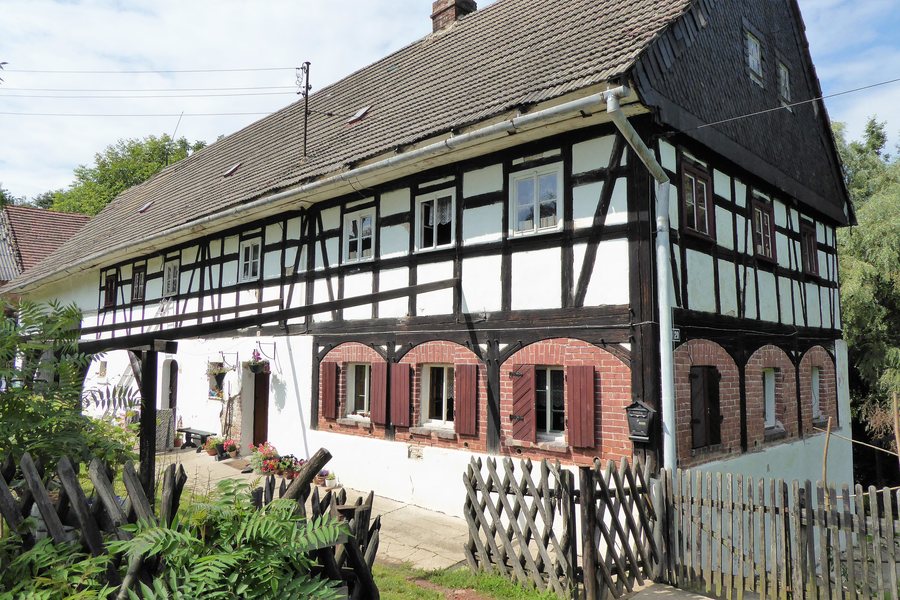 Museum of Technology and Rural Crafts in Zapusta
Photo: Cieslak Jürgen via Wikimedia Commons, CC BY-SA 3.0
Zapusta at a glance
- Rajsko Castle stands on a rocky bank by the Kwisa gorge.
- From the high tower, the view extends to Czocha Castle and its reflection in Jezioro Leśniańskie.
- A holiday resort is located on the Kwisa in the area around Jezioro Leśniańskie.
- A 2013 PTTK excursion report describes a museum in a 19th-century half-timbered house.
- The 12-kilometre PTTK Tour No. 37 travelled through the foothills of the Jizera Mountains to Zapusta on 20 October 2013.
How do the Kwisa and the lake shape the area?
There are two clearly distinct landmarks on the banks of the Kwisa: Rajsko Castle stands on a rocky bank by the gorge, while a holiday resort is located on the Kwisa in the area around Jezioro Leśniańskie. The river connects these descriptions of the area, while the specific landscape changes: at the castle, it is the rocky gorge bank; at the resort, it is the setting near the lake. This distinction helps place the different aspects of Zapusta in context without reducing both sites to a single viewpoint.
What can you see from Rajsko Castle?
From the high tower of Rajsko Castle, the view reaches Czocha Castle, reflected in the waters of Jezioro Leśniańskie. Three specific elements come together in this view: the tower as the vantage point, Czocha as the visible castle, and the lake as its reflection. Rajsko and Czocha play different roles in the landscape. For travellers interested in architecture and scenery, this combination offers a vivid reason to take a closer look at the view.
What insights did the museum collection offer?
A 2013 PTTK excursion report describes the Muzeum Techniki i Rzemiosła Wiejskiego in Zapusta, housed in a 19th-century half-timbered house. The collection included 19th- and early 20th-century agricultural machinery, furniture, former household items, and objects related to historic crafts and everyday use. The subjects described thus ranged from agriculture and domestic life to crafts and everyday life. The timeframe matters: the house and collection are described in the context of the 2013 report.
What was the route of PTTK Tour No. 37?
PTTK Sudety Zachodnie’s 12-kilometre Tour No. 37 travelled through the foothills of the Jizera Mountains on 20 October 2013, following the Kwisa and Jezioro Leśniańskie to Zapusta. The route went from the museum across the Kwisa, past the holiday centre of Wrocław University of Science and Technology, and on to Rajsko Castle on the edge of the lake. This historical route description thus includes both landscape landmarks and cultural sites. It shows how the river, lake, museum, and castle came together on that excursion at the time.
Discover more destinations: Jałowiec, Lauban, Pobiedna, Olszyna, Niemstów, Marklissa, Złoty Potok, Wolimierz
FAQ
Where is Rajsko Castle?
Rajsko Castle stands on a rocky bank by the Kwisa gorge in Zapusta.
What can you see from the tower of Rajsko Castle?
From the high tower, the view reaches Czocha Castle, reflected in the waters of Jezioro Leśniańskie.
What did the museum collection in Zapusta include?
The 2013 PTTK report mentions agricultural machinery, furniture, former household items, and objects related to historic crafts and everyday use.
What route did PTTK Tour No. 37 describe?
The 12-kilometre tour travelled in 2013 from the museum, across the Kwisa, past the holiday centre of Wrocław University of Science and Technology, to Rajsko Castle on the edge of Jezioro Leśniańskie.
Go to the main travel overview: Lubański.

