
Zebrzydów
Accommodation in Zebrzydów
Zebrzydów combines historic buildings with a circular route that makes the village part of a longer trail through several places. When deciding where to travel, it is therefore particularly worth considering whether you are interested in church art and manor history or in Route 5.
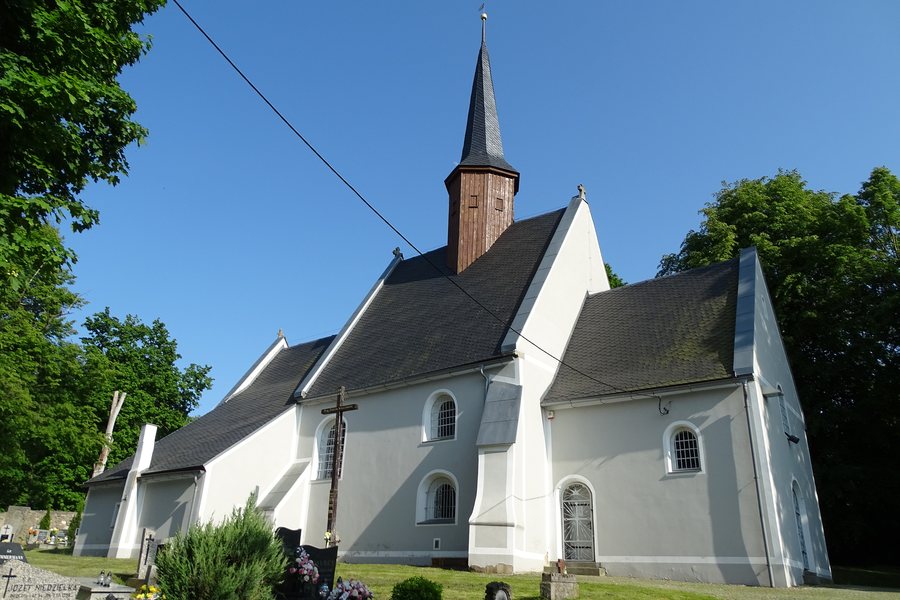 File:Kościół MB Szkaplerznej Zebrzydów.jpg
Photo: Robert Niedźwiedzki via Wikimedia Commons, CC BY-SA 4.0
File:Kościół MB Szkaplerznej Zebrzydów.jpg
Photo: Robert Niedźwiedzki via Wikimedia Commons, CC BY-SA 4.0
Zebrzydów at a glance
- Zebrzydów lies on the Czarna Woda at an elevation of around 215 m.
- The branch Church of Our Lady of the Scapular stands on a rise east of the center.
- Route 5 is a 23 km circular route from Marcinowice via Zebrzydów, Kątki, Wirki, Wiry and Tapadła, returning to Marcinowice.
What does the church offer visitors interested in culture?
The branch Church of Our Lady of the Scapular was built at the beginning of the 16th century and is listed in the register of monuments. Its furnishings include works from different centuries: a late Gothic stone baptismal font from the 16th century, a Baroque wooden polychrome altar from the 18th century, and an organ dating from 1874. The organ was built by the Świdnica-based company “Schlag und Söhne.”
During your visit, you can view the church and its furnishings as evidence of different periods. Its location on a rise east of the center also makes it a useful landmark within the village. Anyone with a particular interest in religious buildings, historic furnishings or organs will find concrete points of interest here when exploring Zebrzydów.
What traces of the manor’s history remain?
Several different traces of manor history stand side by side in Zebrzydów. The manor house was built around 1860 and remodeled at the beginning of the 20th century. The remains of the lower manor are distinct from it: they survive as a low, rectangular earth mound surrounded by the remains of a moat and an outer rampart. These remains are interpreted as the seat of the lords of Seifferdau, built no later than the end of the 14th century.
The upper manor also has its own historical context. It is a remnant of a former village headman’s farm with an outlying farmstead. This had features of a “knightly” seat, including a moat and a tower on a hill. The manor house, lower manor and upper manor therefore do not refer to the same historic structure: they represent different forms and periods in the village’s history.
What other architectural and natural features shape the village?
A cemetery chapel dates from around 1800; two reconciliation crosses stand in the cemetery wall. The school is a brick building from the early 20th century. Its sections are one and two stories high. It stands in an extensive park surrounded by a fence from the same period. The chapel, cemetery wall and school building thus add other architectural forms to the traces of church and manor history.
A small-leaved lime tree by the mill race is another named feature of the village: it is designated a natural monument. If you want to take historic buildings and individual natural features into account when choosing a destination, you can include these different points of interest in your exploration of Zebrzydów without combining them into a single walk.
What should you consider when planning Route 5?
Route 5 is a 23 km circular route from Marcinowice via Zebrzydów, Kątki, Wirki, Wiry and Tapadła, returning to Marcinowice. The total distance and the complete sequence of places are particularly relevant for your planning. The route does not end in Zebrzydów, but returns to Marcinowice. If you are interested in this circular route, take its entire course into account rather than just the section through Zebrzydów.
For your stay, you can then weigh up whether your trip is mainly about the village’s historic buildings or the circular route. If you would like to consider other destinations within the same broader selection, you can also find Bystrzyca Górna, Świdnica, Świebodzice, Lubachów, Strzegom, Marcinowice, Jawor and Żarów here.
FAQ
How long is Route 5?
The circular route is 23 km long and runs from Marcinowice via Zebrzydów, Kątki, Wirki, Wiry and Tapadła, returning to Marcinowice.
What historic furnishings are in the church?
These include a late Gothic stone baptismal font from the 16th century, a Baroque polychrome wooden altar from the 18th century, and an organ built in 1874.
What remains of the lower manor?
A low, rectangular earth mound with the remains of a moat and an outer rampart has survived. It is interpreted as the seat of the lords of Seifferdau.
For the broader travel overview: Świdnica County.

