
Discover Biegoszów
Accommodation in Biegoszów
Biegoszów combines the history of a village in the Kaczawskie Foothills with a landscape of a narrow valley and forests. One other detail is important for planning your trip: a local road passes through the village, and there is currently no bus stop in service.
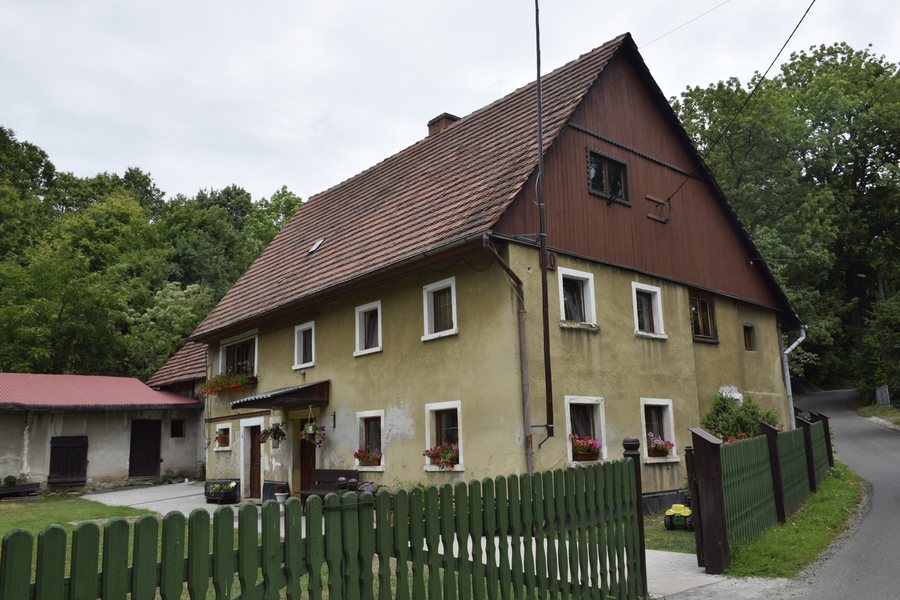
Key facts about Biegoszów
Biegoszów was established in the mid-14th century. The small village lies at an elevation of about 260 to 299 metres in the eastern Kaczawskie Foothills, also known as the Złotoryja Foothills. The settlement is situated in a narrow valley through which a left-bank tributary of the Wilcza flows.
The surrounding area is rural in character: the forests south and east of the village are predominantly spruce, mixed with beech and other broadleaf species. Basalt quarries are also part of the immediate surroundings. The village’s history and landscape offer two distinct ways to get to know Biegoszów.
What characterises the landscape around Biegoszów?
The narrow valley is a distinctive feature of the village’s location. The elevation figure also describes a range, not a single point: Biegoszów lies at about 260 to 299 metres above sea level. The forests south and east of the village are predominantly spruce, with beech and other broadleaf species. If you are interested in the landscape, you can take these details into account when deciding whether a village in the foothills and its forest surroundings suit your travel plans.
Basalt quarries are also part of the immediate surroundings. The valley and forests define the landscape around this small village in the foothills.
What historical traces tell the story of Biegoszów?
The village’s history dates back to the mid-14th century. Biegoszów developed into an important centre of Protestantism, but it never had its own church. Its inhabitants belonged to the estates and parish of Nowy Kościół. This connection is a distinctive part of the village’s history: its religious significance did not go hand in hand with having its own church in Biegoszów.
A peasant uprising in the 16th century was also associated with Biegoszów. It was directed against the landowner of Leist at the time. In the 18th century, copper ores were prospected for in the area; this was connected with the development of mining and smelting in nearby Leszczyna. These historical connections thus range from village and religious history to the region’s mining history.
An almost complete complex of residential and farm buildings has largely retained its original form in Biegoszów, without major alterations. Alongside historical events, this surviving built heritage is an important subject for anyone interested in rural history.
What is known about the cultural heritage project and the walk?
The cultural heritage project documented in 2020 was titled “Gozdno i Biegoszów – poznajemy dzieje, odkrywamy tajemnice” in Polish. It included an interactive walk through the villages. Mieczysław Hajder led participants to eight important places associated with the history of Gozdno and Biegoszów. The former school building in Biegoszów was also marked on the project map.
What should you consider when travelling to Biegoszów?
A local road from Świerzawa to Wilków runs through the Biegoszów valley. At the same time, the village currently has no bus stop in service. If you are looking for accommodation and considering Biegoszów as a destination, take this transport information into account when planning your trip.
For more destination pages in the wider directory, see also Dobków, Złotoryja, Sędziszowa, Schönau An Der Katzbach, Wojcieszów and Nowy Kościół.
FAQ
What is the elevation of Biegoszów?
The village lies at about 260 to 299 metres above sea level in the eastern Kaczawskie Foothills.
Is there a bus stop in Biegoszów?
There is currently no bus stop in service in Biegoszów.
What historical themes are associated with Biegoszów?
Local historical associations include Protestant history, a peasant uprising in the 16th century, and an almost completely preserved complex of residential and farm buildings. Copper ores were prospected for in the area in the 18th century.
For the wider travel overview: Złotoryjski.

.jpg)